PGNiG Upstream Norway prepares PDO for the King Lear field


PGNiG Upstream Norway and Aker BP have started advanced design work on a Plan of Development and Operations for the King Lear field in the North Sea. Once operational, King Lear may increase PGNiG Group’s natural gas production on the Norwegian Continental Shelf by 0.33 bcm a year.
PGNiG Upstream Norway and Aker BP have decided to move on to the final stage of work on the King Lear field PDO. The companies awarded contracts for front-end engineering and design (FEED), which will define, among other things, the scope and schedule of activities related to production start-up and the field operation, technical solutions and investment budget.
‘We continue strengthening our position in Norway, which is our main foreign market for hydrocarbon exploration and production. In the case of King Lear, we are entering a key stage of preparations which will enable PGNiG Upstream Norway and Aker BP to make a final investment decision and apply for administrative permits to start development of the field’, said Paweł Majewski, President of PGNiG SA, the mother company of PGNiG Upstream Norway. ‘The development of the King Lear field shall contribute to maintaining the PGNiG Group’s natural gas production in Norway at a level consistent with our strategic aspirations. By making long-term plans, we are able to secure a stable and diversified gas portfolio which will be supplied to Poland through the Baltic Pipe pipeline’, emphasised Paweł Majewski.
According to the preliminary concept, production from the King Lear field will be carried out by four wells operated by an unmanned production platform. Production is expected to start at the end of 2027. The installation will be connected to the production infrastructure of the Valhall field, located 50 kilometres from King Lear. One of the advantages of this solution will be a significant reduction in carbon dioxide emissions accompanying production. The installations at the Valhall field are powered from land by hydroelectric power. As a result, the carbon footprint associated with the exploitation of King Lear may amount to 1.5 kg of CO2 per barrel of oil equivalent, with the average for the Norwegian Continental Shelf being 8 kg of CO2 per barrel.
According to the Norwegian Petroleum Directorate, King Lear’s proven recoverable reserves are 11.0 billion cubic meters of gas and 9.6 million cubic meters of oil. At peak production, the PGNiG Group will be able to produce 0.33 bcm of gas and 258 000 metric tonnes of oil annually from the field.
The King Lear field is located in licences PL 146 and PL 333 in the North Sea. PGNiG Upstream Norway holds a 22.2% stake in both licences, which it acquired in 2019. The remaining shares are held by Aker BP, which is the operator. Aker BP is also the operator of the Valhall field in which it holds 90% stake.



Related News.

Navigating the Multi-Orbit Era: In Conversation with Intellian’s Jon Harrison at SMM 2026
At SMM 2026 in Hamburg, the rapid evolution of maritime satellite communications took centre stage. Across the exhibition halls, discussions among…
Cyprus ports need joint energy and investment strategy, shipping agents chief says
Cyprus needs a coordinated strategy for shipping, energy and environmental protection to support port investment and modernisation, Cyprus shipping…

MASO Public Affairs introduces MASO Regulatory Intelligence
A new subscription service helping businesses understand what is changing and what it means for them MASO Public Affairs introduces MASO Regulatory…
Anglo-Eastern helps turn CMBTECH’s ammonia ambition into an operational reality
From early feasibility study and risk-based design to newbuilding supervision, crew readiness and technical management, Anglo-Eastern drew on its…

Escalation of attacks threatens to derail recovery in Middle East oil exports
World oil demand is forecast to fall by 2.5 mb/d y-o-y in 4Q26 and 2.6 mb/d on average in 2026. As the Iran war manifests itself through restricted…
New study finds shipping pays twice its share to EU ETS earmarked revenues should triple to help build market for sustainable fuels and technologies
Shipping is responsible for around 10% of EU ETS emissions but pays almost 20% of the ETS bill. Unlike other sectors, it has never received free…

MSARC strengthens maritime mass rescue readiness through training and national live exercise off Dakar, Senegal
Joint MSARC–FHAS programme combines three days of SAR training with a national multi-agency live exercise The Maritime Search and Rescue Council ,…
Sogese report deliveries are still being delayed as container freight rates fluctuate
FOR IMPORTERS Spot rates into the Mediterranean are back at January levels, Far East to Europe reliability sits at pandemic lows, and nearly…

Glencore begins trading on Australian Securities Exchange
Glencore has begun trading on the Australian Securities Exchange under the ASX code GLC. Gary Nagle, Glencore’s CEO, said it was an exciting day for…
BIMCO Shipping Number of the Week
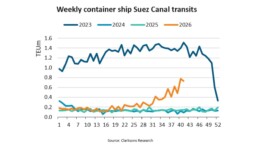
Suez Canal container ship transits exceed 50% of pre-disruption levels "During the first two weeks of October, weekly container ship capacity…
Subscribe to our newsletter!
if you dont want to swim alone in the ocean of news, sign up for the newsletter, and you will receive daily all the important news of world shipping!
