New Policy Brief on Search and Rescue exposes EU countries disregard for human life and Frontex involvement in maritime pushbacks
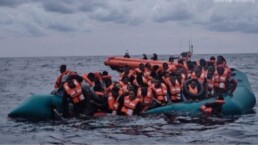

Human Rights at Sea issues a new civil society policy briefing critically reviewing EU Member States and the European Border and Coastguard Agency policies and practices in undertaking search and rescue operations in the Mediterranean Sea.
The Brief titled ‘Crossing the Mediterranean Sea: Searched for but not Rescued’ authored by Dr Farzaneh Shakeri (PhD) and Human Rights at Sea finds that the Central and Eastern Mediterranean continue to be for an increasing number of migrants and refugees the only way to reach safety. These people who risk their lives attempting the perilous sea crossings are instead pushed back to their unsafe point of departure, drown and disappear at sea, as well as on land within the broken detention and relocation systems that are unfit for purpose.
1,589 died or went missing in the Mediterranean Sea in 2021, a 26% increase from 2020, UNHCR reports. These statistics do not however account for those migrants who set out for Europe, either from Libya or Turkey, but who were halfway pulled back by the Libyan Coast Guard or pushed back by the Greek authorities. Those people who are pulled back by the Libyan Coast Guard are subject to systematic violations of their human rights, including rape and torture, as survivors testify.
For a second year in a row, EU Member States continue to refuse to designate their ports as places of safety for disembarkation of rescued people using the COVID pandemic as a pretext while they seek to demonise and criminalise civil society search and rescue (SAR) organisations who save lives at sea.
Frontex
Frontex, the EU Border and Coast Guard agency, is also facing serious accusations of prioritising EU border management over human life contributing to pushback and pullback practices in the Central and Eastern Mediterranean. 2020 – 2021 have witnessed the initiation of investigations by the European Parliament, European Ombudsman and European Court of Auditors into the work of Frontex. Frontex is also being taken to the Court of Justice of the European Union, under two independent complaints, for its non-compliance with human rights and rule of law.
The proposed EU Pact
The New Pact on Migration and Asylum legitimises criminalisation of NGOs and individuals engaged in SAR activities and does not offer a revised common policy towards search and rescue at EU level. It explicitly endorses the outsourcing of EU border management by giving funding to Turkey and Libya and other transit countries and only incidentally may, ‘as an add-on, contribute to saving lives at sea’ but this is not the priority’.
While the New Pact is yet to pass through the final adoption phase, and while two cases against Frontex are pending before the Court of Justice of the European Union, Human Rights at Sea suggests the following 10 EU policy recommendations:
1.The EU must require its member States to respond to search and rescue needs in accordance with their international legal obligations;
2. The EU must explicitly ban and sanction any criminalisation and unfounded administrative proceedings against those organisations and individuals engaged in humanitarian assistance;
3. The EU must cease providing aid and assistance through financing the Libyan Coast Guard and Turkey in the knowledge that such aid is subsequently used for the purposes of violating human rights;
4. Frontex must stop sharing information with the Libyan Coast Guard and facilitating push/pullback practices in the Central and Eastern Mediterranean;
5. The EU and its member States must declare Libya as an unsafe place for the purposes of disembarkation following rescue and must prohibit EU-flagged vessels from disembarking in Libya;
6. The EU must ensure that any search and rescue operation carried out by the Libyan Coast Guard leads to disembarkation in an EU member State;
7. The EU must put an end to the EU–Turkey deal and its blanket return scheme;
8. The EU must amend its relocation scheme established in the proposed New Pact and set up a system which ensures a compulsory fair and swift relocation of rescued migrants after disembarkation;
9. The EU must ensure that Frontex fulfils its legal duties to protect fundamental human rights and has an independent, neutral and efficient internal complaint system;
10. The EU must secure a fair and effective control mechanism, which holds Frontex accountable for any violation of fundamental human rights;
Dr. Elizabeth Mavropoulou, Head of Research at Human Rights at Sea says “we urge the EU and its Member States to implement the recommendations we have laid out. Human lives are being lost on a daily basis because of the inaction of states to live up to their obligations under international law. We cannot allow states to continue to turn a blind eye to the desperate situation taking place at sea.”



Related News.

Navigating the Multi-Orbit Era: In Conversation with Intellian’s Jon Harrison at SMM 2026
At SMM 2026 in Hamburg, the rapid evolution of maritime satellite communications took centre stage. Across the exhibition halls, discussions among…

Cyprus ports need joint energy and investment strategy, shipping agents chief says
Cyprus needs a coordinated strategy for shipping, energy and environmental protection to support port investment and modernisation, Cyprus shipping…

MASO Public Affairs introduces MASO Regulatory Intelligence
A new subscription service helping businesses understand what is changing and what it means for them MASO Public Affairs introduces MASO Regulatory…

Anglo-Eastern helps turn CMBTECH’s ammonia ambition into an operational reality
From early feasibility study and risk-based design to newbuilding supervision, crew readiness and technical management, Anglo-Eastern drew on its…

Escalation of attacks threatens to derail recovery in Middle East oil exports
World oil demand is forecast to fall by 2.5 mb/d y-o-y in 4Q26 and 2.6 mb/d on average in 2026. As the Iran war manifests itself through restricted…

New study finds shipping pays twice its share to EU ETS earmarked revenues should triple to help build market for sustainable fuels and technologies
Shipping is responsible for around 10% of EU ETS emissions but pays almost 20% of the ETS bill. Unlike other sectors, it has never received free…

MSARC strengthens maritime mass rescue readiness through training and national live exercise off Dakar, Senegal
Joint MSARC–FHAS programme combines three days of SAR training with a national multi-agency live exercise The Maritime Search and Rescue Council ,…

Sogese report deliveries are still being delayed as container freight rates fluctuate
FOR IMPORTERS Spot rates into the Mediterranean are back at January levels, Far East to Europe reliability sits at pandemic lows, and nearly…

Glencore begins trading on Australian Securities Exchange
Glencore has begun trading on the Australian Securities Exchange under the ASX code GLC. Gary Nagle, Glencore’s CEO, said it was an exciting day for…

BIMCO Shipping Number of the Week
Suez Canal container ship transits exceed 50% of pre-disruption levels "During the first two weeks of October, weekly container ship capacity…
Subscribe to our newsletter!
if you dont want to swim alone in the ocean of news, sign up for the newsletter, and you will receive daily all the important news of world shipping!
