UECC has taken delivery of the world’s first dual-fuel LNG battery hybrid PCTC
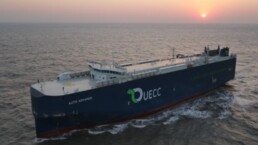

UECC has taken delivery of the world’s first dual-fuel LNG battery hybrid PCTC that is set to provide significant gains in energy efficiency and emissions reduction as it enters service this year to boost the leading European shortsea ro-ro carrier’s bold effort to decarbonise its fleet.
The vessel, to be named Auto Advance, is the first in a series of three newbuild pure car and truck carriers (PCTC) – measuring 169 by 28 metres and with capacity for 3600 vehicles on 10 cargo decks – that are being delivered from China’s Jiangnan Shipyard. The remaining two sister vessels are scheduled for delivery in 2022.
“Having brought into operation the first-ever dual-fuel LNG PCTCs five years ago, UECC is now taking delivery of the first of three of the world’s first dual-fuel LNG battery hybrid PCTC to be built. This is another big step forward in eco-friendly ship operations that shows we walk the talk,” says UECC chief executive Glenn Edvardsen.
“This is also a technological milestone as the successful performance of the vessel in sea trials has vindicated our confidence in the viability of this innovative solution.”
UECC has taken the lead in the PCTC segment by developing the pioneering design, together with DNV and Jiangnan’s in-house ship designer Shanghai Merchant Ship Design & Research Institute, to incorporate proven technology in a new configuration geared to enhancing operational and environmental performance.
Technology puzzle
LNG battery hybrid technology, together with an optimised hull design for better fuel efficiency, will enable these newbuilds to exceed the IMO requirement to cut carbon intensity by 40% from 2008 levels within 2030.
Emissions of carbon dioxide will be reduced by around 25%, SOx and particulate matter by 90% and NOx by 85% from the use of LNG, while the newbuilds will also meet the IMO’s Tier 3 NOx emissions limitations for the North Sea and Baltic Sea.
Dual-fuel engine technology has now been combined with an energy storage system (ESS), supplied by Finland’s WE Tech, incorporating a battery package from Corvus Energy that will be charged by a permanent magnet, directly driven shaft generator or dual-fuelled generators.
The ESS, which will provide power to the main switchboard with a DC link for power distribution, will enable peak shaving for the main engine and auxiliaries to reduce fuel consumption and emissions, with a controllable pitch propeller, bulb rudder and dual-fuel boiler also part of the power system.
These vessels will require only two auxiliary dual-fuel gensets, in addition to the main engine, as the ESS and shaft generator provide a spinning reserve to eliminate the need for another genset that would normally be required.
Smart energy management
Battery capacity is based on detailed modelling of the vessels’ expected operational profile to economise on installation, with payback time for the ESS estimated at only five years, according to UECC’s head of ship management and newbuilding Jan Thore Foss.
The hybrid solution, which has gained DNV’s Battery Safety notation, will be steered by an intelligent energy management system, supplied by Kongsberg Maritime, that will serve as a control system for overall energy production and consumption – essentially the ‘energy brain’ of the vessel.
Batteries can be most efficiently charged while at sea using the shaft generator so that they are fully charged when entering port, enabling the vessel to manoeuvre in port using bow thrusters driven solely by battery power that can also supply the ship’s other energy needs while it is docked.
“This will effectively eliminate emissions while in port and these vessels are also equipped to connect to green power from shore that is becoming increasingly available in order to reduce harmful emissions of NOx, SOx and particulate matter,” Foss says.
Operational flexibility can deliver significant fuel efficiency gains and Foss believes this, combined with a low-emissions profile, will give the vessels an advantage in the European market as EU plans to include shipping in the Emissions Trading System are set to hike costs for pollutive vessels.
Fuel optionality
UECC’s energy and sustainability manager Daniel Gent says: “LNG is presently the most environment-friendly and widely available low-carbon fuel, with an estimated emissions reduction of around 25% compared with other fossil fuels.
“We are therefore taking advantage of the best available fuel solution now and combining this with hybrid technology to further cut emissions. But we are not locked into LNG and these dual-fuel engines are also ready to use alternative low-emission fuels such as biofuel, bio-LNG and synthetic LNG as these become commercially and technically viable.”
Edvardsen claims that UECC, jointly owned by green-focused players NYK and Wallenius Lines, is presently the only shipping company in its regional market segment that is investing in sustainable newbuilds.
“UECC has already achieved a substantial reduction in the carbon intensity of its fleet, but we aspire to do much more,” he concludes.



Related News.

Navigating the Multi-Orbit Era: In Conversation with Intellian’s Jon Harrison at SMM 2026
At SMM 2026 in Hamburg, the rapid evolution of maritime satellite communications took centre stage. Across the exhibition halls, discussions among…
Cyprus ports need joint energy and investment strategy, shipping agents chief says
Cyprus needs a coordinated strategy for shipping, energy and environmental protection to support port investment and modernisation, Cyprus shipping…

MASO Public Affairs introduces MASO Regulatory Intelligence
A new subscription service helping businesses understand what is changing and what it means for them MASO Public Affairs introduces MASO Regulatory…
Anglo-Eastern helps turn CMBTECH’s ammonia ambition into an operational reality
From early feasibility study and risk-based design to newbuilding supervision, crew readiness and technical management, Anglo-Eastern drew on its…

Escalation of attacks threatens to derail recovery in Middle East oil exports
World oil demand is forecast to fall by 2.5 mb/d y-o-y in 4Q26 and 2.6 mb/d on average in 2026. As the Iran war manifests itself through restricted…
New study finds shipping pays twice its share to EU ETS earmarked revenues should triple to help build market for sustainable fuels and technologies
Shipping is responsible for around 10% of EU ETS emissions but pays almost 20% of the ETS bill. Unlike other sectors, it has never received free…

MSARC strengthens maritime mass rescue readiness through training and national live exercise off Dakar, Senegal
Joint MSARC–FHAS programme combines three days of SAR training with a national multi-agency live exercise The Maritime Search and Rescue Council ,…
Sogese report deliveries are still being delayed as container freight rates fluctuate
FOR IMPORTERS Spot rates into the Mediterranean are back at January levels, Far East to Europe reliability sits at pandemic lows, and nearly…
Glencore begins trading on Australian Securities Exchange
Glencore has begun trading on the Australian Securities Exchange under the ASX code GLC. Gary Nagle, Glencore’s CEO, said it was an exciting day for…
BIMCO Shipping Number of the Week
Suez Canal container ship transits exceed 50% of pre-disruption levels "During the first two weeks of October, weekly container ship capacity…
Subscribe to our newsletter!
if you dont want to swim alone in the ocean of news, sign up for the newsletter, and you will receive daily all the important news of world shipping!
