Wärtsilä report anticipates that accelerated adoption of renewables can reduce electricity production costs by up to 50 percent
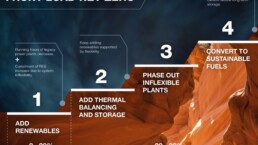

The technology group Wärtsilä has issued a report ahead of COP26, the UN’s Climate Change Conference to be held in Glasgow this autumn, demonstrating the environmental and economic opportunities for states that decarbonise rapidly. The report will be presented at the Economist Sustainability Week event today, 6 October.
The ‘Front-Loading Net Zero’ report states that electricity production costs could be reduced by up to 50% by 2050 if countries and states adopt 100% renewable systems faster than currently planned. Significant cost reductions can be achieved by front-loading the deployment of renewables, mainly wind and solar photovoltaic, and by utilising the technologies needed to balance their inherent intermittency, such as energy storage and thermal balancing power plants. The report indicates that carbon neutral systems can provide cheaper electricity compared to current fossil fuel-based systems.
The report models Germany, India, and California, three markets with vastly different socio-economic dynamics, energy systems, and challenges, demonstrating the cost-optimal path towards 100% renewable power systems in each region.
The report reveals that by accelerating 100% renewable power systems, substantial benefits are unlocked:
● Accelerating renewables to become main source of electricity drives down fossil fuel usage (i.e. coal and gas), significantly reducing the overall levelised cost of electricity. India can halve its electricity costs by 2050, while California and Germany can cut costs by 17% and 8% by 2040 respectively.
● Coal-fired power – 70% of generation in India and 33% in Germany – can be securely replaced by renewables and flexibility from energy storage and thermal balancing power plants as early as 2040.
● Colossal carbon savings can be made in the short term, enabling national climate targets to be achieved. Germany can avoid 422 million tonnes of carbon dioxide by 2040 by accelerating its coal phase-out. This would help achieve its 65% reduction target (compared to 1990 levels) set for 2030.
● Renewables as the main source of primary energy for electricity generation can drive energy independence. For example, Germany could avoid the need to import 550 TWh of power by accelerating the phase-out of coal.
The clear, deliverable pathways to 100% renewables modelled in these vastly different energy systems show that affordable net zero economies are in reach for every country at COP26. In addition to the deep dive models, the report’s chapters focusing on Australia, Chile and the UK’s energy transitions underline that the technologies needed to achieve 100% renewable power systems are already available at scale around the world. The report shows the once-in-a-generation opportunity to dramatically scale-up renewable generation and energy storage to bridge the gap to 100% renewable electricity without adding to the cost of power.
Wärtsilä’s President & CEO, Håkan Agnevall explains: “As we approach COP26, our ‘Front-Loading Net Zero’ report should act as a wake-up call for leaders, as this is our last and best chance to get countries on pathways to carbon neutrality. Our modelling shows that it is viable for energy systems to be fully decarbonised before 2050, and that accelerating the shift to renewable power coupled with flexibility, will help economies to thrive. We have all the technologies that we need to rapidly shift to net zero energy. The benefits of renewable-led systems are cumulative and self-reinforcing – the more we have, the greater the benefits – so it is vital that leaders and power producers come together now to front-load net zero this decade.”
Sushil Purohit, President, Wärtsilä Energy and EVP, Wärtsilä adds: “There is no single solution that fits all markets, and this report highlights the different paths and technologies that can be utilised. The ultimate aim, however, is common to all and that is to decarbonise energy production and take the fullest advantage of our natural energy sources.”
“This valuable report from Wärtsilä shows very clearly what can be achieved by moving away from conventional fuels towards 100% renewable energy. Reducing electricity cost and CO2 emissions in parallel generates CO2 reduction benefits. The technologies available today offer the flexibility and rapid reaction time needed to balance renewables,” said Christian Breyer, Professor at the LUT University.



Related News.
Navigating the Multi-Orbit Era: In Conversation with Intellian’s Jon Harrison at SMM 2026
At SMM 2026 in Hamburg, the rapid evolution of maritime satellite communications took centre stage. Across the exhibition halls, discussions among…
Cyprus ports need joint energy and investment strategy, shipping agents chief says
Cyprus needs a coordinated strategy for shipping, energy and environmental protection to support port investment and modernisation, Cyprus shipping…

MASO Public Affairs introduces MASO Regulatory Intelligence
A new subscription service helping businesses understand what is changing and what it means for them MASO Public Affairs introduces MASO Regulatory…
Anglo-Eastern helps turn CMBTECH’s ammonia ambition into an operational reality
From early feasibility study and risk-based design to newbuilding supervision, crew readiness and technical management, Anglo-Eastern drew on its…

Escalation of attacks threatens to derail recovery in Middle East oil exports
World oil demand is forecast to fall by 2.5 mb/d y-o-y in 4Q26 and 2.6 mb/d on average in 2026. As the Iran war manifests itself through restricted…
New study finds shipping pays twice its share to EU ETS earmarked revenues should triple to help build market for sustainable fuels and technologies
Shipping is responsible for around 10% of EU ETS emissions but pays almost 20% of the ETS bill. Unlike other sectors, it has never received free…

MSARC strengthens maritime mass rescue readiness through training and national live exercise off Dakar, Senegal
Joint MSARC–FHAS programme combines three days of SAR training with a national multi-agency live exercise The Maritime Search and Rescue Council ,…
Sogese report deliveries are still being delayed as container freight rates fluctuate
FOR IMPORTERS Spot rates into the Mediterranean are back at January levels, Far East to Europe reliability sits at pandemic lows, and nearly…

Glencore begins trading on Australian Securities Exchange
Glencore has begun trading on the Australian Securities Exchange under the ASX code GLC. Gary Nagle, Glencore’s CEO, said it was an exciting day for…
BIMCO Shipping Number of the Week
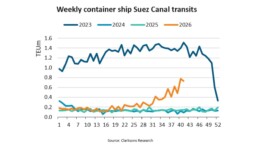
Suez Canal container ship transits exceed 50% of pre-disruption levels "During the first two weeks of October, weekly container ship capacity…
Subscribe to our newsletter!
if you dont want to swim alone in the ocean of news, sign up for the newsletter, and you will receive daily all the important news of world shipping!
