GEA supports shipping industry as a system supplier in solutions for the fuels of the future – ammonia is one option
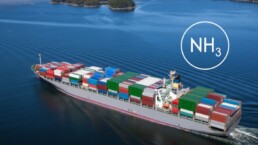

Shipping companies and shipping lines that rely on ammonia as an alternative to diesel and heavy fuel oil for marine engine fuels can count on GEA’s support in developing appropriate technologies. GEA plans to support the shipping industry in reducing emissions as a system supplier with in-house solutions
This was announced by the machinery and plant manufacturer and systems supplier GEA at the international “Ship Efficiency” conference in Hamburg on September 27 and 28, 2021. In developing appropriate concepts for the use of ammonia (NH₃), GEA relies on its many years of experience and expertise in separator technology as well as refrigeration and heating technology using natural refrigerants such as CO₂ and ammonia.
“In 30 years, around a quarter of the ships on the oceans will be powered by ammonia”
To reduce harmful emissions, more and more ships will be powered by alternative fuels to heavy fuel oil and diesel in the future. Experts from DNV, an international classification society and service provider in the fields of technical consulting, engineering services, certification and risk management, predict that in around 30 years at the latest, around a quarter of all ships on the world’s oceans will be powered by ammonia – alongside diesel, liquefied petroleum gas, heavy fuel oil and biofuels.
Decarbonizing shipping
With the fuel ammonia and a five percent diesel blend, shipping can be almost completely decarbonized in the long term. The reason is that ammonia burns without emitting CO₂. However, the decisive factor in terms of climate friendliness is that the energy-intensive production of ammonia is switched to renewable energy sources. Another advantage is that ammonia also transports hydrogen bound in the molecule (NH₃), which can be converted into electricity on site in fuel cells. Another clear argument in favor of ammonia is that there is a great deal of experience worldwide in production, storage and logistics. Of course, as mentioned above, production still needs to be converted to renewable sources. In addition, it can be expected that there will be a stable supply of ammonia, since many places are working on production methods for ammonia based on renewable energy.
GEA with a lot of experience in technical handling and safety precautions for ammonia
GEA has developed a lot of expertise in the properties relevant to ship design and technical handling on board. In addition, there is a great deal of experience in safety precautions for handling ammonia. At ambient pressure, it already becomes liquid at minus 33°C and is therefore less costly in terms of energy to handle and keep cool than natural gas (liquefied natural gas – LNG), where this temperature is around -160°C. In the case of hydrogen, the temperature would even be around -260°C. In the case of hydrogen, the temperature would be around -5°C. For hydrogen, it would even be around -250°C. It is therefore relatively easy and requires relatively little energy to keep ammonia liquid.



Related News.

Navigating the Multi-Orbit Era: In Conversation with Intellian’s Jon Harrison at SMM 2026
At SMM 2026 in Hamburg, the rapid evolution of maritime satellite communications took centre stage. Across the exhibition halls, discussions among…
Cyprus ports need joint energy and investment strategy, shipping agents chief says
Cyprus needs a coordinated strategy for shipping, energy and environmental protection to support port investment and modernisation, Cyprus shipping…

MASO Public Affairs introduces MASO Regulatory Intelligence
A new subscription service helping businesses understand what is changing and what it means for them MASO Public Affairs introduces MASO Regulatory…
Anglo-Eastern helps turn CMBTECH’s ammonia ambition into an operational reality
From early feasibility study and risk-based design to newbuilding supervision, crew readiness and technical management, Anglo-Eastern drew on its…

Escalation of attacks threatens to derail recovery in Middle East oil exports
World oil demand is forecast to fall by 2.5 mb/d y-o-y in 4Q26 and 2.6 mb/d on average in 2026. As the Iran war manifests itself through restricted…

New study finds shipping pays twice its share to EU ETS earmarked revenues should triple to help build market for sustainable fuels and technologies
Shipping is responsible for around 10% of EU ETS emissions but pays almost 20% of the ETS bill. Unlike other sectors, it has never received free…

MSARC strengthens maritime mass rescue readiness through training and national live exercise off Dakar, Senegal
Joint MSARC–FHAS programme combines three days of SAR training with a national multi-agency live exercise The Maritime Search and Rescue Council ,…

Sogese report deliveries are still being delayed as container freight rates fluctuate
FOR IMPORTERS Spot rates into the Mediterranean are back at January levels, Far East to Europe reliability sits at pandemic lows, and nearly…

Glencore begins trading on Australian Securities Exchange
Glencore has begun trading on the Australian Securities Exchange under the ASX code GLC. Gary Nagle, Glencore’s CEO, said it was an exciting day for…
BIMCO Shipping Number of the Week
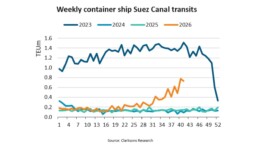
Suez Canal container ship transits exceed 50% of pre-disruption levels "During the first two weeks of October, weekly container ship capacity…
Subscribe to our newsletter!
if you dont want to swim alone in the ocean of news, sign up for the newsletter, and you will receive daily all the important news of world shipping!
