Why Oceanbird claims a 90% reduction of emissions
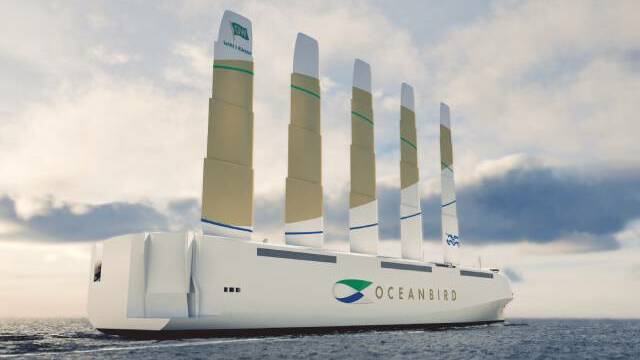

It is a bold statement – that the Oceanbird concept could reduce 90% of the emissions compared to a conventional vessel. And we wouldn’t make it if we didn’t have the facts to back it up.
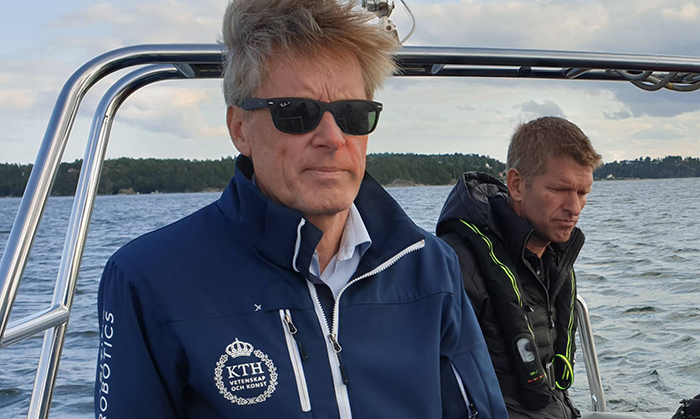
When the young aerospace professor Jakob Kuttenkeuler competed in sailing races, he created a simulation program to optimize his performance. 20 years later, that program would be laying the ground for the calculations showing that the Oceanbird concept could reduce emissions by 90%.
Wallenius has added pieces to the program, as well as SSPA, which mainly contributes with the hydrodynamic forces from hull, propeller, rudder, fins, and the aerodynamic forces from the wings.
How does it work?
The procedure is in principle quite straight forward but advanced in the details. The Oceanbird team wants to know what happens with for example the emissions if the wings where bigger/smaller, if the speed increases/decreases, with less/more ballast water and so on. Jakob Kuttenkeuler, nowadays a professor at KTH Centre of Naval Architecture, puts these parameters in the program.
He selects the departure and arrival destinations, normally Southampton-New York but also across the Pacific, and add historic weather conditions. The computer program then optimizes the sailing route according to the authentic weather conditions. The virtual vessel sets off on a round-trip twice a month for a decade, thus crossing the sea 480 times. After that, there is a lot of data to transform into statistics.
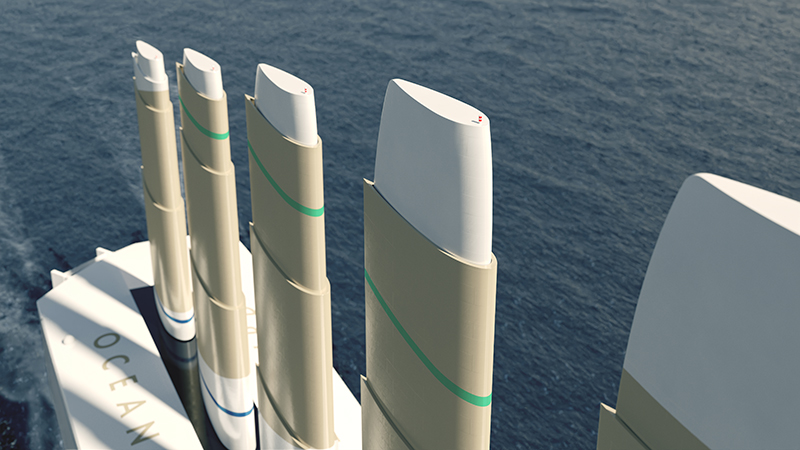
“The devil is in the details and during this last year the simulations got much more detailed. We have been looking at for example varying reefing schemes. The telescopic function is useful in many ways”, says Jakob Kuttenkeuler.
Data meets a captain’s experience
The program chooses the optimal route to get to the destination using the wind as effective as possible. This will also be a vital component in real life, the optimal routing is actually as vital as any other component of the fine-tuned ship system.
“There is a danger in trusting the computer simulations too much. The computer loves hard weather to sail fast, whereas the captain onboard might not be equally enthusiastic about going through passages with winds up to 20 meters per second and waves reaching seven meters. That’s why it’s so great that we have one of Wallenius’ Captains in the project. He contributes with so much experience that is valuable for making this work in real life.”

Three equations
The foundation of the simulations are basically three equations of equilibrium working in harmony. One is related to the thrust: the forces that makes the vessel go forward (the wings and sometimes engine) needs to be equal to the forces slowing it down (the sum of the resistance components, mainly from the hull).
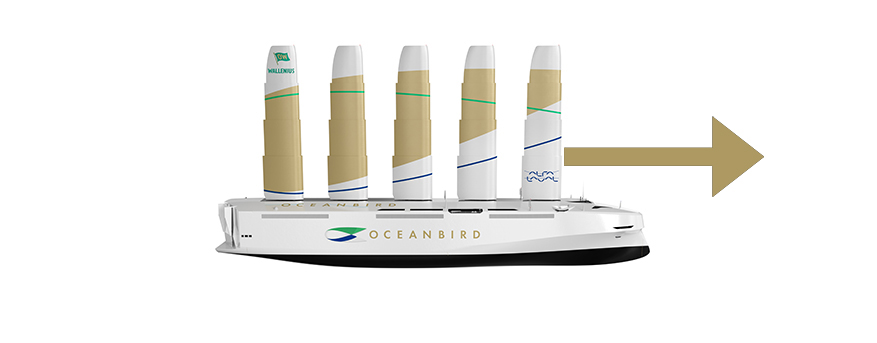
Second is sideways equation. The vessel will not go straight forward like a conventional cargo vessel but slightly on the side like any other sailing boat (this is often referred to as leeway).
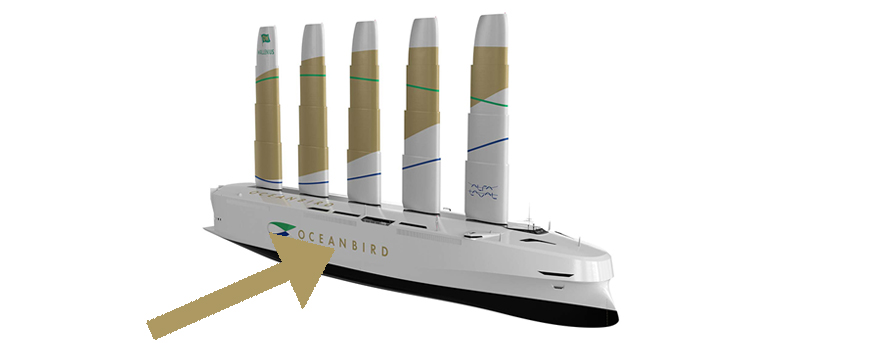
Third equation is coming from the wind, pushing the wings high above water, the heeling equation.
“That was one thing that surprised me. Before we did the simulations, I thought the vessel, being the world’s highest sailing vessel, would heel a lot more and I was worried about the cargo and the amount of ballast water needed to maintain stability. But the specially designed hull stabilizes the vessel, so it won’t tilt more than maximum 5 degrees even without ballast. With ballast you won´t notice it onboard!”

SSPA maps uncertainties
To verify the calculations, both KTH and SSPA have made extensive model testing in water tanks and open water. SSPA are also working on a scientific report to map uncertainties in the entire simulation chain. When the report is published in the end of 2021, it will be public and available for anyone to read.
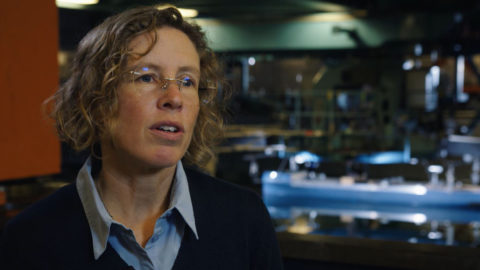
“The transparency is one of the things that are so great about this project. Scientists and students in the project have already published a lot of interesting reports, and more will come” says Sofia Werner, Manager Strategic Research Hydrodynamics at SSPA.
Facts
Wallenius, KTH and SSPA have been partners during the development project, which is supported by the Swedish Transport Administration. The development project, called wPCC, started in 2019 and ends during 2022. In September 2020, the collaboration presented the Oceanbird concept. Learn more at TheOceanbird.com



Related News.
Cyprus Maritime Innovation takes Centre Stage at SMM Hamburg 2026
Underscoring its expanding role as a premier international hub for cutting-edge maritime technology and sustainable shipping, the Republic of Cyprus…

Trump seeks to refill US oil reserve with Venezuela deal but faces long delay
U.S. President Donald Trump said on the 30th (local time) that he would refill the U.S. Strategic Petroleum Reserve, which has been depleted with…

US Navy Official visits South Korean Shipyards in private
With U.S. President Donald Trump pushing a plan to allow overseas construction of U.S. warships, attention is focusing on whether the building of…
SES and De Boer Marine expand collaboration with FlexMaritime deployment across Global Markets
SES, a leading space solutions company, and De Boer Marine, a leading provider of top-quality marine equipment and maritime connectivity services,…
New ESG guidance to help maritime industry turn sustainability into commercial advantage
New framework helps shipowners and ports align ESG strategy with access to capital, charterer expectations and long-term asset value. Maritime…

Britannia P&I Club analysis finds four in five crew deaths linked to illness rather than accidents
New report highlights cardiovascular disease as leading cause of fatalities and raises concerns over mental health risks among younger seafarers.…
The Swedish Club launches new Loss Prevention podcast, Knot Another Lesson
The Swedish Club has launched Knot Another Lesson, a new podcast exploring the practical lessons, emerging risks and operational challenges shaping…
Lloyd’s Register appoints Jens Grunenberg as Senior Representative for Germany
Lloyd’s Register has appointed Jens Grunenberg as its Senior Representative for Germany, effective 1 September. Based in Hamburg, Grunenberg will…
Indian Register of Shipping sets sights on Hamburg for European Expansion
Indian Register of Shipping, a leading international classification society and full member of the International Association of Classification…
MOL completes Merger of 6 Ship Management Companies
Unifying Management of Over 200 Vessels and Strengthening Safety Mitsui O.S.K. Lines, announced that it has completed the integration of the MOL…
Subscribe to our newsletter!
if you dont want to swim alone in the ocean of news, sign up for the newsletter, and you will receive daily all the important news of world shipping!
