Global trade at risk of disruption without urgent action on zero-carbon shipping, finds Lloyd’s Register report.


New study from maritime professional services organisation points to potential future supply chain upheaval from energy transition uncertainty, with leaders calling for ambition to be turned into immediate action.
Leaders from across the global supply chain are calling for immediate action on maritime decarbonisation if a successful energy transition to zero-carbon supply chains is to be achieved.
Drawing views from leaders across the supply chain, a report from maritime professional services organisation Lloyd’s Register, titled “How To Make Shipping’s ‘Decade of Action’ a Reality” says the transition to zero-carbon shipping will be among the most significant in the sector’s history, with investments made today preventing future supply chain interruptions and minimising disruption to the backbone of world trade.
Currently, around 80% of goods transported worldwide rely on shipping and the maritime sector accounts for almost 3% of global greenhouse gas emissions. However, despite widespread commitment to addressing the decarbonisation of the sector, a lack of regulatory certainty and support from policymakers could see a rushed and uncoordinated transition, potentially leading to significant supply chain disruption.
Nick Brown, Chief Executive, Lloyd’s Register, said:
“Our industry is no longer asking ‘if’ or ‘when’ decarbonisation should take place. We know we must act now and many of us are. The question that remains is ‘how’ will the maritime industry deliver meaningful change during this crucial decade of action.
“This report brings together expert views and insights from the public and private sector on what the global maritime industry needs to do to make this decade of change a reality. The challenge is immense, but the commitment is real, from many organisations and governments. Everyone involved in the maritime supply chain must play their part.”
The Lloyd’s Register study, produced in association with Longitude, the research unit of the Financial Times, found consensus among maritime experts that shipping companies, their customers, and governments, need to work together on global solutions before the urgency of the climate crisis forces the sector into disruptive and fragmented changes. Contributors to the report called for greater global regulation of shipping to head off the emergence of inconsistent national policies.
Jim Barry, chief investment officer, BlackRock Alternatives Investors, said:
“The natural instinct of any industry will be to look to defer regulation, ‘How long can I drag it out?’ That’s the wrong instinct today and it’s not going to work this time because the climate is changing. There’s no ambiguity on that. The cost of this transition will be less the sooner you get your head around the future roadmap and the sooner you begin the adjustment.”
Contributors to the study also urged public and private sectors to work in unison to drive funding into the most promising emerging technologies and to support smaller businesses unable to decarbonise on their own. In addition, they emphasised the importance of infrastructure – such as alternative shipping fuels being available in ports – to ensure the ships of the future can deliver goods on a truly global basis.
Katharine Palmer, shipping lead, UNFCC High-Level Climate Champions, said:
“The pace of change required needs to be ramped up. This is a climate crisis which requires an urgent response. The momentum is building, commitments are being made, the understanding of the transformation needed across the maritime system is there. We now need everyone to mobilise and convert understanding, awareness and commitment into action.”
There was consensus among maritime experts that the next decade presents a fundamental challenge to the future of shipping. With consumers, investors, and governments increasingly demanding zero-carbon solutions from the private sector, contributors to the report highlighted the risk of stranded assets, financial loss, and regulatory complexity if the maritime sector fails to proactively address the climate crisis. However, they also noted that shifting to zero-carbon shipping would deliver competitive benefits at a relatively low cost that can be comfortably absorbed across the supply chain.
Lindsay Zingg, senior director of sustainability, freight forwarder DSV Panalpina, said:
“If you cannot offer a ‘green’ product, you will lose business – it is an absolute requirement. Our customers are constantly asking what we can do to lower CO2, and we will launch our green logistics programme later this year. Customers push us, we push our suppliers, and we will make a difference.”



Related News.

Navigating the Multi-Orbit Era: In Conversation with Intellian’s Jon Harrison at SMM 2026
At SMM 2026 in Hamburg, the rapid evolution of maritime satellite communications took centre stage. Across the exhibition halls, discussions among…
Cyprus ports need joint energy and investment strategy, shipping agents chief says
Cyprus needs a coordinated strategy for shipping, energy and environmental protection to support port investment and modernisation, Cyprus shipping…

MASO Public Affairs introduces MASO Regulatory Intelligence
A new subscription service helping businesses understand what is changing and what it means for them MASO Public Affairs introduces MASO Regulatory…
Anglo-Eastern helps turn CMBTECH’s ammonia ambition into an operational reality
From early feasibility study and risk-based design to newbuilding supervision, crew readiness and technical management, Anglo-Eastern drew on its…

Escalation of attacks threatens to derail recovery in Middle East oil exports
World oil demand is forecast to fall by 2.5 mb/d y-o-y in 4Q26 and 2.6 mb/d on average in 2026. As the Iran war manifests itself through restricted…
New study finds shipping pays twice its share to EU ETS earmarked revenues should triple to help build market for sustainable fuels and technologies
Shipping is responsible for around 10% of EU ETS emissions but pays almost 20% of the ETS bill. Unlike other sectors, it has never received free…

MSARC strengthens maritime mass rescue readiness through training and national live exercise off Dakar, Senegal
Joint MSARC–FHAS programme combines three days of SAR training with a national multi-agency live exercise The Maritime Search and Rescue Council ,…

Sogese report deliveries are still being delayed as container freight rates fluctuate
FOR IMPORTERS Spot rates into the Mediterranean are back at January levels, Far East to Europe reliability sits at pandemic lows, and nearly…

Glencore begins trading on Australian Securities Exchange
Glencore has begun trading on the Australian Securities Exchange under the ASX code GLC. Gary Nagle, Glencore’s CEO, said it was an exciting day for…
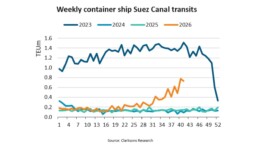
BIMCO Shipping Number of the Week
Suez Canal container ship transits exceed 50% of pre-disruption levels "During the first two weeks of October, weekly container ship capacity…
Subscribe to our newsletter!
if you dont want to swim alone in the ocean of news, sign up for the newsletter, and you will receive daily all the important news of world shipping!
