Hurricane Ida hits US oil supply and refinery capacity, paving the way for price volatility


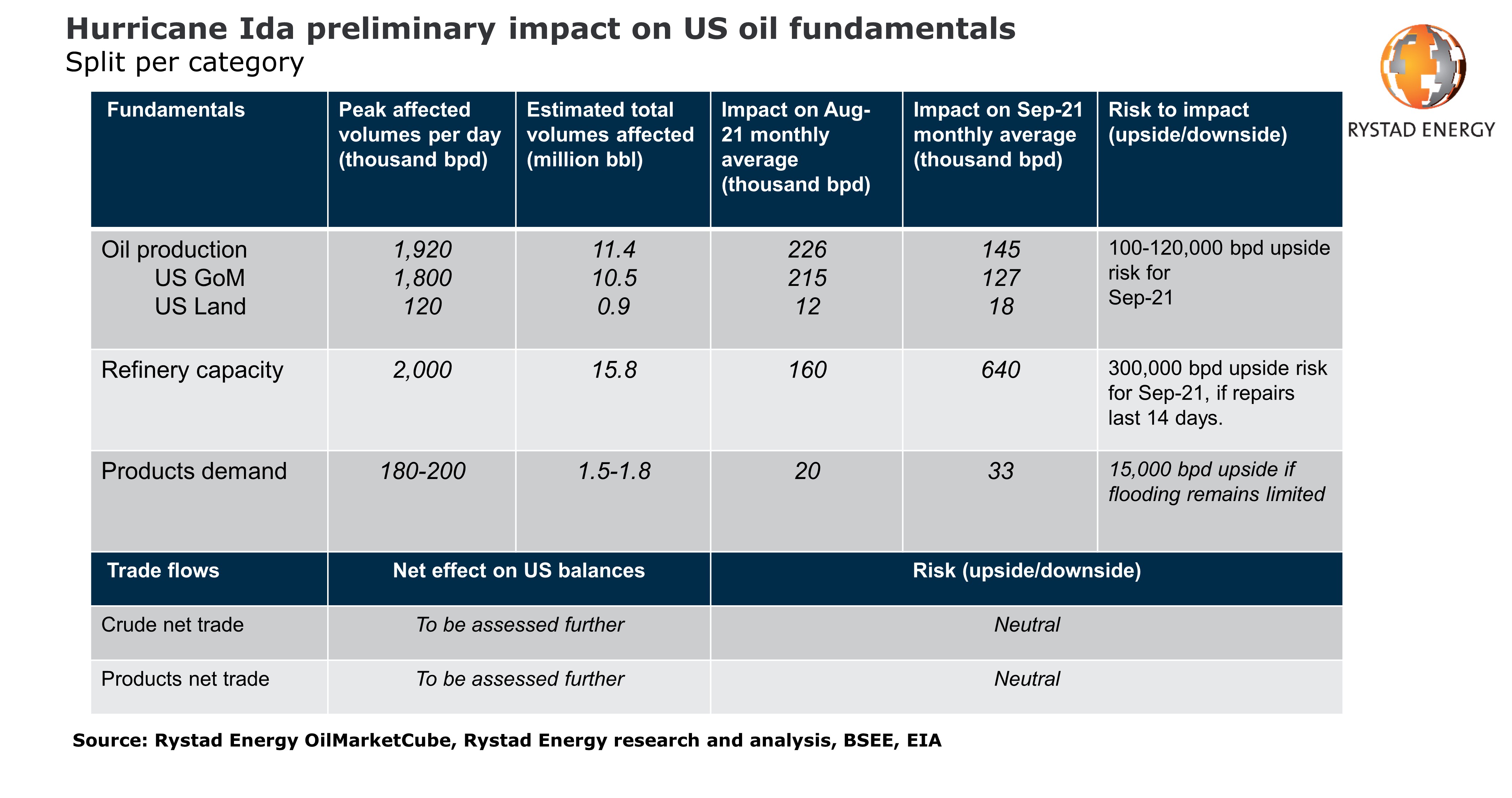
Rystad Energy’s initial assessment of Hurricane Ida’s impact on US oil production and refinery capacity estimates a peak daily supply curtailment of 1.8 million barrels per day in the Gulf of Mexico, which currently has a peak daily production capacity of 1.9 million bpd. Based on reported power outages and the closure of refineries in preparation for the storm, nearly 2 million bpd of US Gulf Coast refining capacity is estimated to be currently offline.
As was the case with major hurricane and storm events during the 2016-2020 period, we estimate the cumulative production outage impact to be equivalent to 5.5 days of maximum capacity, assuming rapid reactivation to start as soon as 31 August and 1 September.
This will result in an impact of approximately 215,000 bpd and 127,000 bpd on monthly averages for August and September, respectively. However, a certain downside supply risk is present, relating both to additional weather disruptions as we remain in the middle of hurricane season and to delayed reactivation of some facilities.
When it comes to onshore oil supply, we are seeing marginal impact on conventional legacy oil volumes in Louisiana and Mississippi. With Ida being downgraded to Category 1 shortly after landfall, the likelihood of prolonged upstream disruptions in the area has diminished. However, up to 120,000 bpd of onshore oil production in the US was shut in the last two days, which will likely result in an impact of between 11,000 and 18,000 bpd on monthly averages for August and September, respectively.
On the trade flows side, the EIA stated that the following ports capable of receiving petroleum products are closed: Baton Rouge, Gramercy, New Orleans, Morgan City and Lake Charles ports in Louisiana; Pascagoula in Mississippi; and Mobile in Alabama. Louisiana Offshore Oil Port (LOOP) suspended operations at its marine terminal earlier, on 28 August. Furthermore, we estimate that around 13 million barrels of crude oil is awaiting to offload in the US Gulf Coast region.
Learn more in Rystad Energy’s OilMarketCube.
Based on reported power outages and the closure of refineries in preparation for the storm, nearly 2 million bpd of US Gulf Coast refining capacity is currently offline due to Hurricane Ida. As Ida has been downgraded from Category 4 to Category 1 and is moving northeast, we expect the worst impact to have passed and estimate that refineries will remain offline for between 7 and 14 days maximum, depending on the extent of damage due to flooding.
We expect the monthly impact in August on Gulf Coast refining capacity to be around 160,000 bpd, and on runs around 150,000 bpd (due to utilization rates), but the monthly impact in September capacity could rise to around 640,000 bpd based on power availability and the repairs required.
“We see a risk that the loss of US refinery demand will be greater and more prolonged than the loss of crude supply, which, depending on the extent of refinery shut-ins and power outages, could further weaken the flat price, the structure for WTI and potentially WTI-Brent further for both September and possibly October 2021,” says Bjornar Tonhaugen, head of oil markets at Rystad Energy.
Given the loss of crude supply is mostly medium sour GOM crudes, this is supportive of Mars and Latam grades.
Impact on products demand
When it comes to road transport, Louisiana is among the states in PADD 3 that are the most affected by the hurricane. The traffic index on Saturday 28 August saw a short spike up to 40% above the equivalent day in 2019, as many residents drove out of state to flee the hurricane. The following day showed traffic activity dropping to 68% of normal levels. While other states have not shown such an extreme drop, traffic in Alabama did slide to 75% of normal levels, representing a 16% reduction week-on-week.
While international travel remains weak and is hampering a return to pre-Covid levels, domestic travel is the main contributor to flight activity in the US. However, the anticipation of the landfall of Ida prompted people in Louisiana to flee their homes, spurring an increase in flight activity on Saturday 28 August of 11% week-on-week, to reach 60% of normal levels. The following day, in contrast, saw the cancellation of all flights from New Orleans’ Louis Armstrong International Airport, with traffic activity plummeting to 17% of normal levels. We observe similar effects on flight traffic due to Ida in the neighboring states, though the drop is more modest.
As a result of the above, we pin our initial estimates of current demand impact to between 180,000 and 200,000 bpd of reduced end-user demand at least until Thursday this week. Specifically, we expect gasoline to be reduced by 90,000 bpd, diesel by 40,000 bpd, and jet fuel by 15,000 to 20,000 bpd, with the balance representing demand for other products.
In the petrochemicals sector, the reduction in ethane consumption could be as high as 150,000 bpd, and its normalization will follow the process of re-opening of the refinery and petchem plants in the region.
As the damage assessments unfold, our estimates will be updated in the coming days. The nature of Hurricane Ida and the extent of power outages and flooding requires particular attention, especially with respect to the duration of refinery outages. Barring any immediate new storms, offshore crude production should be able to bounce back relatively quickly, leading to an overall net negative effect on crude and conversely a bullish effect on road fuels such as gasoline.
For more analysis, insights and reports, clients and non-clients can apply for access to Rystad Energy’s Free Solutions and get a taste of our data and analytics universe
Source: Rystad Energy



Related News.

Navigating the Multi-Orbit Era: In Conversation with Intellian’s Jon Harrison at SMM 2026
At SMM 2026 in Hamburg, the rapid evolution of maritime satellite communications took centre stage. Across the exhibition halls, discussions among…

Cyprus ports need joint energy and investment strategy, shipping agents chief says
Cyprus needs a coordinated strategy for shipping, energy and environmental protection to support port investment and modernisation, Cyprus shipping…

MASO Public Affairs introduces MASO Regulatory Intelligence
A new subscription service helping businesses understand what is changing and what it means for them MASO Public Affairs introduces MASO Regulatory…

Anglo-Eastern helps turn CMBTECH’s ammonia ambition into an operational reality
From early feasibility study and risk-based design to newbuilding supervision, crew readiness and technical management, Anglo-Eastern drew on its…

Escalation of attacks threatens to derail recovery in Middle East oil exports
World oil demand is forecast to fall by 2.5 mb/d y-o-y in 4Q26 and 2.6 mb/d on average in 2026. As the Iran war manifests itself through restricted…

New study finds shipping pays twice its share to EU ETS earmarked revenues should triple to help build market for sustainable fuels and technologies
Shipping is responsible for around 10% of EU ETS emissions but pays almost 20% of the ETS bill. Unlike other sectors, it has never received free…

MSARC strengthens maritime mass rescue readiness through training and national live exercise off Dakar, Senegal
Joint MSARC–FHAS programme combines three days of SAR training with a national multi-agency live exercise The Maritime Search and Rescue Council ,…

Sogese report deliveries are still being delayed as container freight rates fluctuate
FOR IMPORTERS Spot rates into the Mediterranean are back at January levels, Far East to Europe reliability sits at pandemic lows, and nearly…

Glencore begins trading on Australian Securities Exchange
Glencore has begun trading on the Australian Securities Exchange under the ASX code GLC. Gary Nagle, Glencore’s CEO, said it was an exciting day for…

BIMCO Shipping Number of the Week
Suez Canal container ship transits exceed 50% of pre-disruption levels "During the first two weeks of October, weekly container ship capacity…
Subscribe to our newsletter!
if you dont want to swim alone in the ocean of news, sign up for the newsletter, and you will receive daily all the important news of world shipping!
