Onshore pipeline project costs are set to increase by 4%-6% globally by the end of 2022
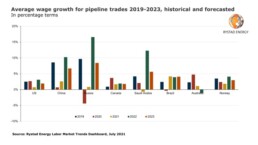

The costs associated with onshore pipeline projects are likely to increase by between 4% and 6% globally by the end of 2022 against current levels, a Rystad Energy analysis reveals, as prices continue to surge for labor, raw materials and transportation. Materials in particular – which account for 30%-40% of the total cost for a pipeline – are expected to become 2%-3% more expensive in the same period and may approach $1 million per kilometer in leading pipeline regions such as the US.
A recent increase in steel demand has also led to higher iron ore prices, thus pushing up steel costs. Moving forward, the removal of tax rebates for line pipe in major export hubs like China could result in higher material costs, hence making Chinese exports more expensive. In addition, prices for other pipeline construction materials – such as valves and flanges – have also spiked. The price index for pipeline flanges and valves in the US, for instance, has grown by more than 30% since early 2020.
It is important to note that the anticipated rise in material costs will not be driven by an increase in general steel prices – as they are expected to slide next year – but instead by the present regulatory hurdles and a lull in pipeline development activity. This in turn could hinder operators from locking in long term agreements with steel suppliers as prices take a turn for the better.
Additionally, the stronger than expected demand from other industries, combined with the slow pace of pipeline project sanctioning activity, could push pipeline operators to the back of the queue to secure large orders, thereby forcing them to pay a premium to procure the required quantities.
“High steel prices and rapidly growing wages for key pipeline trades could emerge as significant challenges for operators looking to drive costs down. When also factoring in higher transportation costs – led by a strong rebound in crude prices – the total price tag of pipeline projects is set to test operators,” says Sumit Yadav, analyst in Rystad Energy’s energy service team
Construction and installation costs are the largest cost components of a pipeline project, potentially accounting for nearly half the total cost. Compared to other cost elements, which may undergo periods of decline, construction and installation costs have been highly resilient, driven in large part by rising wages, which can account for more than 50% of these costs.
For instance, wages for major pipeline construction trades such as welders, construction equipment operators, electricians, plumbers, construction managers and drivers – have not dropped in the US despite a Covid-19 induced downturn and are expected to increase by more than 5% by the end of 2023 compared to current levels.
Based on our Labor Market Trends Dashboard, we expect wages for major pipeline trades to grow at an average of about 8% across major pipeline regions by the end of 2022 against current levels. This means an expected rise of 2% to 3% in construction and installation costs during this period.
The cost pressure exerted by rising wages could further intensify as the US construction industry still lacks more than 200,000 workers, according to the US Department of Labor. This skills shortage is likely to boost wages further, even for entry level trades. Additionally, with the US Congress advancing the Biden Administration’s $1 trillion infrastructure bill, competition for the limited workforce is set to intensify.
While the pipeline industry is actively exploring potential solutions to reduce labor requirements, we note that the bulk of these solutions are concentrated around inspection and maintenance, such as drones and crawlers. But scalable solutions are still largely unavailable for leading construction trades, such as plumbers and equipment operators. Therefore, at least for the near future, the cost pressure of growing wages continues to weigh on operators.
It is worth noting that while the difference in wage growth across the various regions may allude to direct cost savings, this is partly offset by differences in productivity. For instance, while wages in Asia can be around 80% lower than US wages for pipeline trades, labor productivity in the US is also about three to four times higher. This materially reduces the benefits offered by the lower wages in Asia.
Right-of-way costs have historically been largely limited to nearly 5% of total project costs across most regions. However, given the boom in renewable energy projects and a notable shift in government sentiment, especially in regions like North America, it would hardly be surprising to see these costs also escalate in the coming years.
For instance, our Onshore Pipeline Cost Estimating Dashboard suggests rock clearing costs can more than quadruple for a pipeline stretch covered by solid rock instead of common rock. Similarly, a pipeline passing through a semi-urban setting instead of a rural setting could be around 30% more expensive.
Source: Rystad Energy



Related News.

Navigating the Multi-Orbit Era: In Conversation with Intellian’s Jon Harrison at SMM 2026
At SMM 2026 in Hamburg, the rapid evolution of maritime satellite communications took centre stage. Across the exhibition halls, discussions among…
Cyprus ports need joint energy and investment strategy, shipping agents chief says
Cyprus needs a coordinated strategy for shipping, energy and environmental protection to support port investment and modernisation, Cyprus shipping…

MASO Public Affairs introduces MASO Regulatory Intelligence
A new subscription service helping businesses understand what is changing and what it means for them MASO Public Affairs introduces MASO Regulatory…
Anglo-Eastern helps turn CMBTECH’s ammonia ambition into an operational reality
From early feasibility study and risk-based design to newbuilding supervision, crew readiness and technical management, Anglo-Eastern drew on its…

Escalation of attacks threatens to derail recovery in Middle East oil exports
World oil demand is forecast to fall by 2.5 mb/d y-o-y in 4Q26 and 2.6 mb/d on average in 2026. As the Iran war manifests itself through restricted…

New study finds shipping pays twice its share to EU ETS earmarked revenues should triple to help build market for sustainable fuels and technologies
Shipping is responsible for around 10% of EU ETS emissions but pays almost 20% of the ETS bill. Unlike other sectors, it has never received free…

MSARC strengthens maritime mass rescue readiness through training and national live exercise off Dakar, Senegal
Joint MSARC–FHAS programme combines three days of SAR training with a national multi-agency live exercise The Maritime Search and Rescue Council ,…

Sogese report deliveries are still being delayed as container freight rates fluctuate
FOR IMPORTERS Spot rates into the Mediterranean are back at January levels, Far East to Europe reliability sits at pandemic lows, and nearly…

Glencore begins trading on Australian Securities Exchange
Glencore has begun trading on the Australian Securities Exchange under the ASX code GLC. Gary Nagle, Glencore’s CEO, said it was an exciting day for…
BIMCO Shipping Number of the Week
Suez Canal container ship transits exceed 50% of pre-disruption levels "During the first two weeks of October, weekly container ship capacity…
Subscribe to our newsletter!
if you dont want to swim alone in the ocean of news, sign up for the newsletter, and you will receive daily all the important news of world shipping!
