Congestion – A short-term problem with limited impact on the port industry’s valuation


Supply chains generally tend to be well orchestrated for moving goods across global networks. Any short-term disruption can lead to bottlenecks as is the case with port congestion these days. Port congestions are not new to the industry and have been handled in the past as well. Since ports are gateways for global trade, any bottleneck at ports will have a ripple effect across the maritime supply chain. In this update, we try to demystify the current situation and explore its possible impact on the port sector valuation.
What is port congestion?
Port congestion occurs when ships arrive at the port but cannot load or unload because of the already full port capacity. Ships can either queue up and wait for their turn to get a spot at the port or call-in at the nearby port.
What is driving congestion?
There are multiple reasons:
- Tight capacity management and increased blank sailings by carriers: The pandemic-led lockdowns disrupted global trade. Across the supply chain, container shipping alliances were the fastest to respond – curtailing services on certain routes or cancelling (blanking) port calls. This has disturbed the containers demand and availability equilibrium at ports.
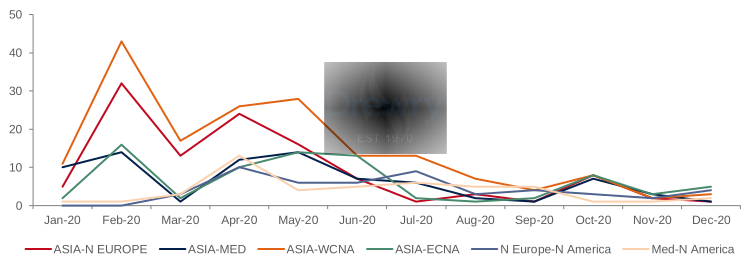
- Unexpected increase in demand: 1) the sudden spike in container volumes to meet the higher demand following the reopening of economies after lockdowns, 2) the usual pick-up in demand before the holiday season, and 3) front loading of orders by importers to safeguard themselves from any supply chain disruption that could be triggered by a second wave of infections (which has already become a reality in some parts of the world), have led to congestion at ports (mainly in the US – Los Angeles and Long Beach). Ports are generally characterised by fixed capacity which cannot be changed/modified to meet the short-term requirements.
- Cost management tactics adopted by ports to combat the impact of COVID -19: Container ports deployed cost management strategies to save the bottom line from the COVID-19-led decline in revenue. However, these strategies have resulted in unwarranted consequences once the operating environment improved. In Felixstowe (UK), the decision to let go the contract workers to lower the cost has left the port underprepared for a steep recovery in volumes that started in 3Q20 and has resulted in the current congestion at the port.
- Ripple effect of congestions at nearby ports: The heavy congestion at Felixstowe (UK) has not only overburdened other ports in the UK (Southampton) but also ports of northern Europe (Rotterdam and Zeebrugge) as carriers have stopped calling Flexistowe and are instead unloading containers at nearby ports.
- Increased health measures adopted to safeguard against COVID-19 infections: Several ports in China are facing congestion as the country mandated COVID-19 checks primarily to stop the spread of the infection.
Who is to blame?
Each industry segment has its own justification. Shipping companies claim that rerouting/ cancelling port calling has primarily led by increased time to complete the round trip (due to quarantine measures opted by various ports worldwide). While the technique of positioning containers based on historical trends and future projections across ports works in the normal course, it has failed in the current stressed situation.
Ports, on the other hand, claim that with easing lockdown measures, volumes have picked up suddenly and they are doing their best to deal with the situation. While they believe it is a short-term phenomenon and expect normalcy to return soon, some ports have opted to increase their workforce, while others have introduced overtime to deal with the situation. Additionally, the capacity of inland transport and warehousing providers in each market is broadly fixed, and therefore, cannot be easily ramped-up to meet short-term fluctuations in demand.
Shippers (who are at actual risk of losing the business due to delayed delivery) contest that the recent consolidation in the shipping industry has given unwarranted power to the big three shipping alliances, which virtually dominate 85% of the market share. Their respective capacity management efforts have led to the recent spike in container freight rates, which has stirred the regulators in many countries to closely watch the situation. Recently, the US Federal Maritime Commission (FMC) has intensified monitoring of shipping alliances, requiring them to provide carrier-specific trade data monthly rather than quarterly. This comes in conjunction with the regulators in South Korea and China, which are already keeping an eagle eye on the situation.
Who is bearing the brunt?
Shippers (the weakest link) are bearing most of the cost burden as the maritime industry plays a central role in global trade, container shipping alliances dominate in terms of market share and ports play a vital role in the marine supply chain. Container shipping lines pass on the cost of delay to shippers by adding a congestion surcharge to freight rates, while ports and hauliers pass on the cost in the form of higher demurrage charges and storage cost.
Shippers, who generally rely on sea for international trade (because of the cheapest cost when compared with other modes of transport), generally bear the burden of inefficiencies within the supply chain — when they are aware of the inefficiency, they are better prepared, but for inefficiencies caused by disruption (such as COVID-19), shippers have to bear the indirect cost as well, such as loss of business due to late delivery and increased stock holding led by longer/less reliable service leads.
Impact on the port companies’ valuation
As stated at the start of this analysis, port congestions are not new and have already been tackled in the past. They impact trade in the short term even though their wider impact can be felt by various industries. Therefore, we believe the current crises is also short term and should be resolved soon with limited impact on valuations. The recent uptrend in Drewry’s port index substantiates our claim.
Figure 2: Drewry Port Index
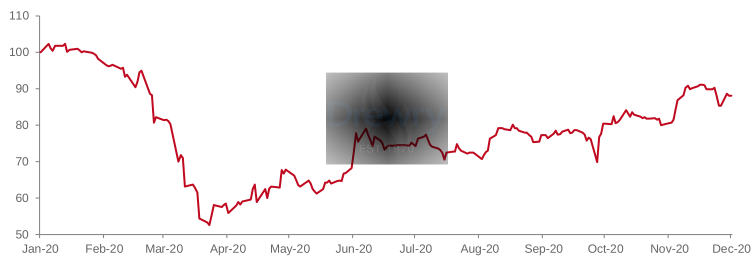
Note: The index represents average stock price of ten port companies covered by Drewry.
Source: DMFR
Also, financial markets are already enjoying the flood of liquidity injected by the central bankers/governments, which instead of supporting the real economy, is actually making its way into various financial assets. We believe liquidity will continue to support the Port company valuations at least until the vaccines are fully available and governments continue to pump money into their respective economies.
Source: Drewry



Related News.

Beyond Technical Skills: WISTA Cyprus explores the human side of leadership
WISTA Cyprus hosted The Art of Leadership & Emotional Mastery, an interactive workshop held on 15 October at the Alasia Hotel in Limassol,…
The human cost of sending merchant mariners into war zones extends far beyond the immediate danger of missiles and drones. It raises a harder question: who is really protecting the seafarer?
Who protects the seafarer? I have spent much of my professional life at sea. I am a Master Mariner. I have stood on the bridge, made decisions…

Loss of bridge control: Human failure is normal – context is key
When bridge control is lost in a functioning system, it can be easy to blame human error. But accidents rarely happen because of one mistake…

Danish Shipping announces the transport of live animals by sea new rules should improve safety for animals, seafarers and the environment
Revised rules on the transport of live animals by sea are being negotiated in the EU. Danish Shipping wants to ensure good animal welfare,…

Japan’s flawed shipping proposal leaves developing countries adrift
A new analysis by Opportunity Green warns governments of the wide-ranging risks posed by Japan’s proposal at the International Maritime Organization…

Intermodal Report Week 42 2026
Pls find below the Intermodal Report - Week 42 2026 Intermodal Report Week 42 2026

Allied Weekly Market Review Week 42
Pls find below the Allied - Weekly Market Review - Week 42 ALLIED - Weekly Market Report- Week 42
EU Arctic Strategy NGOs welcome EU ambition on on cutting shipping’s Arctic Black Carbon Emissions
Responding to today’s publication of the EU’s Arctic Strategy, which definitively states the EU’s intention to support International Maritime…

The final quarter of 2026 is expected to see softer bauxite flows
Chinese front-loading is expected to have run its course, pointing to softer bauxite flows in 2026 Q4. Global bauxite flows increased by 2.8% y/y…

DP World Foundation and Belewan new container terminal mark groundbreaking of AED 3.7 million school project in Indonesia
Classrooms of Hope initiative expands to Belawan, Medan with a new junior high school designed to provide modern learning facilities and greater…
Subscribe to our newsletter!
if you dont want to swim alone in the ocean of news, sign up for the newsletter, and you will receive daily all the important news of world shipping!
