The Covid-19 downturn slashed Australia’s oil and gas workforce by a quarter, effect will be lasting
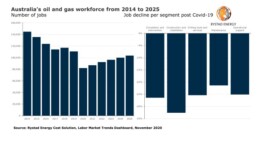

The Covid-19 pandemic hit Australia’s already declining oil and gas workforce hard, causing a loss of over 28,000 jobs this year, equivalent to a quarter of the country’s total count, a Rystad Energy analysis reveals. Some of these jobs will be restored from 2021 onwards, but Australia’s oil and gas workforce will struggle to recover pre-pandemic levels for at least five years – if ever, as the energy transition increasingly alters the global energy mix.
In 2019, Australian oil and gas jobs numbered just over 110,000, a tally slashed by current downturn to just over 82,000, Rystad Energy calculates. The industry’s workforce had been declining steadily even before the present catastrophic downturn, shrinking by close to 24% in 2019 from what it was in 2014. This is, in part, the result of lagging growth in operators’ spending in the country.
The engineering and construction segments have been amongst the worst hit in the current downturn. Over 8,000 jobs have been lost across these segments, representing nearly 29% of all industry job cuts this year. With the combined spend expected to further decline by almost 17% by the end of next year in both segments, we do not expect to see a strong resurgence in hiring levels in the short term.
Maintenance has been one of the best performing segments historically, and contrary to the performance of other segments, it witnessed a net addition in jobs from 2014 to 2019. As operators curtail their discretionary spending and prioritize maintenance activities, this segment may, yet again, remain resilient and avoid any steep job cuts compared to the rest of the industry.
In line with the global trend, drilling is one of the worst affected segments, having seen more than 1,100 drillers’ jobs face the ax in Australia, per our estimates. However, starting 2021, rig demand across the country is expected to rise and average at 6.5 rig years between 2021-2025, thus offering a much-needed respite to workers across the drilling segment.
On an overall basis, we expect the labor market will rebound starting in late 2021, adding a minimum of 20,000 jobs by 2025.
“In the future, the growth in labor demand will not only be driven by oil and gas projects that are under development, but also to a great extent by the infrastructure initiatives undertaken by the Australian government to bring gas prices down across the country,” says Sumit Yadav, energy service research analyst at Rystad Energy.
The government is expected to focus the bulk of its efforts on the country’s east coast, where residents need to shell out gas prices that are double international pricess, as most of gas produced in the eastern region is exported. To alleviate such price issues, the government is planning the Amadeus-to-Moomba gas pipeline worth over $1 billion, which will connect the east coast to the Beetaloo shale assets, which have lower gas breakeven prices. The Port Kembla LNG import terminal expansion and the Hunter Gas Pipeline will also likely lower gas prices and lift labor demand in the coming years.
Despite these positive developments, we do not expect hiring levels to replicate the historic highs of 2014. This can be attributed to the fact that the present downturn has adversely impacted the ability of major operators to take the large-scale risks seen before the 2014 downturn – risks which helped Australia become the largest LNG exporter in the world.
With the breakeven prices for Australian gas assets already at the higher end, and existing LNG terminals failing to run at nameplate capacity, in addition to other concerns, operators are taking a more cautionary approach to new investments. Combining these factors with the operational complications of Covid-19 means that operators are unlikely to make the large-scale investments they did in the heydays, thus directly impacting the labor requirement in the industry.
While the present scenario looks gloomy, the industry’s troubles could be slightly mitigated by the support extended by the government. For instance, in Southern Australia, the government has deferred all costs associated with exploration and licensing fees for the petroleum sector until the end of this year. Similarly, the national government is actively championing a gas-led recovery from the Covid-19 pandemic, which has brought a glimmer of hope for the oil industry, which is now actively competing with the renewables industry in the increasingly low-oil-price-environment.
When compared to labor demand, wages have fared relatively better. The industry’s workforce, on average, makes 50% more than the national average, with wages for industry-specific job titles such as petroleum engineers registering an impressive compound annual growth rate (CAGR) of 3.38% over the past decade. However, this could soon change; the industry’s workforce may have to contend with lower wage growth in the coming years if the revenue prospects of industry players do not take a turn for the better.
For more analysis, insights and reports, clients and non-clients can apply for access to Rystad Energy’s Free Solutions and get a taste of our data and analytics universe.
Source: Rystad



Related News.

Register Now for the CSN London Maritime Forum “Shipping: Predicting an Unpredictable Future”, 13 October – Two Weeks Left
“Shipping: Predicting an Unpredictable Future” REGISTER HERE Date: 13 September 2026 Time: 09:00-16:00 Venue: Marriott Hotel Regent's Park Following…

Working visit of the Shipping Deputy Minister of Cyprus to Brussels
The Shipping Deputy Minister to the President, Ms. Marina Hadjimanolis, departed on Monday, 28 September 2026, for Brussels, following an official…

Navigating the S-100 Transition: Real-World Trials and the Future of Digital Navigation
As the maritime industry prepares for the implementation of the S-100 data standard, the shift from traditional Electronic Navigational Charts (S-57)…

Electronic evidence is transforming maritime casualty investigations, says The Nautical Institute
New edition of Guidelines for Collecting Maritime Evidence Volume 2 addresses electronic records, AI, digital reconstruction and the changing…
Xeneta freight rates set to climb in early October
“For the high-flying spot rates from Far East to US East and West Coasts, we may just begin to see the end of that rising trend as we get into the…
A new gateway to Turkey – Stolthaven Terminals and Rönesans Holding on the DAPEK Ceyhan Terminal
Stolthaven Terminals and Rönesans Holding are building a new chemical and industrial terminal at Ceyhan, on Turkey’s Mediterranean coast. The…

KME & KMSM Family Day 2026 held in Singapore
Promoting Business Understanding and Employee Engagement Through Interaction Between Employees and Their Families K LINE MARINE & ENERGY a…
Maritime Coastguard Agency celebrates World Maritime Day 2026
Transport Secretary Heidi Alexander has written to the International Maritime Organization on World Maritime Day. On Thursday 24 September,…
Paracel Carbon Forestry Project verifies first carbon removal credits
Paracel, a large-scale carbon removals project in Paraguay backed by Trafigura, has verified its first carbon removal credits, totalling over 190,000…
When the Levee Breaks
The weakest June for Chinese crude imports in a decade did not cost a single barrel of throughput. Imports fell 41.3% on the year, runs held above…
Subscribe to our newsletter!
if you dont want to swim alone in the ocean of news, sign up for the newsletter, and you will receive daily all the important news of world shipping!
