Global discovered oil and gas resources set to reach 10 billion boe in 2020, Russia in the lead
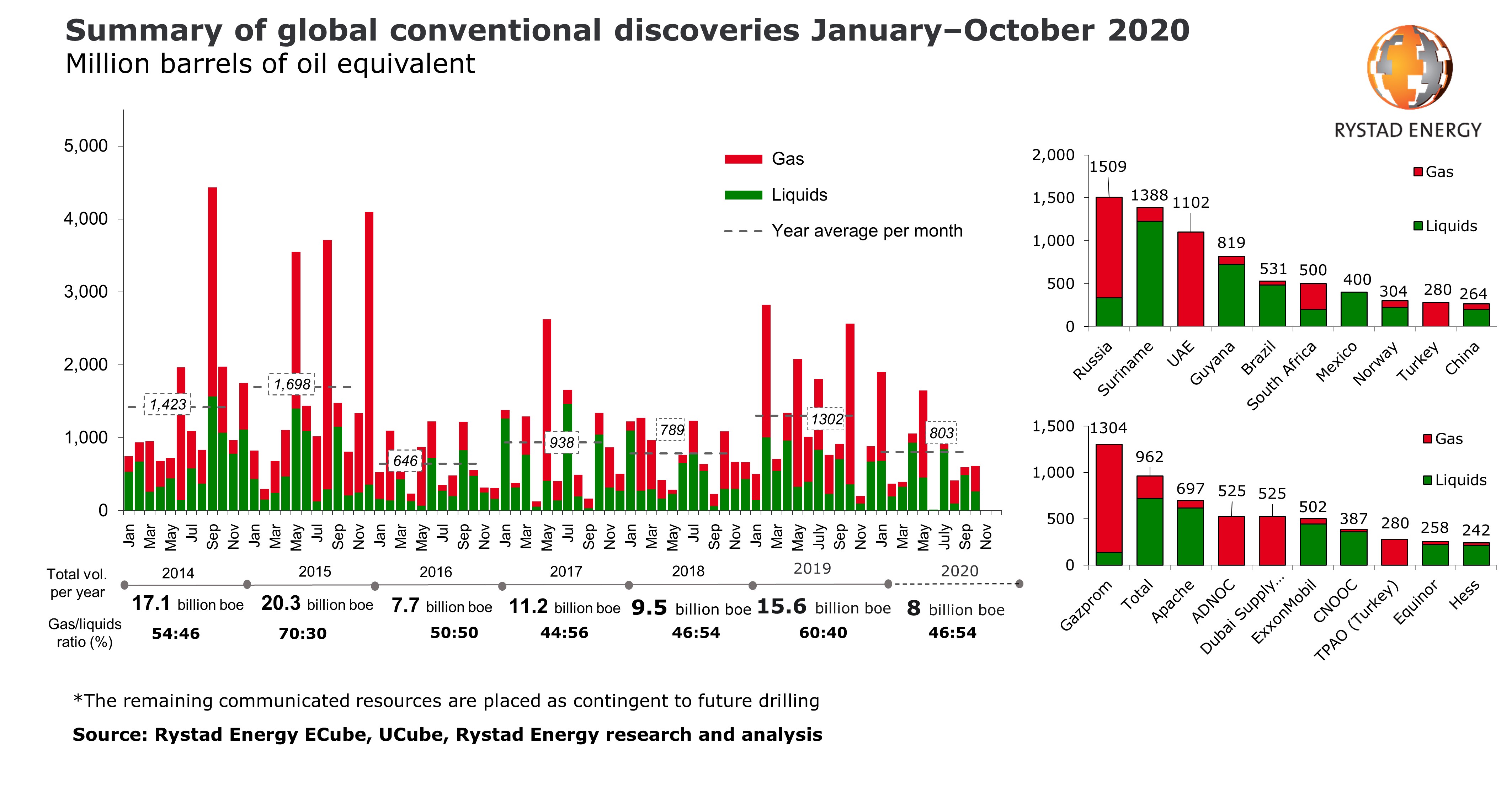
Despite concerns that Covid-19 could drive down discovered volumes to their lowest levels in decades, exploration activity has been resilient this year. Found resources already exceed 8 billion barrels of oil equivalent (boe) and are projected to settle at around 10 billion boe by year-end, a Rystad Energy analysis reveals.
About 3.75 billion boe, or 46% of total discovered volumes, are gas while liquid volumes are estimated at 4.31 billion boe. Yet-uncounted resources in finds like Sakarya in Turkey point to additional upside, meaning that 2020 will avoid returning to the multi-decade low seen in 2016 at just 7.7 billion boe.
The 73 new discoveries announced this year (through October) are evenly split between land and sea with 36 onshore and 37 offshore. Russia leads in terms of discovery volume, with 1.51 billion boe, while Suriname comes second with 1.39 billion boe and the UAE follows third with 1.1 billion boe.
Of the offshore volumes, which account for slightly over three-quarters of discovered resources, 33% was found in ultra-deep waters, 38% in deepwater areas and 29% in shallow waters. Looking at the timing of the discoveries, the third quarter was the weakest with about 2 billion boe of new finds, compared to about 2.7 billion boe during each of the first two quarters.
“Global oil and gas operators will chase plenty of additional volumes in wildcats planned for the final two months of the 2020, although some may not be completed until early 2021 and will therefore add to next year’s tally. We believe discovered volumes are likely to settle at around 10 billion boe,” says Palzor Shenga, senior upstream analyst at Rystad Energy.
Oil and gas companies’ exploration plans have included prospects with higher chances of success in mature areas, as well as high-risk, high-reward wildcats in frontier regions, resulting in some game-changing offshore discoveries. The willingness to invest in high-risk probes proves that E&P companies are not shying away from frontier basins – if prospects are promising enough. Companies have experienced exploratory success in emerging plays in countries including Suriname, Guyana, South Africa and Turkey, as well as in proven mature regions such as Brazil and Norway.
Ranking companies by discovered volumes shows that Russia’s Gazprom is in the lead, ahead of Total and Apache. The latter two have found around 960 million boe and 700 million boe respectively of net recoverable resources this year, mainly thanks to three major discoveries in Block 58 off the coast of Suriname.
We expect that only about 4.5 billion boe of the 8 billion boe discovered so far this year will be produced by 2040, and in coming years annual discovered volumes are likely to settle at a new normal of around 10 billion boe per year.
We see two main reasons for this trend. First, oil and gas players are streamlining portfolios and exploration strategies and will scrutinize prospects more closely than before, thereby reducing the number of wells that will be drilled. A more stringent selection procedure for drill-ready prospects means that only the ones with the highest chance of success will see a spinning drillbit.
Second, companies will be less willing to drill high-risk wells in environmentally sensitive frontier areas, both for financial and environmental reasons. As a result, the full petroleum potential of areas like the Alaskan Arctic, Foz do Amazonas in Brazil and the Barents Sea may never be unlocked.
While fewer wells will be drilled, we expect improved data access and digitization will help operators pinpoint successful prospects with more accuracy. Today a large portion of exploration data is restricted. However, increasing access to data and the growth digital platforms will enable exploration teams to rapidly discover and access basin-scale data, and manage exploration opportunities using data sharing across multi-disciplinary teams.
Increasing use of digitization will reduce costs and make exploration procedures more standardized, and data sharing and collaboration means each operator will need to drill fewer wells to understand the subsurface. This will lead to higher productivity per well drilled.
For more analysis, insights and reports, clients and non-clients can apply for access to Rystad Energy’s Free Solutions and get a taste of our data and analytics universe.
Source: Rystad



Related News.

Columbia Group calls for greater focus on retaining women at sea as second She Beyond Conference takes place
Columbia Group has called on the maritime industry to create a future where women can thrive, progress and lead at sea, as it celebrated the second…

Neptune Group Welcomes “NIKOS TRAVLOS”
The new vessel proudly bears the name of Neptune's founder, who laid the foundation for the creation and enduring evolution of the Group. Her…

Wildcat Defense enters into exclusive agreement to acquire Fraser Shipyards
American family firm takes the next step in its strategy to rebuild U.S. shipbuilding and repair capacity, following its offer for Austal USA.…
Kawasaki signs strategic partnership MOU with Romania’s Transgaz for Onshore Hydrogen Gas Transport
Establishing a model for large-scale hydrogen supply and transport via pipelines Kawasaki Heavy Industries, announced at the Romania–Japan…

UK P&I Club and TT Club secure regulatory approval for Thomas Miller acquisition
The UK P&I Club and TT Club announce the successful completion of their joint acquisition of the Thomas Miller Holdings group, marking a major…

Valenciaport presents its Sandbox at PEIC’26 as a tool to bridge the gap between innovation and implementation
The opening session featured a discussion between Valenciaport President Mar Chao and Valenciaport Foundation Director Antonio Torregrosa. The…

Major investments strengthen Gothenburg RoRo Terminal
Expanded terminal areas, new rail connections and modernised quays are among the investments that have strengthened Gothenburg RoRo Terminal in…

ABP appoints key roles in the Humber
Associated British Ports has made two key appointments at its container terminals strengthening its unitised operations at the ports of Immingham…
Xinhua Silk Road 2026 North Bund Forum unveils 20 shipping-related achievements
The 2026 North Bund Forum opened in Shanghai on October 20 with 20 key shipping-related achievements spanning international cooperation, green…
Ports encouraged to prepare now for advanced nuclear in maritime and clean energy
New joint Lloyd’s Register and British Ports Association paper sets out a practical readiness pathway for ports considering nuclear-powered vessels,…
Subscribe to our newsletter!
if you dont want to swim alone in the ocean of news, sign up for the newsletter, and you will receive daily all the important news of world shipping!
