New report provides blueprint to unlock the first wave of zero emission shipping projects
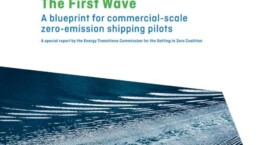

The decarbonization of shipping will require the creation of a new green shipping value chain. It is urgent to launch a first wave of commercial scale zero emission shipping projects to test new technologies and business models. Cost-lowering and de-risking strategies can reduce the total costs of the first commercial scale zero emission pilots by 30-50% but governments and shipping customers have to play a crucial role in supporting the maritime transport’s energy transition.
The maritime industry has no time to waste if it is to meet the International Maritime Organization’s ambition of at least halving emissions from international shipping by 2050. It will require commercially viable zero emission vessels to be operating along deep sea trade routes by 2030. This is the goal of the Getting to Zero Coalition, which brings together more than 120 companies within the maritime, energy, infrastructure and finance sectors, supported by key governments and IGOs.
Produced by the Energy Transitions Commission for the Getting to Zero Coalition, a new report catalogues the barriers to the early adoption of zero emission technologies throughout the entire energy value chain. More importantly, it calls attention to five key actions that first movers can take to make tangible progress towards zero emission pilots over the next three to four years:
- Join forces to fast-track technology trials and regulatory approvals
- Choose pilot locations that offer privileged access to low-cost renewable electricity
- Seize opportunities to repurpose and retrofit existing infrastructure and assets
- Co-invest in critical equipment such as bunkering assets and vessels
- Form consortiums with key value chain actors to establish voluntary offtake agreements and distribute cost across the value chain to the end-consumer
Renewable electricity for the production of green hydrogen represents the largest share of the total pilot cost for the ammonia and methanol fuel pathways that the report explores. First movers can lower electricity cost at the outset by selecting the right geographical locations for the energy production and by entering into long-term corporate purchase power agreements to secure large volumes of clean power at the lowest costs.
Though first movers will have to contend with higher investment and operational costs, the report shows that this can be mitigated through a green fuel premium, which would help distribute the additional cost throughout the value chain up to the end-consumer.
“Despite the higher business to business costs of operating zero emission vessels, the impact on end consumer prices is likely to be limited. The increase in the cost of a high-end athletic shoe will represent around 0,5-1% of the total cost,” says Michael Parker, Chairman, Global Shipping, Logistics & Offshore, Citi and Co-Chair of the Getting to Zero Coalition’s Motivating First Movers workstream.
To deploy zero emission vessels globally, new and existing stakeholders will need to work together in creating a new green shipping value chain. Forming consortiums with core value chain actors is another key action first movers can undertake to lower pilot costs.
“Shipping’s decarbonization cannot be achieved without collaboration. Forming consortiums will allow first movers to cooperate easily, diversify risks across multiple actors, enter into voluntary offtake agreements, and provide robust demand signals,” says Randy Chen, Director and Vice Chairman, Wan Hai Lines and Co-Chair of the Getting to Zero Coalition’s Motivating First Movers workstream.
To lower investment costs, early adopters can also retrofit existing infrastructure, and establish industrial clusters of industrial sectors.
“The economics of zero emission shipping will depend massively on the cost of zero emission fuels. Commitments from cargo owners to procure “green shipping” services at a premium price will be crucial to unlock a first wave of commercial scale projects. A combination of tactical corporate decisions reducing fuel costs, enhanced public support to investment, and collaborations across the maritime value chain can also boost the commercial viability of zero-emission shipping for first movers“, comments Faustine Delasalle, Director, Energy Transitions Commission.
The report emphasizes that governments have to play a decisive role in supporting the shipping industry’s transition to zero emission. This ranges from direct grants, offering concessional loans to first movers, waiving electricity taxes and grid fees, co-investing in zero emission pilots, to exploring measures such as a carbon levy.
“Governments have a crucial role in incentivizing and accelerating shipping’s green transition. By supporting first movers, governments can help generate the technology learnings and economies of scale that will allow the market to take over, similarly to the role governments has played within renewable energy technologies such as solar and wind,” adds Kasper Søgaard, Head of Research at the Global Maritime Forum, a Partner of the Getting to Zero Coalition.
The first wave of pilots will prove the technological and commercial case for zero emission shipping, create demand signals for fuel producers and engine manufacturers, set the template for regulatory measures, and provide the foundations of the long-term infrastructure needed for the decarbonization of maritime shipping.
The analysis focuses on green ammonia and green methanol use in pilots involving containerships, but insights will be relevant for other potential zero emission fuel options.
Read the full report ‘The First Wave – A blueprint for commercial-scale zero-emission shipping pilots’ here.



Related News.

Beyond Technical Skills: WISTA Cyprus explores the human side of leadership
WISTA Cyprus hosted The Art of Leadership & Emotional Mastery, an interactive workshop held on 15 October at the Alasia Hotel in Limassol,…
The human cost of sending merchant mariners into war zones extends far beyond the immediate danger of missiles and drones. It raises a harder question: who is really protecting the seafarer?
Who protects the seafarer? I have spent much of my professional life at sea. I am a Master Mariner. I have stood on the bridge, made decisions…
Loss of bridge control: Human failure is normal – context is key
When bridge control is lost in a functioning system, it can be easy to blame human error. But accidents rarely happen because of one mistake…

Danish Shipping announces the transport of live animals by sea new rules should improve safety for animals, seafarers and the environment
Revised rules on the transport of live animals by sea are being negotiated in the EU. Danish Shipping wants to ensure good animal welfare,…

Japan’s flawed shipping proposal leaves developing countries adrift
A new analysis by Opportunity Green warns governments of the wide-ranging risks posed by Japan’s proposal at the International Maritime Organization…

Intermodal Report Week 42 2026
Pls find below the Intermodal Report - Week 42 2026 Intermodal Report Week 42 2026

Allied Weekly Market Review Week 42
Pls find below the Allied - Weekly Market Review - Week 42 ALLIED - Weekly Market Report- Week 42
EU Arctic Strategy NGOs welcome EU ambition on on cutting shipping’s Arctic Black Carbon Emissions
Responding to today’s publication of the EU’s Arctic Strategy, which definitively states the EU’s intention to support International Maritime…

The final quarter of 2026 is expected to see softer bauxite flows
Chinese front-loading is expected to have run its course, pointing to softer bauxite flows in 2026 Q4. Global bauxite flows increased by 2.8% y/y…

DP World Foundation and Belewan new container terminal mark groundbreaking of AED 3.7 million school project in Indonesia
Classrooms of Hope initiative expands to Belawan, Medan with a new junior high school designed to provide modern learning facilities and greater…
Subscribe to our newsletter!
if you dont want to swim alone in the ocean of news, sign up for the newsletter, and you will receive daily all the important news of world shipping!
