Oil and gas well intervention costs in Mexico could surpass $3 billion over the next three years


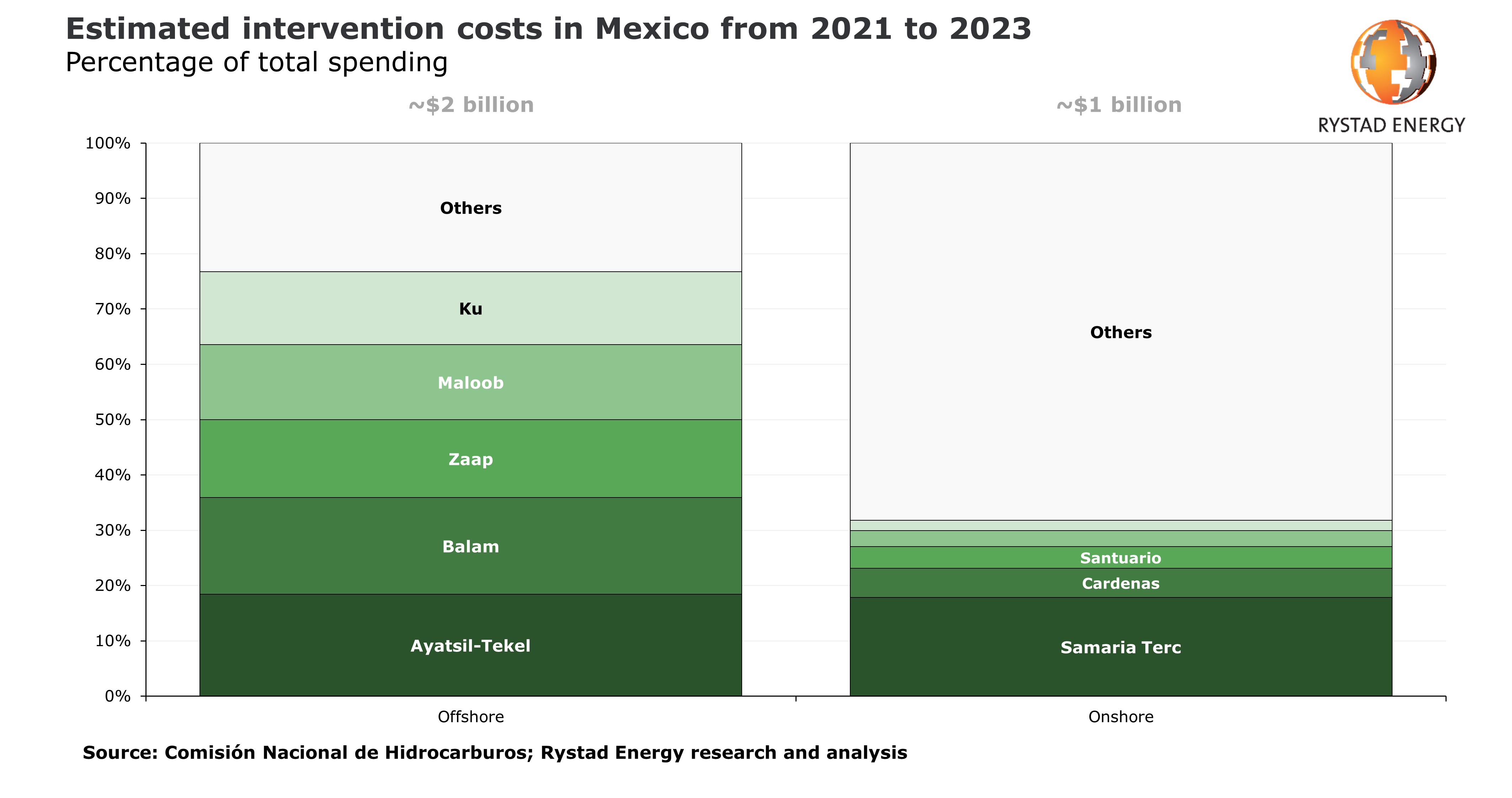
As around 75% of Mexico’s oil and gas producing wells are ageing, intervention activities should remain resilient in the years ahead, likely surpassing $3 billion from 2021 to 2023, a Rystad Energy analysis shows. Around 30% of that will be spent onshore with the remaining 70% going offshore.
The number of producing offshore wells in Mexico dropped by 14% between 2015 and 2020, with a steeper decline for onshore wells, at 27%. The drops follow relatively slower drilling activities over the same timeline, with offshore drilling at around 60% of the level seen between 2010 and 2015. For onshore drilling, the drop was even bigger, with the number of completed wells down nearly 80% from 2015 to 2020 compared to the previous five-year period.
As a result, the median age of producing wells has increased for both onshore and offshore wells over the past five years. In the offshore segment, the median age of producing wells has increased from 8.1 years to 11.5 years, while doubling for the onshore segment, from 6.7 to 13.6 years.
“Both onshore and offshore drilling activity experienced peaks before 2015, so the median age for producing wells in Mexico has increased significantly in the past few years. Water cuts have also increased for a majority of both offshore and onshore wells from 2015 to 2020. In addition, there seems to be an increased willingness to pursue intervention on younger fields,” says Daniel Holmedal, energy research analyst at Rystad Energy.
Learn more in Rystad Energy’s WellCube.
Oil wells typically require more intervention than gas wells. Looking deeper into specific fields, using costs from Comisión Nacional de Hidrocarburos (CNH), we see some clear examples of fields that are likely to need spending on intervention over the next three years.
Among the onshore fields that will require the most spending, Samaria Terc leads by far. Most of its producing wells, at more than 150 in total, have a median wellbore age of eight years with wellbore lengths of around 2,100 meters. The Cardenas, with eight producing wells and the Madrefil field, with six, are the second and fourth in onshore spending, respectively. They have fewer producing wells, but the wellbore length is longer, at 5,800 meters, for the Cardenas and 6,600 meters for the Madrefil. The more complex wells at Cardenas and Madrefil are likely to require costlier intervention techniques compared to the ones at Samaria Terc.
In the offshore segment, four out of the top five fields in terms of spending are fixed facilities with Ku being the sole exception as a floater. In terms of the wellbore age, Ayatsil-Tekel at two years and Balam at six years have the lowest median wellbore age, along with the longest offshore wells at 4,300 meters and 4,900 meters, respectively.
For service suppliers exposed to the Mexican market, these fields provide a good breadth of intervention possibilities in the years ahead. While fields like Ayatsil-Tekel and Balam are likely to require costlier intervention techniques, Zaap and Maloob will see lighter interventions.



Related News.

Connected Fleets under Siege: Navigating Geopolitical Cyber Threats and Modern Maritime IT
An exclusive CSN interview between Adonis Violaris and Dr Matthew Maheras As commercial shipping becomes ever more digitally integrated, the industry…
InterManager warns enclosed space deaths demand urgent industry action
InterManager has called for urgent industry action on enclosed space safety after its latest research highlighted persistent failures in procedures,…
ATPI Greece marks 50 years at the heart of global crew changes
Five decades supporting the Greek and global shipping community 35% of ATPI’s marine business now managed from Greece More than 130 professionals…
Euroseas announces a new time charter contract for its 2001-built 2,556 teu Feeder Containership, M/V EM Corfu, and the sale of its sister vessel, M/V Evridiki G
Euroseas an owner and operator of container carrier vessels and provider of seaborne transportation for containerized cargoes, announced a new…
Possible further delay to road transport’s inclusion in EU ETS causes serious concern
Interferry, the global trade association representing the ferry shipping industry, is raising serious concerns over the current state of EU Emissions…

ABP appoints new head of commercial for Humber
Associated British Ports, the UK’s largest port operator, has appointed Sandrine Lagrost as its new Head of Commercial for the Humber, joining the…
Commodity Radar | Spotlight: Bauxite – Week 43.2026
The final quarter of 2026 is expected to see softer bauxite flows Chinese front-loading is expected to have run its course, pointing to softer…
Japan IMO attempt to weaken the IMO Net-Zero Framework
Japan has put forward a proposal to the International Maritime Organization to remove the Net-Zero Fund and put shipping companies in control of…

xclusiv S&P Report 19th October 2026
Pls find below the [xclusiv] S&P Report 19th October 2026 [xclusiv] 2026_10_19
Glencore achieves land access for the Coroccohuayco project at Antapaccay
Antapaccay, a Peruvian entity controlled by Glencore, has completed the access agreements required for the last blocks of land to unlock the…
Subscribe to our newsletter!
if you dont want to swim alone in the ocean of news, sign up for the newsletter, and you will receive daily all the important news of world shipping!
