Covid-19 and energy transition will expedite peak oil demand to 2028 and cut level to 102 million bpd


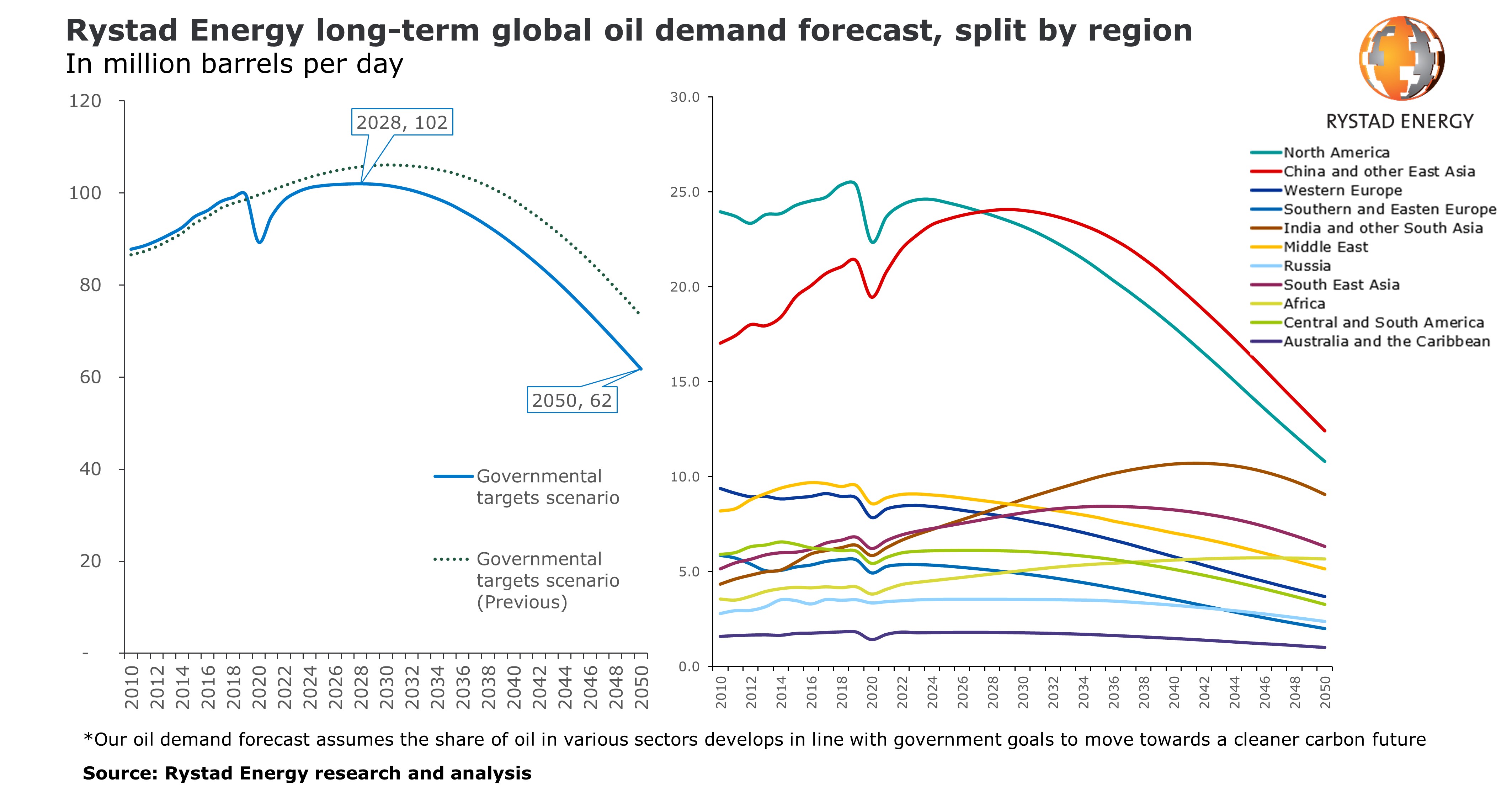
The Covid-19 pandemic and the acceleration of the energy transition have led Rystad Energy to significantly revise its long-term oil demand forecast. The virus is expected to have a lasting impact on global oil demand, which we now see peaking at 102 million barrels per day (bpd) in 2028. Before Covid-19, we had called for peak oil demand of just over 106 million bpd in 2030.
Rystad Energy examines three different scenarios in its long-term oil demand prognosis, and peak demand at 102 million bpd in 2028 is the most likely outcome. This forecast scenario is called the “Governmental Targets Scenario” and assumes the share of oil in various sectors develops in line with stated government goals to move towards a cleaner carbon future, notably in the electrification of transport.
Meanwhile, the persistence of the Covid-19 pandemic is likely to cause 2020 oil demand to decline to 89.3 million bpd, compared to 99.6 million bpd in 2019. Demand will then recover to 94.8 million bpd in 2021 still capped by regional lockdowns and slow international aviation recovery as airlines continue to operate far below pre-virus levels. In our Governmental Targets Scenario, oil demand then recovers to 98.4 million bpd in 2022, still stuck below pre-virus levels due to structural Covid-19 impacts such as less work commuting and slower aviation recovery. It is only in 2023 that demand will recover to pre-Covid-19 levels and jump back to 100.1 million bpd.
“The slow recovery will permanently affect global oil demand levels, shaving at least 2.5 million bpd off our forecasts made before the coronavirus. We have lost at least 2 years of oil demand growth in 2020 and 2021, while before the virus we expected yearly growth of 1 million bpd. The lockdowns will stunt economic recovery in the short-term and in the long-term and the pandemic will also leave behind a legacy of behavioral changes that will also affect oil use,“ says Artyom Tchen, Senior Oil Markets Analyst at Rystad Energy.
Supplementing the effect of Covid-19 on oil demand, the energy transition is accelerating and also weighs on our peak oil demand revision. All sectors contribute to the transition, but transport (60% of oil demand) will be the ultimate driver of this shift. By 2025, the plug-in-hybrid and battery electric vehicles (EVs) are expected to achieve 14% market share in new passenger vehicle sales, according to public governmental targets, then further grow to 80% by 2050.
Learn more in Rystad Energy’s OilMarketCube.
In the short-and-medium-term, we also account for an indirect impact of Covid-19 on oil demand prompted by individual behavioral changes. Although some more months will be needed to fully assess how the pandemic has reshaped peoples’ habits and companies’ business models, we already observe some behavioral headwinds to oil demand recovery from slower rush-hour traffic recovery in summer, an indication that a fraction of commuters will continue working from home even after lockdowns are lifted.
We expect this behavioral headwind to visibly cap demand recovery towards 2023. On the aviation side, the behavioral barriers to oil recovery can be even stronger as cost-cutting policies and teleconferencing may cap aviation business travel recovery, while we also expect some leisure travelers to abstain from airborne travel in the first years following the pandemic.
Interestingly, we observe a sustained commitment from vehicle manufacturers and governments to meet electrification and CO2 abatement targets, little changed even by the economic turmoil brought by Covid-19. This proves the resilience of the ongoing technological developments; however, oil substitution effects are yet strong enough to derail oil demand from recovering to pre-virus levels and then growing for a few years to come.
Between 2025 and 2030, oil demand will enter a plateau phase at around 102 million bpd. In this phase, we no longer see any residual Covid-19 impacts. We expect firm structural demand growth driven mostly by developing Asia and Africa, which will push demand up, and an increasing, yet weak substitution impact in the road transportation segment as well as a continued structural decline in the power, industry and buildings sectors, which will drive demand down. In this phase, we estimate that these effects will roughly net each other out.
The post-peak phase (2030 – 2050) is characterized by the acceleration in EV adoption and recycled plastics use, which will also spill over to developing countries and satisfy part of their energy demand. In the very long-term, we see a steep decline of oil demand to 62 million bpd in 2050, driven by the high penetration rate of EVs in the automotive industry. In addition, the convergence of plastics recycling rates to around 70-75% – rates currently observed in other materials such as glass, aluminum cans and iron – will also contribute to that declining trend, albeit at a lesser extent.
The sectors that contribute most to the demand shift from a plateau to post-peak decline are passenger vehicles and trucks/buses. Historically, these two sectors represent the biggest share of oil demand, accounting together for 48% of the total. At the same time, we expect more sustained and prolonged demand support from the aviation segment, where feasible/viable substitution technologies are limited as well as in the petrochemical sector, where only a portion of plastics consumption can be recycled and substituted by bioplastics. In the post-peak phase, the rise of EV adoption will accelerate and spill over to developing countries, contributing to the precipitous demand fall.
Geographically, the demand growth that we observe until 2030 will be driven by Asia, led by China and India. In fact, for many Asian, Latin American and African countries to satisfy economic expansion and middle-class growth plans, oil demand will most probably increase through 2030 in those countries. Afterward, we expect that the energy demand in developing countries will keep increasing, driven by GDP and population growth, but that it will be increasingly satisfied by alternative sources and new technologies in a decarbonization push.
Developing countries in Asia and Africa will see a sustained increase in oil demand through the end of the 2040s in our updated forecast as infrastructure hurdles and heavy discounts on imported used internal combustion engines will make it harder for new technologies to penetrate these regions, particularly in rural areas.
“Overall, we do not believe Covid-19 has put peak oil demand behind us, but we do acknowledge the pandemic will greatly alter the peak oil demand reckoning moment, both in terms of timing and volumes. This will help oil substitution gain speed and inevitably take global consumption to lower levels quicker, hand in hand with the energy transition,“ Tchen concludes.
For more analysis, insights and reports, clients and non-clients can apply for access to Rystad Energy’s Free Solutions and get a taste of our data and analytics universe.



Related News.

Connected Fleets under Siege: Navigating Geopolitical Cyber Threats and Modern Maritime IT
An exclusive CSN interview between Adonis Violaris and Dr Matthew Maheras As commercial shipping becomes ever more digitally integrated, the industry…

InterManager warns enclosed space deaths demand urgent industry action
InterManager has called for urgent industry action on enclosed space safety after its latest research highlighted persistent failures in procedures,…

ATPI Greece marks 50 years at the heart of global crew changes
Five decades supporting the Greek and global shipping community 35% of ATPI’s marine business now managed from Greece More than 130 professionals…

Euroseas announces a new time charter contract for its 2001-built 2,556 teu Feeder Containership, M/V EM Corfu, and the sale of its sister vessel, M/V Evridiki G
Euroseas an owner and operator of container carrier vessels and provider of seaborne transportation for containerized cargoes, announced a new…

Possible further delay to road transport’s inclusion in EU ETS causes serious concern
Interferry, the global trade association representing the ferry shipping industry, is raising serious concerns over the current state of EU Emissions…

ABP appoints new head of commercial for Humber
Associated British Ports, the UK’s largest port operator, has appointed Sandrine Lagrost as its new Head of Commercial for the Humber, joining the…

Commodity Radar | Spotlight: Bauxite – Week 43.2026
The final quarter of 2026 is expected to see softer bauxite flows Chinese front-loading is expected to have run its course, pointing to softer…

Japan IMO attempt to weaken the IMO Net-Zero Framework
Japan has put forward a proposal to the International Maritime Organization to remove the Net-Zero Fund and put shipping companies in control of…

xclusiv S&P Report 19th October 2026
Pls find below the [xclusiv] S&P Report 19th October 2026 [xclusiv] 2026_10_19

Glencore achieves land access for the Coroccohuayco project at Antapaccay
Antapaccay, a Peruvian entity controlled by Glencore, has completed the access agreements required for the last blocks of land to unlock the…
Subscribe to our newsletter!
if you dont want to swim alone in the ocean of news, sign up for the newsletter, and you will receive daily all the important news of world shipping!
