Telenor is forging a new path with THOR 10-02
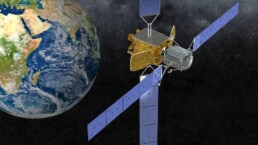

Already a quarter of the way into its historic journey, MEV-2 will dock with Intelsat 10-02 / THOR 10-02 in early 2021 and we are eagerly counting down the days.
It was roughly four years ago that we first started exploring the best options for the future of THOR 10-02, a satellite which we share with Intelsat. We knew that the satellite was in excellent health and that, if it wasn’t for the fuel, it would have the potential for many years of continued operation. As with all satellites, once the fuel gauge shows it is close to depletion, we would need to retire it from active service and relocate it out of geostationary orbit.
It was fortunate for us that the timing of our research lined up with news of a new, game-changing satellite servicing technology that was on the horizon. We knew that we had a very healthy satellite in all respects with the capacity to continue operation for some years to come, if only it had the fuel supply to maintain its position.
THOR 10-02 carries thousands of valuable communication links on its Ku payload, including maritime connectivity, land-based services, video contribution and occasional use, making crucial communications possible in inaccessible, unconnected and remote locations throughout Europe and the Middle East. We were very keen to carry on the services in a way that would keep our commitment to serve our customers and allow us to maintain our THOR fleet of satellites in an efficient manner. We realized early on that this new life-extension technology being developed by Northrop Grumman, the Mission Extension Vehicle (MEV), was definitely worth further investigation.
As part of the life extension procedure, the MEV-2 satellite will be docked onto the communications satellite while in full operation, effectively providing the space equivalent of a jetpack, taking control over both the orbit and pointing of THOR 10-02. The result of this would be the extension of the operational life of THOR 10-02 by up to five years, allowing our customers to continue to benefit from the communications links upon which they rely.
Naturally, when you are dealing with innovative technology, there are concerns about the reliability and safety of a new and untested system and we certainly questioned in great detail how it would work and what safeguards were in place. For us, it is always vital to know that there will be no disruption to the service we deliver to our customers, so we couldn’t risk an unproven system.
Taking part in the second MEV mission, we were reassured by observing the MEV-1 pathfinder mission in operation, when it first docked with a satellite. This docking was with a satellite which was, at that time, in a graveyard orbit, roughly 350 km above the geosynchronous orbit where we operate our THOR fleet. And, in fact, we at Telenor Satellite, have always been open to fresh ideas, and are not strangers to innovation, having been at the forefront of the introduction of more sophisticated communications to the maritime sector. To name a few; we were pioneers in equipping ships with VSATs on stabilized platforms, we went for early adoption of Ka-band and multi-spot beams, and we were an early mover in offering managed services to our resellers.
The pathfinder mission pioneered by Intelsat and Northrop Grumman, MEV-1, was a great success, docking with the satellite and moving it back into geostationary orbit. At that point, we were fully convinced that we had made the right choice in terms of opting for the MEV technology.
MEV-2 was successfully launched on an Ariane 5 rocket from Kourou, French Guiana on 15 August, 2020, starting the countdown to its arrival in geostationary orbit. It is currently working its way towards THOR 10-02 and is scheduled to dock in early 2021. The docking procedure will occur while the satellite remains fully operational, ensuring minimal interruption to service.
It has been an exciting time for Telenor Satellite and we are very proud to be part of this innovative new technology. We believe this is just the first step along with way for in-orbit servicing and the technology has the future potential to refuel, repair and de-orbit satellites opening up many more options for satellite operators like ourselves. Telenor Satellite is currently contributing with operator insights to a European Space Agency (ESA) project, where Airbus is the prime contractor, looking at the wider possibilities for in-orbit servicing and investigating how feasible, not only in practical terms but also commercially, they might be.
Article contributed by Peter Olsen, Director Business Development, Telenor Satellite.

Peter has more than 20 years of experience from the space industry. Peter has held various managerial positions related to satellite operations, procurement and business development. Prior to joining Telenor, Peter has worked with European Space Agency, TSAT and EUMETSAT. Peter holds a Master of Science in Electrical Engineering from the Norwegian University of Science. He also holds a Masters of Space Systems in Engineering from TU Delft, TopTech School of Executive Education.



Related News.

5th CSN Greece ICT Conference, Athens 19th November 2026 “Intelligent Skies, Secure Seas: The AI Impact on ICT” – Save the date
About the Conference The 5th CSN Greece Shipping ICT Conference, titled “Intelligent Skies, Secure Seas: The AI Impact on ICT”, will take place on…
Maritime piracy incidents remain at historic lows despite Somali piracy concerns
The ICC International Maritime Bureau (IMB) has reported the lowest level (51) of piracy and armed robbery incidents since 1992 in the first nine…
Piraeus Port Authority main sponsor of Ferry Shipping Summit 2026
With the participation of more than 200 delegates from several European countries, the Ferry Shipping Summit 2026 took place on 8–9 October 2026 in…

EuroDry announces order for the construction of a third modern 82,000 DWT Kamsarmax Bulk Carrier
EuroDry , an owner and operator of drybulk vessels and provider of seaborne transportation for drybulk cargoes, announced that it has signed a…
India urges Russia, Ukraine to protect Black Sea shipping
India has urged both Russia and Ukraine to ensure safe passage for commercial shipping through the Black Sea as attacks on merchant vessels put…
PD Ports strengthens its commitment to the River Tees with multi-million pound Marine investment
PD Ports has officially opened a new multi-million-pound Marine facility on the banks of the River Tees, reinforcing its long-term commitment to the…

Maritime leaders head to Shanghai for the Annual Summit 2026
Shared seas, shifting horizons Maritime trade stands at a turning point. The rules-based order on which shipping has long depended is under…
Indian Register of Shipping grants type approval to Medha Energy’s 92 kWh LTO Lithium-Ion battery system
Indian Register of Shippinghas successfully completed the Type Approval process for the 92 kWh Lithium-Ion Battery System developed by M/s Medha…
KLine opens a Singapore New Hub for Consolidated Ship Management and Maritime Talenτ
Three Companies, One Roof — Singapore's New Hub for Consolidated Ship Management and Maritime Talenτ A ceremony for around 280 guests sets the stage…
ASA explores measures to Safeguard Free and Safe Navigation at Critical International Maritime Chokepoints
The Asian Shipowners’ Association which accounts for 56% of the world’s fleet capacity and consists of China, Cook Islands, Hong Kong, Japan, Korea…
Subscribe to our newsletter!
if you dont want to swim alone in the ocean of news, sign up for the newsletter, and you will receive daily all the important news of world shipping!
