IMO working group agrees further measures to cut ship emissions


Proposed amendments to the MARPOL convention would require ships to combine a technical and an operational approach to reduce their carbon intensity.
Draft new mandatory measures to cut the carbon intensity of existing ships have been agreed by an International Maritime Organization (IMO) working group. This marks a major step forward, building on current mandatory energy efficiency requirements to further reduce greenhouse gas emissions from shipping.
The proposed amendments to the MARPOL convention would require ships to combine a technical and an operational approach to reduce their carbon intensity. This is in line with the ambition of the Initial IMO GHG Strategy, which aims to reduce carbon intensity of international shipping by 40% by 2030, compared to 2008. The amendments were developed by the seventh session of the Intersessional Working Group on Reduction of GHG Emissions from Ships (ISWG-GHG 7), held as a remote meeting 19-23 October 2020.
The draft amendments will be forwarded to the Marine Environment Protection Committee (MEPC 75), to be held in remote session 16-20 November 2020. The MEPC is the decision-making body. If approved, the draft amendments could then be put forward for adoption at the subsequent MEPC 76 session, to be held during 2021.
The ISWG-GHG 7 also discussed the next steps in assessing the possible impacts on States of the proposed combined measure. The group agreed the proposed terms of reference for assessing the possible impacts on States, paying particular attention to the needs of developing countries, in particular Small Island Developing States (SIDS) and least developed countries (LDCs).
Despite the COVID-19 pandemic and postponements of meetings during the first half of the year, the progress on developing the short-term measures has continued, with two informal remote sessions in July and early October preceding the formal working group session. The progress follows the timeline as set out in the initial IMO GHG strategy. The strategy proposed that short-term measures should be those measures finalized and agreed by the Committee between 2018 and 2023.
In more detail:
Proposed MARPOL amendments
The proposed draft amendments would add further requirements to the energy efficiency measures in MARPOL Annex VI chapter 4. Current requirements are based on the Energy Efficiency Design Index (EEDI), for new build ships, which means they have to be built and designed to be more energy efficient than the baseline; and the mandatory Ship Energy Efficiency Management Plan (SEEMP), for all ships. The SEEMP provides for ship operators to have in place a plan to improve energy efficiency through a variety of ship specific measures.
The draft amendments build on these measures by bringing in requirements to assess and measure the energy efficiency of all ships and set the required attainment values. The goal is to reduce the carbon intensity of international shipping, working towards the levels of ambition set out in the Initial IMO Strategy on reduction of GHG emissions from ships.
These are two new measures: the technical requirement to reduce carbon intensity, based on a new Energy Efficiency Existing Ship Index (EEXI); and the operational carbon intensity reduction requirements, based on a new operational carbon intensity indicator (CII).
The dual approach aims to address both technical (how the ship is retrofitted and equipped) and operational measures (how the ship operates).
Attained and required Energy Efficiency Existing Ship Index (EEXI)
The attained Energy Efficiency Existing Ship Index (EEXI) is required to be calculated for every ship. This indicates the energy efficiency of the ship compared to a baseline.
Ships are required to meet a specific required Energy Efficiency Existing Ship Index (EEXI), which is based on a required reduction factor (expressed as a percentage relative to the EEDI baseline).
Annual operational carbon intensity indicator (CII) and CII rating
The proposals are for ships of 5,000 gross tonnage and above to have determined their required annual operational carbon intensity indicator (CII). The CII determines the annual reduction factor needed to ensure continuous improvement of the ship’s operational carbon intensity within a specific rating level.
The actual annual operational CII achieved (attained annual operational CII) would be required to be documented and verified against the required annual operational CII. This would enable the operational carbon intensity rating to be determined. The rating would be given on a scale – operational carbon intensity rating A, B, C, D or E – indicating a major superior, minor superior, moderate, minor inferior, or inferior performance level. The performance level would be recorded in the ship’s Ship Energy Efficiency Management Plan (SEEMP).
A ship rated D for three consecutive years, or E, would have to submit a corrective action plan, to show how the required index (C or above) would be achieved.
Review mechanism
The draft amendments would require the IMO to review the effectiveness of the implementation of the CII and EEXI requirements, by 2026 at the latest, and, if necessary, develop and adopt further amendments.
Next steps
The draft amendments developed by the Working Group will be forwarded to the MEPC for discussion with a view to approval. If approved, they could then be put forward for adoption at the subsequent MEPC 76 session, to be held during 2021.
The MARPOL treaty requires draft amendments to be circulated for a minimum six months before adoption, and they can enter into force after a minimum 16 months following adoption. These are amendment procedures set out in the treaty itself.
Impact assessment
The comprehensive impact assessment would be initiated after MEPC 75, following the Committee’s approval of the terms of reference for the impact assessment. The impact assessment would be based on the Procedure for assessing impacts on States of candidate measures, adopted in 2019, which says a comprehensive impact assessment should provide a detailed qualitative and/or quantitative assessment of specific negative impacts on States, and be evidence-based and should take into account, as appropriate, analysis tools and models, such as, cost-effectiveness analysis tools, e.g. maritime transport cost models, trade flows models, impact on Gross Domestic Product (GDP); updated Marginal Abatement Cost Curves (MACCs); and economic trade models, transport models and combined trade-transport models.
The final comprehensive impact assessment of the short-term combined measure would be submitted to MEPC 76. Based on this, a possible framework for reviewing impacts on States of the measure adopted, and addressing disproportionately negative impacts on States, as appropriate, would be considered.
Initial IMO GHG Strategy
The initial IMO GHG Strategy, adopted in 2018, sets ambitious targets to halve GHG emission from ships by 2050, compared to 2008, and reduce carbon intensity of international shipping by 40% by 2030 compared to 2008. The strategy lists a number of candidate measures which could also be considered to further reduce emissions and help achieve the targets in the strategy, in particular 40% reduction of carbon intensity from shipping by 2030. Short-term measures could be measures finalized and agreed by the Committee between 2018 and 2023, although in aiming for early action, priority should be given to develop potential early measures with a view to achieving further reduction of GHG emissions from international shipping before 2023. Dates of entry into force and when the measure can effectively start to reduce GHG emissions would be defined for each measure individually. A procedure for assessing the impact on States of a measure has been approved.



Related News.

5th CSN Greece ICT Conference, Athens 19th November 2026 “Intelligent Skies, Secure Seas: The AI Impact on ICT” – Save the date
About the Conference The 5th CSN Greece Shipping ICT Conference, titled “Intelligent Skies, Secure Seas: The AI Impact on ICT”, will take place on…
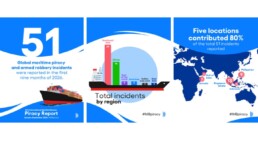
Maritime piracy incidents remain at historic lows despite Somali piracy concerns
The ICC International Maritime Bureau (IMB) has reported the lowest level (51) of piracy and armed robbery incidents since 1992 in the first nine…

Piraeus Port Authority main sponsor of Ferry Shipping Summit 2026
With the participation of more than 200 delegates from several European countries, the Ferry Shipping Summit 2026 took place on 8–9 October 2026 in…

EuroDry announces order for the construction of a third modern 82,000 DWT Kamsarmax Bulk Carrier
EuroDry , an owner and operator of drybulk vessels and provider of seaborne transportation for drybulk cargoes, announced that it has signed a…
India urges Russia, Ukraine to protect Black Sea shipping
India has urged both Russia and Ukraine to ensure safe passage for commercial shipping through the Black Sea as attacks on merchant vessels put…

PD Ports strengthens its commitment to the River Tees with multi-million pound Marine investment
PD Ports has officially opened a new multi-million-pound Marine facility on the banks of the River Tees, reinforcing its long-term commitment to the…

Maritime leaders head to Shanghai for the Annual Summit 2026
Shared seas, shifting horizons Maritime trade stands at a turning point. The rules-based order on which shipping has long depended is under…
Indian Register of Shipping grants type approval to Medha Energy’s 92 kWh LTO Lithium-Ion battery system
Indian Register of Shippinghas successfully completed the Type Approval process for the 92 kWh Lithium-Ion Battery System developed by M/s Medha…

KLine opens a Singapore New Hub for Consolidated Ship Management and Maritime Talenτ
Three Companies, One Roof — Singapore's New Hub for Consolidated Ship Management and Maritime Talenτ A ceremony for around 280 guests sets the stage…
ASA explores measures to Safeguard Free and Safe Navigation at Critical International Maritime Chokepoints
The Asian Shipowners’ Association which accounts for 56% of the world’s fleet capacity and consists of China, Cook Islands, Hong Kong, Japan, Korea…
Subscribe to our newsletter!
if you dont want to swim alone in the ocean of news, sign up for the newsletter, and you will receive daily all the important news of world shipping!
