Zero-emission turbine installation is today’s reality according Ulstein
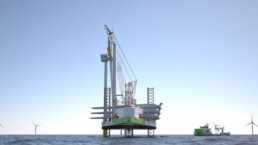

Ulstein’s second hydrogen hybrid design for the offshore wind industry, the ULSTEIN J102 zero emission wind turbine installation vessel (WTIV), can operate 75% of the time in zero emission mode. Using readily available technology, the additional cost is limited to less than 5% of the total CAPEX.
Most new jack-up designs are featuring a battery hybrid system in addition to diesel gen sets, with a future option for hydrogen powered fuel cell system. The downside however of a high-power battery energy storage system (BESS) is its heavy weight and cost. That is not beneficial for a WTIV design, where weight savings are essential for minimizing Elevated Weight and optimising the Variable Deck Load.
Taking the industry from hydrogen prepared to hydrogen powered
Rather than to opt for technology to be matured to perfection and make a design that is prepared for future hydrogen powered fuel cells, Ulstein has taken the pragmatical, yet realistic approach. ‘We have carefully analysed the operational cycle of WTIVs and looked at the power demand in the various modes of operations’, says Ko Stroo, Product Manager at Ulstein. ‘This analysis showed that ca. 75% of its time, a WTIV is in jacked-up position performing crane operations. Using a combination of a hydrogen fuel cell system and a relatively small battery energy storage system (BESS) is then sufficient to meet the overall power demand on board and crane peak loads.’
Attractive business case for turbine installation vessels
‘The same design philosophy as on our first hydrogen powered SX190 design, resulted in a much more attractive business case when applied to a turbine installation vessel’, states Edwin van Leeuwen, managing director of Ulstein’s Rotterdam design office.
The hydrogen hybrid system of the ULSTEIN J102 design has been developed in such a way, that future developments in hydrogen technology can easily be fitted into the vessel without major modifications. ‘The limited availability of hydrogen bunker infrastructure in ports is often seen as a major hurdle. With our modular storage lay-out, we want to break the chicken and egg dilemma’, continues Stroo. ‘It creates flexibility to operate the vessel worldwide, even when bunker infrastructure is not yet present.’
‘The strong focus on renewable energy and emission reduction to meet worldwide climate goals should also be reflected by investments in cleaner operations when installing offshore wind turbines’, says Edwin van Leeuwen. ‘Hydrogen is one of the most promising zero-emission fuels for offshore vessels and we want to be leading in developing sustainable ships.’
Main features of ULSTEIN’s J102 hydrogen-hybrid zero-emission design are:
- CO2 reduction per year: 4,000 mt
- Emission reduction per installation cycle: 25 %
- H2 fuel cell system: PEM fuel cell
- H2 storage system: 7 x 40ft containers compressed H2
- Battery energy storage
Ulstein participates in the UN Global Compact program supporting the UN Sustainability Development Goals (see also https://ulstein.com/about/sustainability).



Related News.

5th CSN Greece ICT Conference, Athens 19th November 2026 “Intelligent Skies, Secure Seas: The AI Impact on ICT” – Save the date
About the Conference The 5th CSN Greece Shipping ICT Conference, titled “Intelligent Skies, Secure Seas: The AI Impact on ICT”, will take place on…
Maritime piracy incidents remain at historic lows despite Somali piracy concerns
The ICC International Maritime Bureau (IMB) has reported the lowest level (51) of piracy and armed robbery incidents since 1992 in the first nine…
Piraeus Port Authority main sponsor of Ferry Shipping Summit 2026
With the participation of more than 200 delegates from several European countries, the Ferry Shipping Summit 2026 took place on 8–9 October 2026 in…
EuroDry announces order for the construction of a third modern 82,000 DWT Kamsarmax Bulk Carrier
EuroDry , an owner and operator of drybulk vessels and provider of seaborne transportation for drybulk cargoes, announced that it has signed a…
India urges Russia, Ukraine to protect Black Sea shipping
India has urged both Russia and Ukraine to ensure safe passage for commercial shipping through the Black Sea as attacks on merchant vessels put…
PD Ports strengthens its commitment to the River Tees with multi-million pound Marine investment
PD Ports has officially opened a new multi-million-pound Marine facility on the banks of the River Tees, reinforcing its long-term commitment to the…
Maritime leaders head to Shanghai for the Annual Summit 2026
Shared seas, shifting horizons Maritime trade stands at a turning point. The rules-based order on which shipping has long depended is under…
Indian Register of Shipping grants type approval to Medha Energy’s 92 kWh LTO Lithium-Ion battery system
Indian Register of Shippinghas successfully completed the Type Approval process for the 92 kWh Lithium-Ion Battery System developed by M/s Medha…
KLine opens a Singapore New Hub for Consolidated Ship Management and Maritime Talenτ
Three Companies, One Roof — Singapore's New Hub for Consolidated Ship Management and Maritime Talenτ A ceremony for around 280 guests sets the stage…
ASA explores measures to Safeguard Free and Safe Navigation at Critical International Maritime Chokepoints
The Asian Shipowners’ Association which accounts for 56% of the world’s fleet capacity and consists of China, Cook Islands, Hong Kong, Japan, Korea…
Subscribe to our newsletter!
if you dont want to swim alone in the ocean of news, sign up for the newsletter, and you will receive daily all the important news of world shipping!
