BIMCO to push for international guidelines for ship/shore communication at IMO

Standardising and harmonising electronic ship/shore communication for reporting purposes is high on the agenda at the International Maritime Organization’s (IMO) virtual Facilitation Committee (FAL) meeting next week (FAL 44).
In 2016, the IMO set out new mandatory requirements on electronic data interchange, stating that national authorities have until April 2021 to establish systems for the electronic exchange of information to assist ship clearance processes.
Many port states have already established such systems (maritime single windows) for the exchange of so-called administrative data. However, also port operational data, like notifications and timestamps, as well as nautical data, are part of such exchange of data, which in combination will pave the way for more efficient port operations.
“The software platforms which link ship and shore communication may differ on national levels, and therefore, we should call for international guidelines for the electronic data interchange, using common standards. This is to ensure that all actors in the port process make use of an identical data structure and common interfaces when exchanging information,” says Jeppe Skovbakke Juhl, Manager, Maritime Safety and Security, adding,
“With more than 95,000 ships operating nationally and internationally between approximately 9,000 ports, globally agreed methods and standards to interact and interface are prerequisites for maritime digitalization to succeed.”
Proposal on the table from BIMCO
For FAL 44, BIMCO has co-authored a proposal (FAL 44/18/2) for developing international guidelines for the electronic interface between ship and shore, and for all actors in the port call operation.
The proposed guidelines will ensure interoperability between port stakeholders and ships and facilitate electronic interaction between ports worldwide. This will optimise the efficiency of both ports and ships, and in turn, benefit the global supply chain.
“Although a bit technical, such guidelines should provide the necessary information on authentication of the users, integrity and confidentiality, but also include technical requirements. This could be service interface descriptions, data structures used by the service(s), dynamic behaviour of the service(s) and sequence of operations. This also covers technical issues like choice of protocols and technology for data exchanges, taking due consideration of international standards developments,” Juhl explains.
“A positive side effect of the COVID-19 pandemic is that we have been forced to re-examine our daily routines in shipping, taking a gigantic leap forward by establishing digital solutions. The IMO framework is a huge step forward for harmonising the machine-to-machine data exchange communication,” Juhl says.
Timing is extremely important to avoid local or regional standards being implemented. Therefore, BIMCO also calls for the establishment of a robust roadmap and time plan for the completion of an electronic information exchange framework in general, allowing all stakeholders to aligning national projects with the IMO progress. The schedule should also include completion of IMO reference data model and guidance.
Source: BIMCO



Related News.
ASA explores measures to Safeguard Free and Safe Navigation at Critical International Maritime Chokepoints
The Asian Shipowners’ Association which accounts for 56% of the world’s fleet capacity and consists of China, Cook Islands, Hong Kong, Japan, Korea…
World’s First Commercial Ship-to-Ship Green Ammonia Bunkering Completed in Zhoushan, Zhejiang, China
On October 13, 2026, the world’s first commercial ship-to-ship bunkering of green ammonia fuel was completed at an anchorage in Zhoushan Port,…
Faster Ballast, Slower Laden: VLCC Supply Signals Diverge
This week’s Tanker Market Monitor examines divergence in VLCC sailing speeds, regional vessel supply, and freight earnings. In the Arabian Gulf,…
AMS Barging christens 9,000 m³ methanol-ready tanker Felicitas as fleet continues to grow
Dutch inland shipping company AMS Barging has christened its new diesel-electric tanker Felicitas at Noordereiland in Rotterdam. Liv and Julie,…

Wärtsilä expands its role in major Brazilian power plant projects to full engineering and construction delivery
Technology group Wärtsilä has broadened its role in seven power plant projects under two contracts for Brazilian energy company Origem Energia,…
Ethanol debut for WinGD as Maersk vessel makes landmark US bunkering and voyage
WinGD has recorded the first in-service operation of its X-DF-M/E alcohol fuel engine platform on ethanol fuel, following a successful bunkering and…

Sweco awarded framework agreements worth SEK 500 million for high-security facilities in Sweden
Sweco has won three framework agreements with property company Specialfastigheter with an estimated combined order value of approximately SEK 500…
Van Oord receives IADC Safety Award 2026 for innovative pipe lifting tool
Van Oord is proud to announce that it has received the International Association of Dredging Companies (IADC) Safety Award 2026 for its…

Keel-laying milestone for Yno 328, a fibre-optic CLV newbuild for OMS
The keel-laying ceremony for the next-generation fibre-optic cable-laying vessel, Ulstein Verft's Yard number 328, was held at the CRIST shipyard in…
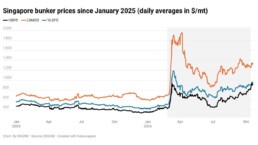
Singapore’s VLSFO and LSMGO prices rise over the weekend, HSFO inches up by ENGINE
Singapore price changes on the day to 12.00 SGT (04.00 GMT) today from Friday: VLSFO price up $21/mt to $930/mt LSMGO price up $37/mt to $1,315/mt…
Subscribe to our newsletter!
if you dont want to swim alone in the ocean of news, sign up for the newsletter, and you will receive daily all the important news of world shipping!
