Faster Ballast, Slower Laden: VLCC Supply Signals Diverge

This week’s Tanker Market Monitor examines divergence in VLCC sailing speeds, regional vessel supply, and freight earnings. In the Arabian Gulf, ballast vessels are accelerating while laden ships are slowing, with no clear improvement in overall voyage turnaround. Meanwhile, the western VLCC ballast surplus has narrowed, in contrast to rising ballast numbers East of Suez. Despite this increase in eastern vessel supply, Gulf VLCC earnings remain exceptionally high, and dirty-tanker freight continues to outperform the clean market by a substantial margin. The findings highlight why faster repositioning and higher ballast counts have yet to translate into meaningful freight relief.
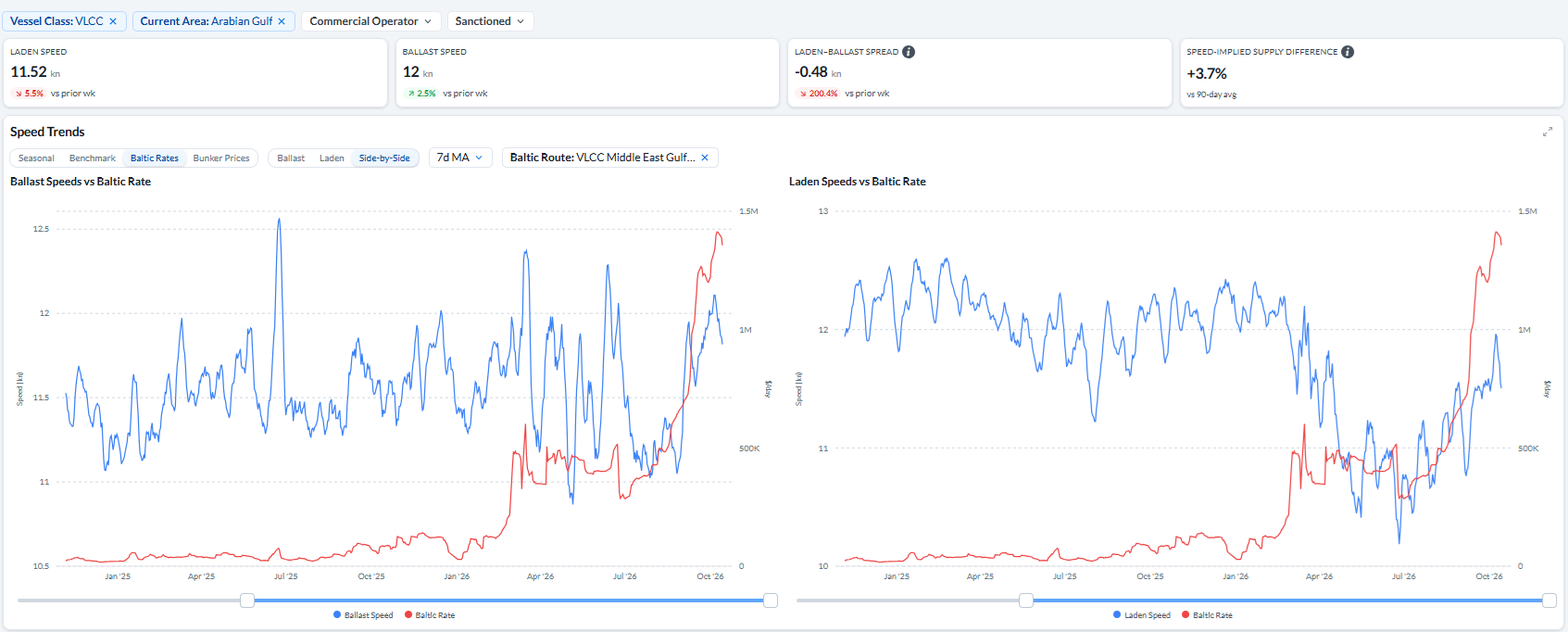
Snapshot of 15 October 2026 with dashboard week-over-week changes; not calendar Week 40–41 averages.
Arabian Gulf VLCC ballast speed reached 12.00 knots, up 2.5% from the previous week, while laden speed declined 5.5% to 11.52 knots, leaving ballast vessels sailing 0.48 knots faster than loaded ships. The current speed-implied supply indicator stood 3.7% above its 90-day average, reflecting faster repositioning rather than an increase in available tonnage. While this may shorten ballast voyages, slower laden sailings, waiting times and cargo transfers continue to affect vessel turnaround, with no clear evidence yet of improved effective VLCC availability.
MARKET SIGNAL: Western VLCC availability tightened, with the ballast surplus down 23.7%, but the combined at-sea balance did not: a larger eastern surplus left it 2.1% higher. Freight performance split sharply by vessel class, with all four assessed Suezmax routes up on the week and all five western Aframax routes down.
Dirty Freight Outpaces Clean Tankers
The Baltic Dirty Tanker Index (BDTI) rose 32% to a Week 41 average of 7,625 points, significantly outpacing the 2% increase in the Baltic Clean Tanker Index (BCTI) to 2,388 points. VLCC freight on the Arabian Gulf–China route (TD3C) also strengthened, averaging WS1,288, up 12% from the previous week. By 14 October, the BDTI stood at 7,922 points, easing from its 13 October peak of 7,999, the highest reading in the supplied 12-month series and almost seven times its level a year earlier. The modest pullback leaves crude tanker freight at historically elevated levels, with little indication of a meaningful reversal in the recent upward trend.
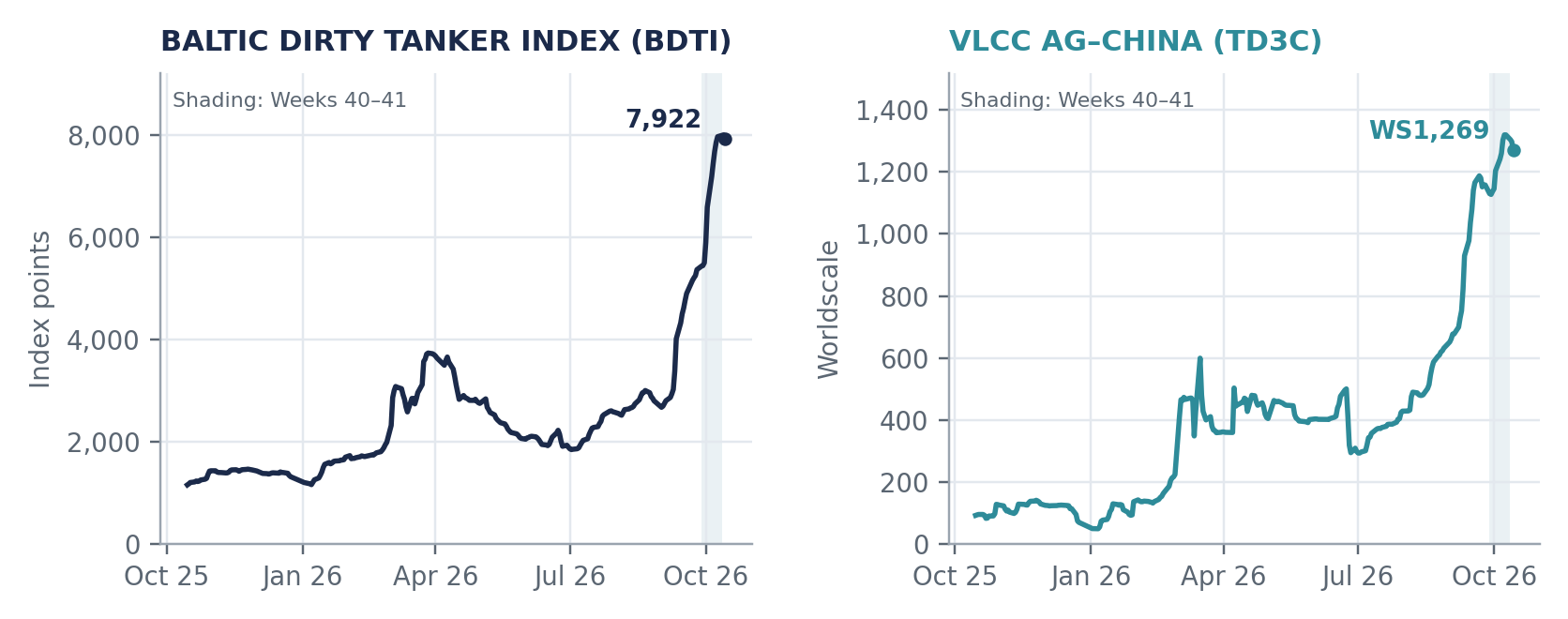
Source: Baltic Exchange assessments via Signal Ocean, data through 14 October 2026.
Baltic index averages: Week 40 vs Week 41

Freight: Gulf VLCC Earnings Lead as Atlantic Aframax Rates Ease
VLCC: In the 15 October snapshot, Gulf routes still carry the highest earnings in the crude basket. MEG–Singapore (TD2) stands at $1,412,730/day, flat on the week, and MEG–China (TD3C) at $1,356,523/day, down 2.8%. AG–China earnings remain 86.0% above West Africa–China (TD15, $729,311/day, -4.0%) and 124.8% above US Gulf–China (TD22, $603,486/day, -2.0%). Over the month, however, the Atlantic routes rose faster: TD22 is up 108.2% and TD15 65.3%, against 31.1% for TD3C.
All four assessed Suezmax routes recorded weekly gains. Black Sea–Mediterranean (TD6) rose 11.7% to $903,854/day, now above MEG–Mediterranean (TD23) at $765,675/day (+1.3%). West Africa–UK Continent (TD20) added 3.1% and Guyana–ARA (TD27) 1.8%.
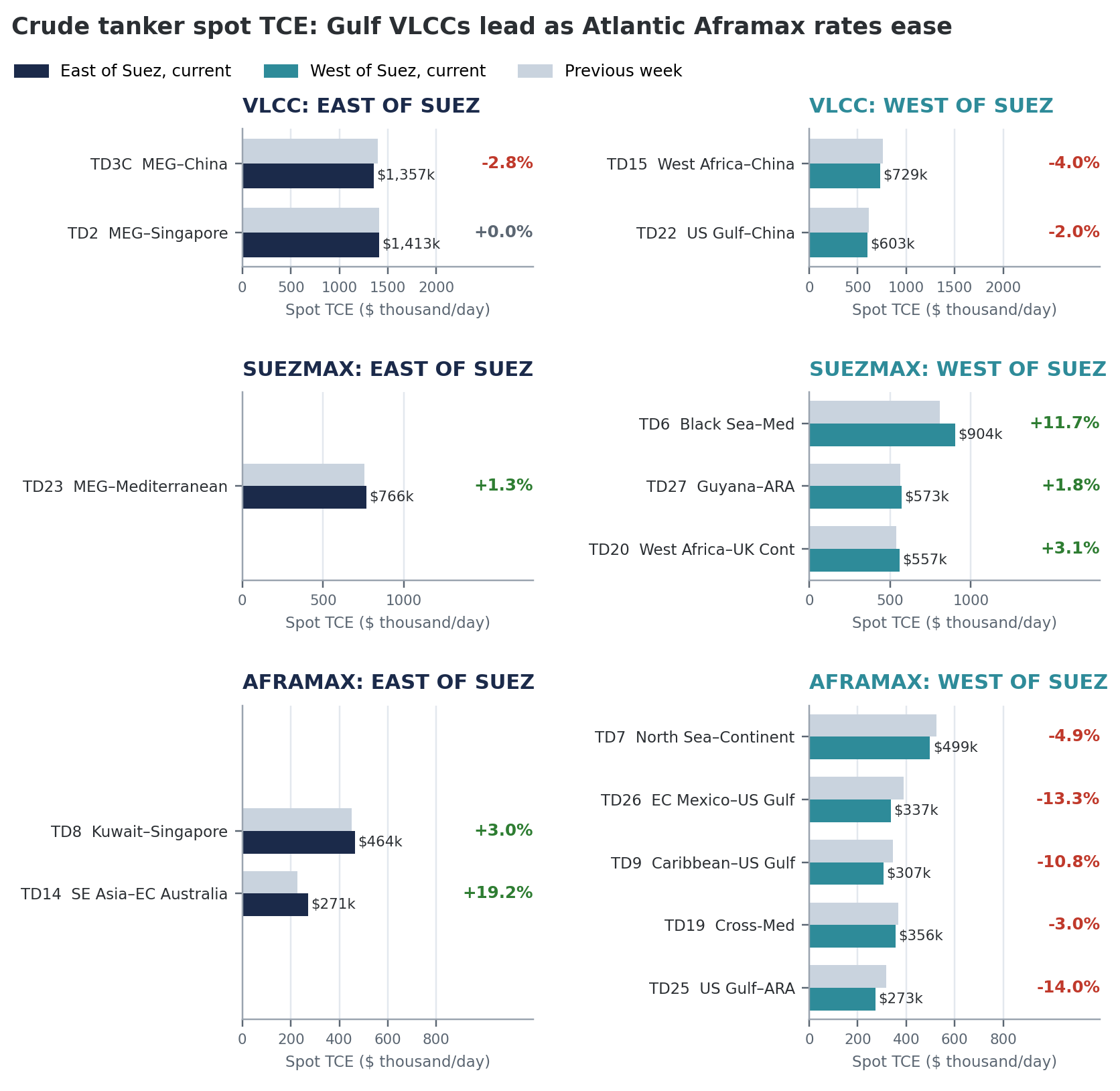
Baltic Exchange TCE assessments via Signal Ocean, snapshot dated 15 October; changes against the dashboard’s prior-week reference.
All five western Aframax routes fell, while both eastern routes increased.US Gulf–ARA (TD25) dropped 14.0% to $273,166/day, East Coast Mexico–US Gulf (TD26) 13.3% to $337,127/day and Caribbean–US Gulf (TD9) 10.8% to $307,313/day.
East of Suez, SE Asia–East Coast Australia (TD14) rose 19.2% to $271,465/day, the largest weekly gain in the basket, and Kuwait–Singapore (TD8) gained 3.0%. In total, nine of the 16 dirty routes declined week on week. All 16 routes remain above their month-earlier levels, with gains ranging from 31.1% to 276.6%.
Spot Rate Summary: dirty TCE, VLCC, Suezmax, Aframax and Panamax


VLCC Supply Tightens West of Suez as Eastern Ballast Numbers Rise
West of Suez, ballast vessels declined 6% to an average of 56, reducing the ballast surplus by 24%, from 8 to 6 vessels. East of Suez, ballast numbers increased 4% to 192, outpacing the rise in laden vessels and lifting the regional surplus by 6% to 49. By 14 October, western laden VLCCs outnumbered ballasters for the first time since mid-August, while eastern ballast numbers continued to rise. The latest figures point to tighter vessel positioning in the Atlantic, against a larger pool of ballast tonnage in the East that has yet to ease exceptional Gulf freight earnings.
VLCCs at sea: Week 40 vs Week 41 averages

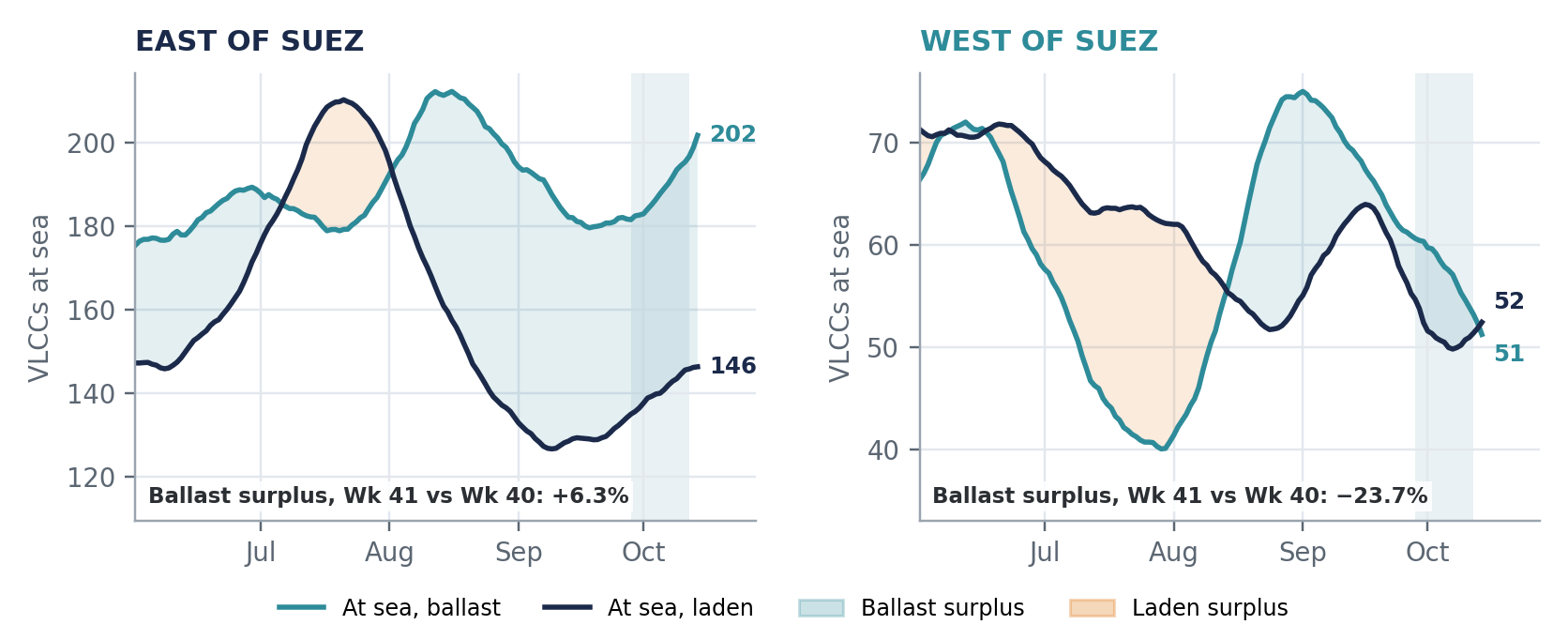
Source: Signal; exported smoothed daily at-sea measures, VLCC 200,000 dwt and above.
Average VLCC counts declined across western regions in Week 41, led by Europe (−26.3%, from 41 to 30), the Atlantic Ocean (−12.8%, from 45 to 39) and the Americas (−9.8%, from 68 to 62). In contrast, counts increased in the Middle East Gulf (+3.8%, from 189 to 196) and Indian Ocean (+6.9%, from 70 to 75). The shift points to a greater concentration of VLCCs in eastern waters, although total vessel counts do not necessarily reflect prompt availability for charter.
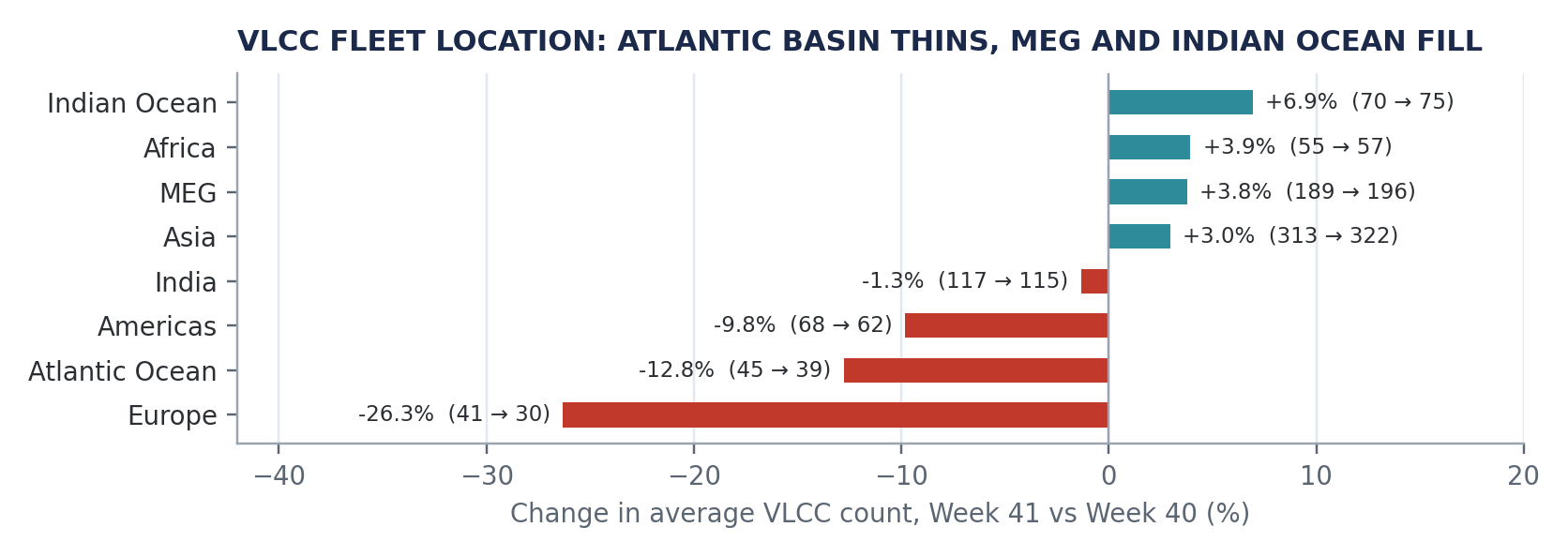
Source: Signal; fleet distribution by zone, VLCC 200,000 dwt and above.
China Congestion Edges Higher but Stays Below Last Year
China’s VLCC waiting count averaged 12 vessels in Week 41, up 14% from the previous week, while vessels at port remained close to seven. The combined average increased 7% to 19 vessels, with the rise concentrated in the waiting queue. Congestion remained below the same week of 2025, when an average of 14 VLCCs were waiting, and 9 were at port. By 14 October, the daily count had eased to 9 waiting vessels, while 8 were at port, pointing to some moderation in the waiting queue.
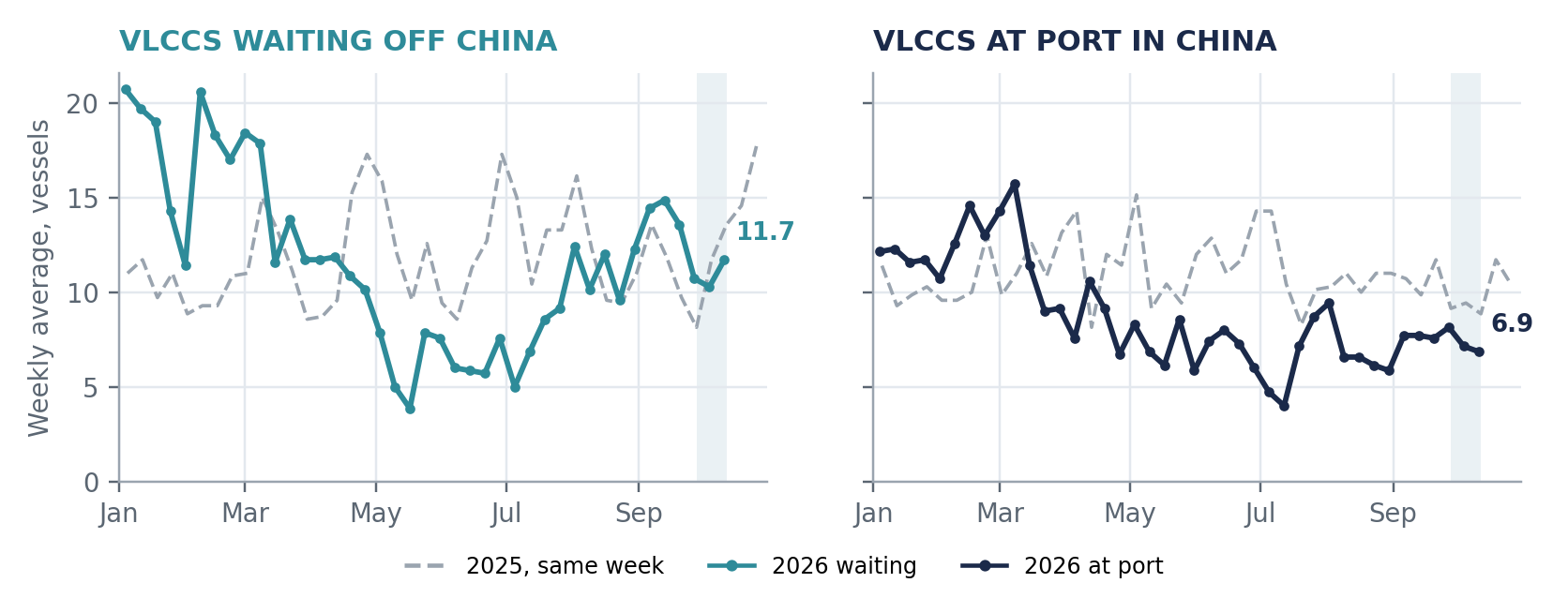
Source: Signal; congestion data through 11 October 2026.
Hormuz Freight Watch: Bunker Supply Tightens as Saudi Delivered Sales Expand
Marine fuel availability remains constrained across key bunkering hubs, while Saudi Arabia expands delivered crude sales to Asian refiners. Renewed attacks in Hormuz continue to complicate vessel deployment and loading arrangements.
Bunker fuel constraints: Marine fuel availability remains tight across several East of Suez locations. In Singapore, recommended lead times have extended to 11–18 days for VLSFO and 11–17 days for HSFO. Fujairah has seen some improvement in VLSFO availability, although HSFO and LSMGO supplies remain limited. Port Suez is also reporting critically low inventories across conventional bunker grades. These constraints add to voyage planning requirements, particularly for vessels operating between the Gulf, Red Sea and Asian discharge ports.
Saudi delivered crude sales: Chinese refiners purchased at least 12 million barrels of Saudi crude for November loading on a delivered basis, with additional sales to India and Taiwan. Buyers’ reluctance to charter vessels for loading inside Hormuz has encouraged Saudi Arabia to arrange transportation directly, while allocations continue through Yanbu and Sidi Kerir. This keeps crude moving but transfers responsibility for securing tanker capacity to the seller.
Hormuz security: UKMTO reported projectile strikes involving a tanker and container ship on 13 October. Singapore’s maritime authority separately confirmed that GFS Pride was struck and subsequently sank, while GFS Giselle sustained damage and reached safe anchorage following an attack on 14 October. These incidents reinforce the continuing uncertainty surrounding Gulf transits.
Source: Signal Ocean



Related News.

ITF joins ISF Verify to help scale trusted digital seafarer certification worldwide
The International Transport Workers’ Federation has joined the ISF Verify project, to support the roll-out to the ITF’s seafarer network -…

Noatum CSM expands regional client base and managed fleet in first year of operations
Noatum CSM has expanded its managed fleet and secured new regional clients during its first year of operations, strengthening its position in the…

New Climate TRACE report quantifies the emissions impact of COP31 climate targets and identifies pathways with the greatest co-benefits
Clean power is a particular force multiplier of COP31 goals, with facility-level analysis showing that pairing smart 35% electrification with new…

INTERCARGO re-elects John A Xylas as Chair and welcomes two new Vice-Chairs
Members meet in Rome as INTERCARGO membership passes 500 INTERCARGO, the International Association of Dry Cargo Shipowners, has re-elected John A.…

IMO’s Marine Environment Protection Committee MEPC 85 to discuss shipping emissions, pollution and other ocean issues
The Marine Environment Protection Committee (MEPC) of the International Maritime Organization (IMO) will meet for its 85th session at IMO…

The Nautical Institute names winner and runners-up in global pilot transfer safety competition
Elliott Steinberg, a student at Wismar University of Applied Sciences in Germany, has won The Nautical Institute’s global student competition on…

Norway’s ‘green battery’ needs faster wind and grid build-out as power surplus narrows, says GlobalData
Norway’s reservoir hydropower makes it the flexible ‘green battery’ of northern Europe and a structural net electricity exporter. However, rising…
Saudi Red Sea Authority introduces ‘Invest with Guidance’ campaign for Maritime Tourism Investors
The Saudi Red Sea Authority has launched the “Invest with Guidance” campaign, which introduces investor guides. It consolidates licensing…

xclusiv S&P Report 16th November 2026
Pls find below the [xclusiv] S&P Report 16th November 2026 [xclusiv] 2026_11_16

Port of Long Beach recognised for outstanding communications
The Port of Long Beach earned four awards from the Los Angeles chapter of the Public Relations Society of America for outstanding communications…
Subscribe to our newsletter!
if you dont want to swim alone in the ocean of news, sign up for the newsletter, and you will receive daily all the important news of world shipping!
