LNG as Marine Fuel – the answer to alternative fuels?
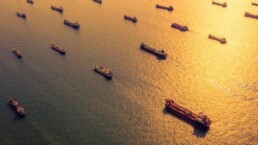

As an alternative marine fuel, Liquefied Natural Gas (LNG) is the most environmental fossil fuel. A decade ago, the use of LNG as vessel fuel was seen as the possible solution to more sustainable shipping practices, though it is now considered more a transition fuel, en-route to using renewable non-fossil fuels when available and at market-acceptable cost.
The attraction of Liquefied Natural Gas as a marine alternative fuel lies in that it does not omit any particles or Sulphur. However, depending on your calculations, the greenhouse gas reduction in most cases is marginal due to methane slip and emissions in handling LNG (the comparative impact of LNG/Methane is 25 times greater than CO2 over a 100-year period). Therefore, the impact of LNG on marine decarbonization is also questionable.
Is LNG as a marine fuel becoming increasingly popular?
Simply put yes:
- LNG Bulk infrastructure is already developed in many ports and matches up well against existing liner trades.
- Of the top 25 global ports ranked by volume of trade, bulk LNG is already available in, or close to, 24 of them.
Importantly nine out of the top 10 bunker ports can already, or plan to by 2021, supply LNG as an alternative marine bunker fuel.

Figure 1 The LNG price at the delivered price is substantially higher than the LNG HUB price
With the current drop in oil price (2020) the price difference between 0.5% LSFO and LNG may not be attractive. However, with a stabilizing oil prices we will most probably see a future price difference where LNG is attractive cost-wise again.
Is it a riskier option though?
The perception by some is that LNG is dangerous. LNG is a highly flammable liquid/gas.

Figure 2 Fire scenarios with an LNG spill
However, the industry have put an array of mitigating measures in place to protect people and assets from the hazards and risks that exist, and so far no significant accident has taken place where LNG was used as the marine fuel.
Equipment such as safety break away couplings are designed to prevent pull-away accidents when bunkering LNG as a marine fuel. These ensure that if the bunker vessel drifts away from the bunkered vessel, that the weak link is de-coupled, the valves will close and the spill will be minimal.
Dry Disconnect Couplings are used to minimize spill when connecting and disconnecting hoses when bunkering LNG.


Figure 3 Break-away coupling Figure 4 Dry disconnect coupling
Other safety measures include ship-shore communication links where safety systems for loading are connected. In their simplest form they allow for an emergency stop on one part, resulting in an emergency stop on the other part as well.
All in all, with the right risk assessment early on and with the right safety measures put in place with a trained crew, the risk levels with LNG as a marine fuel will become acceptable. However, it is not without risks.
So with that in mind:
- When planning for a specific design and scenarios, also look ahead to potential future changes. Ensure in any new design or conversion work that you do not exclude by accident other options for future design, and take into consideration the future lifespan of the vessel.
- There are situations where bunkering with LNG cannot be done due to the type of operation of the ship. Ensure you identify showstopper cases early in the planning and feasibility, so as to avoid future costly delays to the project.
- Compatibility between the LNG fuelled ship and the bunker- ship/truck/terminal is essential for a successful operation.
- If your LNG fuelled ship has an accident, ensure you ask experts for assistance.
How can LOC assist?
- Operational assistance and consultancy
- Marine Accident investigation
- Salvage
- Risk assessment (preconstruction, operational, during accident)
- Terminal layout and operation
- Marine simulations
- Marine Warranty Survey
- Feasibility studies
- Vessel design, upgrade and conversion
Source: by Johan Gahnstrom, LOC London Shipping Operations Director.



Related News.

OL Shipping Group in Tokyo: Capt. Eberhard Koch calls for realistic solutions to Maritime Decarbonisation
An intensive and engaging couple of days in Tokyo brought together leading figures from the international maritime community, providing a valuable…
Regatta for Peace one of the largest ever in Cyprus
Cyprus will host the first European stop on a global sailing journey leading up to the 2027 America’s Cup in Naples. More than 120 sailors…
The propulsion technology powering the marine energy transition
The marine industry is under increasing pressure to future-proof fleets, balancing the need to reduce emissions and improve efficiency. Propulsion…
Signal Ocean acquires Lgmar
Signal Ocean announced the acquisition of Lgmar, the Athens-based company behind Telix, a maritime email and communication platform in daily use…

Canada clean power push challenged by interprovincial grid limits, says GlobalData
Canada is entering a pivotal phase of power-sector expansion as federal tax credits, the phase-out of coal-fired generation, and accelerating…

Maritime safety depends on human factors and leadership, not procedures alone
Interim survey findings point to a gap between seafarers’ perceptions of risk and injury data Seafarers may misjudge when and where they are most at…

New BIMCO contracts tackle ship recycling and energy-saving retrofits
BIMCO adopted two new contractual solutions designed to help you manage important operational and regulatory challenges: the revised…
Stena Line to acquire vessel and make changes to its network
Stena Line has reached an agreement to acquire the RoRo vessel Somerset from CLdN. Subject to closure and transfer, the vessel would begin operating…

DORIC WEEKLY INSIGHT 16 OCTOBER 2026
Please find below the DORIC Market Insight for the week ending 16th October 2026. Weekly Report 16.10.2026

Important information for port clients and freight carriers effective November 1, a new traffic overpass and port checkpoint will open for traffic to the Port of Riga on Kundziņsala
Starting November 1 of this year, a new traffic overpass connecting Tvaika Street to Kundziņsala will open to facilitate traffic to and from the Port…
Subscribe to our newsletter!
if you dont want to swim alone in the ocean of news, sign up for the newsletter, and you will receive daily all the important news of world shipping!
