Don’t sail faster, sail better
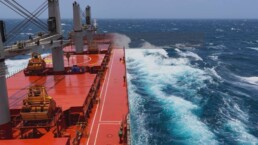

Now we know for certain that not all risks are created equal, the shipping industry faces a fundamental question; how does it make the necessary changes to be sustainable and profitable in a fundamentally changed world?
The answer is (at least) twofold since new ships will be able to progressively adopt efficiency focussed technologies and new fuels, while the existing fleet has a far greater challenge.
In particular, the EEXI concept (essentially applying the EEDI phase 2 standard to existing ships) submitted to IMO and already gaining support, could create a significant gap between those existing vessels which are able to comply and be competitive and those which are forced out of the market.
In any event, the industry that emerges over the next decade will have to accept that it cannot act simply for short term motivations but instead for longer term goals. It’s a big ask, but to survive in a form that any current practitioner would recognise requires a refocusing of priorities.
Most obviously, the concept of just in time (JIT) shipping is one of the most promising solutions to emissions reductions and greater efficiency. But despite its quantified benefits – advocates contend that it would lessen impact on the environment and reduce costs – the multiple operational and contractual barriers to overcome mean it has yet to be widely adopted by shipping or port sectors.
But achieving JIT also requires the vessel to adopt optimised ship routing to reduce time spent waiting for berths or cargo and maximize utilization of ports while reducing costs. This requires adapting the freight contract to allow the ship to reduce its speed on passage to meet the scheduled arrival time.
A full implementation of JIT sailing implies a commitment between ships and ports, and the related actors (shipping companies, cargo owners, port authorities, terminal operators and nautical service providers). The ship must adhere to estimated times of arrival and the port must ensure that the resources for the ship berth are available at that time.
Ship operators face problems such as the nondisclosure of information related to the vessel’s construction or its engine performance that would improve the accuracy of estimations and any efforts to calculate and optimize the associated fuel consumption or GHG emissions.
Without this information, mathematical modelling or the creation of ‘digital twins’ — virtual replicas of physical assets, processes and systems — for ships can be a challenge, thus complicating the task of providing an accurate ETA.
For some types of vessels such as tankers and bulk carriers, contracts may be breached by reducing speed, which renders JIT arrivals impossible. Co-operation with charterers and a joint commitment to reducing GHG emissions is a prerequisite to this process.
The barriers to JIT at ports are equally numerous. Few ports have adequate management systems to estimate the resources (eg: pilots, tugs or mooring) that will be available beyond a 24-48-hour horizon. A standardization of the format for the information is required for automation and further optimization to be possible.
Even so, the application of just in time and optimised shipping are two effective operational measures that can contribute significantly to the reduction of fuel consumption and carbon emissions. Such operational measures, combined with progressively lower carbon and ultimately zero-carbon fuels and efficiency technology can generate cost-effective solutions that could help vessels to meet the IMO’s decarbonization targets.
In this new environment, shipping companies that are able to make the required technology investment – or form alliances with technology partners – are likely to reap significant competitive advantage as well as improved customer relationships.
The shipping ecosystem already generates an immense amount of valuable information that is still mostly not being captured. With the increasing amount of data that will become available as shipping becomes more instrumented, interconnected and intelligent, more powerful processing, machine learning algorithms and analytics have the potential to create huge leaps forward in safety, efficiency and environmental performance.
As this data is captured, onshore teams who used to wait for irregular updates on vessel information, could make use of increasing visibility to monitor situations in real-time and improve the day to day management of their vessels, from decision-support and compliance management to incident management.
The same data and analytics can be used to make increasingly accurate predictions. Voyager Worldwide can already apply historical trading data to predict future navigation requirements with impressive levels of accuracy. Predictions are set to become increasingly advanced and accurate. And, with better predictions, comes better (and more actionable) data to help everyone from the ship’s master to superintendents, operations centres, ports and regulators, bringing the industry one step closer to smarter shipping.
Perhaps more than anything, digital data and technology have the potential to help make new levels of openness possible – putting the shipping companies that embrace them in a strong position to achieve commercial advantage in a highly competitive market.
Combine that transparency with a greater degree of predictability and a higher degree of collaboration and the foundations of just in time, optimised shipping are in place. Ultimately the barriers will fall if enough participants begin to demand a better way of working.
It is possible that we will move sooner and faster towards a two-tier market predicated not just on market knowledge but performance and preferential relationships; the COVID equivalent of sailing straight to your berth while other who have missed their slot sit at anchor.
Do that and it might enable shipping to crack the oldest problem of all, how to sail smarter, not just faster.



Related News.

OL Shipping Group in Tokyo: Capt. Eberhard Koch calls for realistic solutions to Maritime Decarbonisation
An intensive and engaging couple of days in Tokyo brought together leading figures from the international maritime community, providing a valuable…

Regatta for Peace one of the largest ever in Cyprus
Cyprus will host the first European stop on a global sailing journey leading up to the 2027 America’s Cup in Naples. More than 120 sailors…
The propulsion technology powering the marine energy transition
The marine industry is under increasing pressure to future-proof fleets, balancing the need to reduce emissions and improve efficiency. Propulsion…

Signal Ocean acquires Lgmar
Signal Ocean announced the acquisition of Lgmar, the Athens-based company behind Telix, a maritime email and communication platform in daily use…

Canada clean power push challenged by interprovincial grid limits, says GlobalData
Canada is entering a pivotal phase of power-sector expansion as federal tax credits, the phase-out of coal-fired generation, and accelerating…

Maritime safety depends on human factors and leadership, not procedures alone
Interim survey findings point to a gap between seafarers’ perceptions of risk and injury data Seafarers may misjudge when and where they are most at…

New BIMCO contracts tackle ship recycling and energy-saving retrofits
BIMCO adopted two new contractual solutions designed to help you manage important operational and regulatory challenges: the revised…
Stena Line to acquire vessel and make changes to its network
Stena Line has reached an agreement to acquire the RoRo vessel Somerset from CLdN. Subject to closure and transfer, the vessel would begin operating…

DORIC WEEKLY INSIGHT 16 OCTOBER 2026
Please find below the DORIC Market Insight for the week ending 16th October 2026. Weekly Report 16.10.2026

Important information for port clients and freight carriers effective November 1, a new traffic overpass and port checkpoint will open for traffic to the Port of Riga on Kundziņsala
Starting November 1 of this year, a new traffic overpass connecting Tvaika Street to Kundziņsala will open to facilitate traffic to and from the Port…
Subscribe to our newsletter!
if you dont want to swim alone in the ocean of news, sign up for the newsletter, and you will receive daily all the important news of world shipping!
