Lebanon: At Least 78 Killed As Huge Explosion Rocks Beirut
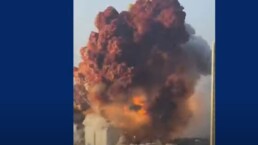

Two huge explosions have rocked Beirut, killing at least 78 people, injuring thousands more, and sending an enormous blast wave across the city that shattered windows, knocked down doors and shook buildings.
Lebanon’s prime minister, Hassan Diab, said the main blast at Beirut’s port was caused when an estimated 2,750 tons of ammonium nitrate had been ignited. He said the chemical had been left unsecured for six years in a warehouse, and vowed to punish those responsible.
As the death toll climbed on the discovery of more bodies in the wreckage, at least 4,000 were reported injured. Hundreds of homes were left uninhabitable by the blast which also destroyed huge grain silos, a devastating blow to a country where bread was already scarce and which is dependent on imports by sea.
The US Embassy in Beirut released a statement advising that people wear masks and stay indoors, following “reports of toxic gases released in the explosion”.
The American University of Aerosol Research Lab’s indicators showed that air quality levels had returned to “Good” by 7pm on Tuesday, however, after showing “Moderate” levels of particulate matter an hour earlier.
Thousands of people sought treatment in nearby hospitals, which were struggling to cope with the casualties. Cars were left strewn across the surrounding highway, and the blast was heard up to 80km (50 miles) away in the country’s north. The health minister, Hamad Hassan, put the confirmed death toll at 78, with at least 4,000 injured.
“God help us from all these catastrophes,” said Mamdouh, 25, a caterer who lost his job in June. “If this was an accident, as they’re saying, it’s the worst you could ever imagine. This was like a nuclear bomb. What have we done to deserve this?”
On Tuesday night Lebanon’s Supreme Defence Council recommended declaring Beirut a disaster-stricken city, declaring a two-week state of emergency in the capital and handing over security responsibility to military authorities.
Donald Trump fuelled the confusion swirling in the hours following the explosion, by referring to it in on-the-cuff remarks as “an attack” which took place at 6.05pm (16.05 BST), adding that “some of our great generals” had told him “it was a bomb of some kind”. Two US officials, speaking on the condition of anonymity, said it was unclear where Trump was receiving his information but that initial information did not appear to show that the explosion was an attack.
Israel has denied any responsibility and offered humanitarian and medical aid.
Initial reports suggested that a fireworks warehouse was involved. The Lebanese security chief, Abbas Ibrahim, later blamed combustible chemicals stored in a warehouse. The interior minister, Mohammed Fahmi, said ammonium nitrate had been among the materials stored and called for an investigation into how it ignited.
“Talk of fireworks is ridiculous,” said Ibrahim. “There are no fireworks but rather highly explosive material, and I can’t foretell the investigations … it seems the explosion happened in a warehouse of highly explosive material that was confiscated years ago.”
So powerful was the force of the blast that it even rattled buildings in west and south Beirut. It happened three days before the verdict is due in an international tribunal trial of four men accused of blowing up a former Lebanese prime minister 15 years ago.
Any link to the tribunal result was quickly downplayed. Meanwhile, the Israeli government said its forces had not carried out an attack. “Israel has nothing to do with the incident,” an Israeli security official told Reuters on condition of anonymity. Israel’s foreign minister, Gabi Ashkenazi, told Israeli N12 television news that the explosion was most likely an accident caused by a fire.
The Beirut port is known to be used by the militant group cum political bloc Hezbollah, which denied any of its facilities had been hit.
Firefighters work near the scene of the explosion. Photograph: Ibrahim Dirani/EPA
The final death toll from the biggest explosion to ever rock Beirut is expected to be significantly higher than the figures given in its immediate aftermath.
Georges Kettaneh, a Lebanese Red Cross official, said more deaths were expected when rescue teams combed through damaged buildings.
A doctor at St George’s hospital, less than 2km (1.2 miles) from the blast, said injured people were being brought for treatment but the hospital had been destroyed. “They’re bringing people to the hospital but we can’t receive them,” he said. “They’re treating them outside in the street. The hospital is broken, the ER is broken.”
Videos shot by bystanders and posted on social media showed a smaller explosion with mini blasts rippling through a warehouse, followed by an enormous secondary blast, which lifted cars from a nearby highway and ravaged a nearby overpass. There was devastating damage at the port and in nearby entertainment areas.
The destruction comes as Lebanon is grappling with an economic crisis that has slashed incomes and jobs and led to soaring nationwide poverty, and also amid rising tensions between Israel and Hezbollah along Lebanon’s southern border.
Lebanon’s economy minister, Raoul Nehme, told local media on Tuesday that the wheat in Beirut’s port granaries was no longer usable, and that the ministry lost track of seven employees at the granaries. Nehme insisted that the country had enough wheat to last until new imports could be arranged.
The impact of the blastwas felt 200km (120 miles) away in Cyprus. “Everyone in Cyprus felt it,” said George, a resident of Larnaca. “The door was shaking in my house.”
The United Nations reported that 48 of its staff in Beirut, 27 of their family members and three visitors were among the wounded.
The office of the Daily Star newspaper, about a kilometre from the blast, was among the buildings to sustain damage from the explosion. Another newspaper, An-Nahar, which has headquarters opposite the port, said 15 of its staff were in hospital.
Inside the port, buildings were reduced to shells, with shipping containers flung around the scene and several fires raging.
One woman covered in blood from the waist up walked down a ruined street, while on another street, a woman with a bloodied face staggered through traffic with two friends at her side.
“This country is cursed,” a young man passing by said.
The British Prime Minister has confirmed that UK nationals were among those caught up in the aftermath of the explosions. All staff at the British embassy in Beirut had been accounted for, but some have sustained “non-life-threatening injuries”, Boris Johnson said.
Source: Guardian



Related News.

Navigating the Multi-Orbit Era: In Conversation with Intellian’s Jon Harrison at SMM 2026
At SMM 2026 in Hamburg, the rapid evolution of maritime satellite communications took centre stage. Across the exhibition halls, discussions among…
Cyprus ports need joint energy and investment strategy, shipping agents chief says
Cyprus needs a coordinated strategy for shipping, energy and environmental protection to support port investment and modernisation, Cyprus shipping…

MASO Public Affairs introduces MASO Regulatory Intelligence
A new subscription service helping businesses understand what is changing and what it means for them MASO Public Affairs introduces MASO Regulatory…
Anglo-Eastern helps turn CMBTECH’s ammonia ambition into an operational reality
From early feasibility study and risk-based design to newbuilding supervision, crew readiness and technical management, Anglo-Eastern drew on its…

Escalation of attacks threatens to derail recovery in Middle East oil exports
World oil demand is forecast to fall by 2.5 mb/d y-o-y in 4Q26 and 2.6 mb/d on average in 2026. As the Iran war manifests itself through restricted…
New study finds shipping pays twice its share to EU ETS earmarked revenues should triple to help build market for sustainable fuels and technologies
Shipping is responsible for around 10% of EU ETS emissions but pays almost 20% of the ETS bill. Unlike other sectors, it has never received free…
MSARC strengthens maritime mass rescue readiness through training and national live exercise off Dakar, Senegal
Joint MSARC–FHAS programme combines three days of SAR training with a national multi-agency live exercise The Maritime Search and Rescue Council ,…
Sogese report deliveries are still being delayed as container freight rates fluctuate
FOR IMPORTERS Spot rates into the Mediterranean are back at January levels, Far East to Europe reliability sits at pandemic lows, and nearly…
Glencore begins trading on Australian Securities Exchange
Glencore has begun trading on the Australian Securities Exchange under the ASX code GLC. Gary Nagle, Glencore’s CEO, said it was an exciting day for…
BIMCO Shipping Number of the Week
Suez Canal container ship transits exceed 50% of pre-disruption levels "During the first two weeks of October, weekly container ship capacity…
Subscribe to our newsletter!
if you dont want to swim alone in the ocean of news, sign up for the newsletter, and you will receive daily all the important news of world shipping!
