HISPASAT Promotes the Role of Satellites in the 5G Ecosystem


5G: a network of networks that needs satellites
Since the outset, 5G has been defined as a network of networks, the result of the alignment of different technologies towards a convergent scenario. Whilst previous generations (2G, 3G, 4G) were focused solely on connecting people, 5G aims to connect objects and people wherever they may be at all times, both with other people and with other objects. To achieve this ambitious goal efficiently, a combined use of different fixed, terrestrial and satellite technologies will be needed. Each of those will integrate with the others to give the most appropriate response to the coverage and capacity requirements of this new technology at any time and under any circumstances. The 5G infrastructure, therefore, has to be a well-organised ecosystem – a network of networks made up of complementary layers based on the strengths of each technology, including satellite technology. Only in this way will a global and viable commercial development of this new standard be guaranteed.
Hence satellites are called to play an important role in different 5G technology use cases. Since a few years ago, high-throughput satellites (HTS) have notably increased its capacity. Also, thanks to innovation, we are seeing significant improvements in the cost and efficiency of user equipment, both with network platforms and terminals.
All this has an impact on the fact that communications satellites have optimised their competitive advantages and offer 5G networks key characteristics to allow for their rapid implementation. Thus, their global coverage allows high capacity services to be supplied anywhere on Earth, no matter how remote – their robustness guarantees connectivity that is even resistant to natural disasters. They make it possible to distribute data or audiovisual content to many users at the same time in a highly efficient manner. In addition, the installation them is a very quick process and does not require civil works, meaning that it allows for the 5G network to be extended to tricky or distant areas in a much shorter time.
Thanks to this, satellites can contribute to the rollout of 5G in several use cases: extending coverage in rural or hard to reach areas; ensuring that passengers on planes, ships and vehicles on land have connectivity; via the broadcast of data towards the network’s nodes or even to users’ own terminals, promoting with this the development of Edge Computing solutions; establishing trunk links on mobile networks to connect remote 5G base stations; acting as a complement to terrestrial networks to prevent them from becoming congested or to guarantee continuity in emergency situations; and connecting objects globally and in isolated areas using satellite IoT solutions.
In essence, the function that HISPASAT and other satellite operators can fulfil in 3GPP working groups is particularly important to achieve the most efficient 5G ecosystem possible. “We have to ensure that every 5G application is working on the most appropriate technological platform in terms of technical requirements and cost efficiency for each situation. Otherwise, it would cause an unnecessary increase in financial resources and in the complexity of the architecture”, states José Luis Serrano, Head of Innovation at HISPASAT. “In the satellite sector we have been working for years on various fronts to offer an optimal solution for any user at any location. Fully integrating satellites into the 5G ecosystem is already one of our main lines of innovation, and we believe that it will be key for 5G technology to achieve its objectives”, Serrano concludes.
HISPASAT, Red Eléctrica Group’s communications satellite operator, is a world leader in content distribution in Spanish and Portuguese speaking countries and its satellite fleet is used by important direct-to-home television (DTH) and high-definition television (HDTV) digital platforms. HISPASAT also provides satellite broadband and connectivity services, which include broadband access, mobility and backhaul networks, in addition to other added value solutions for governments, companies and telecommunication operators in America, Europe and North Africa. HISPASAT –which is comprised of companies that have a presence in Spain as well as in Latin America, where its Brazilian affiliate HISPAMAR is based– is one of the world’s largest companies in its sector in terms of revenue, and the main communications bridge between Europe and the Americas.



Related News.

Navigating the Multi-Orbit Era: In Conversation with Intellian’s Jon Harrison at SMM 2026
At SMM 2026 in Hamburg, the rapid evolution of maritime satellite communications took centre stage. Across the exhibition halls, discussions among…
Cyprus ports need joint energy and investment strategy, shipping agents chief says
Cyprus needs a coordinated strategy for shipping, energy and environmental protection to support port investment and modernisation, Cyprus shipping…

MASO Public Affairs introduces MASO Regulatory Intelligence
A new subscription service helping businesses understand what is changing and what it means for them MASO Public Affairs introduces MASO Regulatory…

Anglo-Eastern helps turn CMBTECH’s ammonia ambition into an operational reality
From early feasibility study and risk-based design to newbuilding supervision, crew readiness and technical management, Anglo-Eastern drew on its…

Escalation of attacks threatens to derail recovery in Middle East oil exports
World oil demand is forecast to fall by 2.5 mb/d y-o-y in 4Q26 and 2.6 mb/d on average in 2026. As the Iran war manifests itself through restricted…

New study finds shipping pays twice its share to EU ETS earmarked revenues should triple to help build market for sustainable fuels and technologies
Shipping is responsible for around 10% of EU ETS emissions but pays almost 20% of the ETS bill. Unlike other sectors, it has never received free…
MSARC strengthens maritime mass rescue readiness through training and national live exercise off Dakar, Senegal
Joint MSARC–FHAS programme combines three days of SAR training with a national multi-agency live exercise The Maritime Search and Rescue Council ,…

Sogese report deliveries are still being delayed as container freight rates fluctuate
FOR IMPORTERS Spot rates into the Mediterranean are back at January levels, Far East to Europe reliability sits at pandemic lows, and nearly…

Glencore begins trading on Australian Securities Exchange
Glencore has begun trading on the Australian Securities Exchange under the ASX code GLC. Gary Nagle, Glencore’s CEO, said it was an exciting day for…
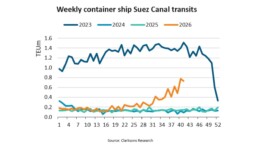
BIMCO Shipping Number of the Week
Suez Canal container ship transits exceed 50% of pre-disruption levels "During the first two weeks of October, weekly container ship capacity…
Subscribe to our newsletter!
if you dont want to swim alone in the ocean of news, sign up for the newsletter, and you will receive daily all the important news of world shipping!
