Crew Changes during Covid-19- “Shame on port states”
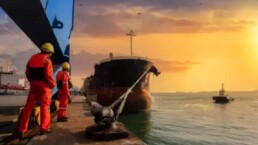

In the following article, ‘Shame on port states’ in the July 2020 edition of the Maritime Reporter & Engineering News, the author, Dennis L. Bryant of Bryant’s Maritime Consulting, adds his voice to the maritime industry’s pleas to port states to implement without further delay the recommended framework of protocols for ensuring safe ship crew changes and travel during the pandemic which were proposed by a broad cross section of global industry associations and which have been endorsed by the IMO (see IMO Briefing 15 07/05/2020).
Shame on port states
By Dennis L. Bryant
Port states benefit greatly from the vessels that call at their ports, loading and unloading
cargoes with great efficiency and speed. The items manufactured in those states and sold
overseas keep many of their citizens gainfully employed. The items imported supply stock for the stores of their nation and provide goods for their citizens. The physical ports utilized by the vessels are employment magnets, attracting a diverse array of industries.
Yet, when the COVID-19 pandemic struck, those port states took swift actions against
the very vessels that keep their economies in operation. They did this, not by preventing the vessels from loading and unloading cargoes, but by banning crew changes. Thus, their
economies have not suffered any immediate harm. The harm has been suffered by the thousands of seafarers doomed to sail on voyages of indeterminate length. This harms the seafarers’ physical and mental health and adversely impacts their families back home.
The United States recently issued an onerous set of requirements for repatriation of
foreign seafarers on cruise ships idled in US waters. The process of gaining approval for
repatriation is complex, paperwork-intensive, and expensive. Insofar as I can determine, only a handful of seafarers have been repatriated through this process. But at least the United States has done something.
Most other nations have done next to nothing. The United Kingdom’s Maritime and
Coastguard Agency (MCA) recently detained five cruise ships idling in its waters for failure to complete timely inspections and to fully comply with Maritime Labour Convention
requirements. Surveyors also found a number of expired and invalid Seafarers Employment Agreements, late payment of wages, and seafarers who have been on board for over twelve months. The repatriation efforts have allegedly been frustrated by shifting Indian government policy regarding its permission for return of Indian seafarers. It is no wonder that some cruise lines have found it less burdensome to sail some of their vessels to ports of the nations of its crews and return them directly to homes.
While the press has devoted a fair amount of time reporting on the plight of seafarers on
idled cruise ships, few are discussing the greater problem of seafarers on cargo vessels.
Thousands of these seafarers are stuck in a form of indentured servitude on their ships, unable to get replacements and return home. They continue to make ports calls, loading and unloading cargoes, loading food and other necessaries, and discharging waste – but they are not allowed to go ashore. The only people that come aboard are pilots, the occasional port state inspector or surveyor, and necessary longshoremen handling cargo. Everyone maintains social distancing and many wear masks. There are no handshakes.
It could be argued that these seafarers are involuntarily being isolated from the ravages of COVID-19. They do not associate with others for weeks and sometimes months at a time. Yet, few of these seafarers have contracted COVID-19.
The toll, though, is the grind of the unending work without break. It imposes physical
and mental punishments on the seafarers. As they endure this routine, their ability to safely and thoroughly perform their important tasks decreases. This puts their ships and the environment at risk.
Singapore recognizes these risks and has approved over 24,000 crew change requests as
of mid-June. Unfortunately, it is the exception. Unless other port states recognize their
responsibility, as pointed out by the IMO and other international agencies, as well as by maritime labor unions, the dangers to these seafarers, their ships, and the international economy will continue to grow. Shame on the port states for allowing this avoidable situation to come into existence and then fester for months.
Source: UK P&I



Related News.

OL Shipping Group in Tokyo: Capt. Eberhard Koch calls for realistic solutions to Maritime Decarbonisation
An intensive and engaging couple of days in Tokyo brought together leading figures from the international maritime community, providing a valuable…

Regatta for Peace one of the largest ever in Cyprus
Cyprus will host the first European stop on a global sailing journey leading up to the 2027 America’s Cup in Naples. More than 120 sailors…
The propulsion technology powering the marine energy transition
The marine industry is under increasing pressure to future-proof fleets, balancing the need to reduce emissions and improve efficiency. Propulsion…

Signal Ocean acquires Lgmar
Signal Ocean announced the acquisition of Lgmar, the Athens-based company behind Telix, a maritime email and communication platform in daily use…

Canada clean power push challenged by interprovincial grid limits, says GlobalData
Canada is entering a pivotal phase of power-sector expansion as federal tax credits, the phase-out of coal-fired generation, and accelerating…

Maritime safety depends on human factors and leadership, not procedures alone
Interim survey findings point to a gap between seafarers’ perceptions of risk and injury data Seafarers may misjudge when and where they are most at…

New BIMCO contracts tackle ship recycling and energy-saving retrofits
BIMCO adopted two new contractual solutions designed to help you manage important operational and regulatory challenges: the revised…
Stena Line to acquire vessel and make changes to its network
Stena Line has reached an agreement to acquire the RoRo vessel Somerset from CLdN. Subject to closure and transfer, the vessel would begin operating…

DORIC WEEKLY INSIGHT 16 OCTOBER 2026
Please find below the DORIC Market Insight for the week ending 16th October 2026. Weekly Report 16.10.2026
Important information for port clients and freight carriers effective November 1, a new traffic overpass and port checkpoint will open for traffic to the Port of Riga on Kundziņsala
Starting November 1 of this year, a new traffic overpass connecting Tvaika Street to Kundziņsala will open to facilitate traffic to and from the Port…
Subscribe to our newsletter!
if you dont want to swim alone in the ocean of news, sign up for the newsletter, and you will receive daily all the important news of world shipping!
