Nine companies have started “Ship Carbon Recycling WG” of Japan’s CCR Study Group

– Cross-industry initiatives for zero-emission ship fuels through methanation technology –
Japanese nine companies (Note 1) have started the Ship Carbon Recycling Working Group (hereinafter referred to as “WG”) formed within Japan’s Carbon Capture & Reuse (CCR) Study Group (Note 2),and held its first meeting. Participating members are EX Research Institute Ltd., Hitachi Zosen Corporation, Japan Marine United Corporation, JFE Steel Corporation, JGC Corporation, Mitsui O.S.K. Lines, Ltd., Nippon Kaiji Kyokai(ClassNK), Nippon Steel Corporation, and Sanoyas Shipbuilding Corporation.
As the effects of climate change become apparent, carbon recycling, a method used to capture and reuse emitted carbon dioxide (CO2), is attracting attention as one of the paths to a decarbonized society.
Formed within the CCR Study Group in August 2019, the WG aims to explore the feasibility of the concept of utilizing methanation technology (Note 3) for zero-emission ship fuels (Note 4). Through its activities, the WG aims to reduce greenhouse gas emissions to zero in sea transportation, which accounts for 99.6% of Japanese imports and exports, and thereby contribute to the formation of a sustainable society. Specifically, the nine companies listed above plan to assume carbon recycling supply chain of methanation fuel that involves the supply of feedstock CO2, transportation of the feedstock, methanation, and conversion into marine fuel. They will calculate the estimated amount of CO2 emissions in the supply chain, and based on these results, identify technical challenges and develop a roadmap for its realization.
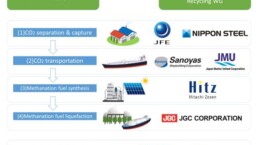
The first stage of activities involves: (1) Separation, capture and liquefaction of CO2 emitted from steelworks (2) Transportation of liquefied CO2 by ship to a hydrogen supply site (3) Generation of synthetic methane from CO2 and hydrogen by methanation reaction, and (4) Liquefaction of the synthetic methane and using it as marine fuel (Figure 1). In addition to obtaining an approximate value of CO2 emissions in this assumed supply chain, the group will also identify challenges and decide whether to proceed with subsequent next-stage activities along with the content of those activities. The acquired knowledge will also be widely disclosed in and out of the industry.
(Note 1)
| EX Research Institute Ltd. | Hiroshi Naito
President |
| Hitachi Zosen Corporation | Sadao Mino
President & Chief Operating Officer |
| Japan Marine United Corporation | Kotaro Chiba
President and CEO |
| JFE Steel Corporation | Yoshihisa Kitano
President and CEO |
| JGC Corporation | Yutaka Yamazaki
Representative Director, President |
| Mitsui O.S.K. Lines, Ltd.
(WG coordinator) |
Junichiro Ikeda
President & CEO |
| Nippon Kaiji Kyokai(ClassNK)
(WG secretariat) |
Hiroaki Sakashita
President & CEO |
| Nippon Steel Corporation | Eiji Hashimoto
President |
| Sanoyas Shipbuilding Corporation. | Takashi Ueda
President & CEO |
(Note 2) The CCR Study Group was established with the objectives of proposing effective carbon neutral measures to reduce the use of fossil fuels by offering alternative energies such as synthetic methane, which is generated by combining CO2 generated by industries with renewable energy-derived hydrogen, and contributing to the establishment of a new energy supply system by 2050.
(Note 3) Methanation is a technology for synthesizing methane, the main component in natural gas, by causing a chemical reaction between hydrogen and CO2 in a reactor vessel filled with a catalyst. It uses emitted CO2 separated and captured from industrial facilities. As the CO2 generated when combusting synthesized methane is considered to be offset by the separated and captured CO2, it is expected that CO2 emissions can be significantly reduced by using hydrogen generated by electrolyzing water with electricity derived from renewable energy.
(Note 4) The International Maritime Organization (IMO), which is considering measures to reduce GHG emissions in international shipping, adopted a GHG reduction strategy in April 2018, aiming to improve carbon intensity of the sector by at least 40% in 2030 and reduce annual GHG emissions by at least 50% in 2050, both compared to 2008 levels, and eventually phase out GHG emissions as early as possible within the century. Fuel methanation has gathered attention as a highly expected technology for the realization of GHG zero emission.



Related News.

Navigating the Multi-Orbit Era: In Conversation with Intellian’s Jon Harrison at SMM 2026
At SMM 2026 in Hamburg, the rapid evolution of maritime satellite communications took centre stage. Across the exhibition halls, discussions among…

Cyprus ports need joint energy and investment strategy, shipping agents chief says
Cyprus needs a coordinated strategy for shipping, energy and environmental protection to support port investment and modernisation, Cyprus shipping…

MASO Public Affairs introduces MASO Regulatory Intelligence
A new subscription service helping businesses understand what is changing and what it means for them MASO Public Affairs introduces MASO Regulatory…

Anglo-Eastern helps turn CMBTECH’s ammonia ambition into an operational reality
From early feasibility study and risk-based design to newbuilding supervision, crew readiness and technical management, Anglo-Eastern drew on its…

Escalation of attacks threatens to derail recovery in Middle East oil exports
World oil demand is forecast to fall by 2.5 mb/d y-o-y in 4Q26 and 2.6 mb/d on average in 2026. As the Iran war manifests itself through restricted…

New study finds shipping pays twice its share to EU ETS earmarked revenues should triple to help build market for sustainable fuels and technologies
Shipping is responsible for around 10% of EU ETS emissions but pays almost 20% of the ETS bill. Unlike other sectors, it has never received free…

MSARC strengthens maritime mass rescue readiness through training and national live exercise off Dakar, Senegal
Joint MSARC–FHAS programme combines three days of SAR training with a national multi-agency live exercise The Maritime Search and Rescue Council ,…

Sogese report deliveries are still being delayed as container freight rates fluctuate
FOR IMPORTERS Spot rates into the Mediterranean are back at January levels, Far East to Europe reliability sits at pandemic lows, and nearly…

Glencore begins trading on Australian Securities Exchange
Glencore has begun trading on the Australian Securities Exchange under the ASX code GLC. Gary Nagle, Glencore’s CEO, said it was an exciting day for…

BIMCO Shipping Number of the Week
Suez Canal container ship transits exceed 50% of pre-disruption levels "During the first two weeks of October, weekly container ship capacity…
Subscribe to our newsletter!
if you dont want to swim alone in the ocean of news, sign up for the newsletter, and you will receive daily all the important news of world shipping!
