Safe container transport north of the Wadden Islands. Lessons learned following the loss of containers from MSC ZOE
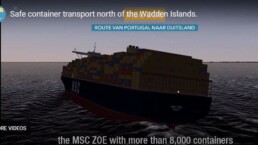

The Dutch Safety Board is investigating the loss of containers overboard of the vessel MSC Zoe. The Board is focussing on the consequences of the incident, the local situation in the Dutch Wadden area and the vessel’s sailing route.
Panama, the vessel’s flag country, is investigating the cause of the incident and the situation on board the vessel. There is collaboration between the different Boards.
MSC ZOE
In the night of 1 to 2 January 2019, the MSC ZOE with more than 8,000 containers on board was travelling from Sines in Portugal to Bremerhaven in Germany. North of the Dutch Wadden Islands, the MSC ZOE found itself in severe weather. The ship lost 342 containers and three million kilograms of cargo fell into the sea. The cargo comprised a wide range of items and packaging materials that on the subsequent days washed ashore on the coastline of the Wadden Islands. This occurrence caused the Dutch Safety Board to initiate two investigations: a combined international investigation with Panama and Germany into the course of events of the accident and an investigation by the Dutch Safety Board itself into the risks on the shipping routes north of the Wadden area.
The investigation into the course of events has revealed that the MSC ZOE lost cargo at six locations. The extreme forces acting on the ship, the containers and the lashing systems as a result of specific conditions on this shipping route were the primary cause of the loss of containers.
Shipping route
Above the Wadden Islands there are two internationally designated shipping routes, a northern and a southern route. The investigation by the Dutch Safety Board has revealed that a combination of a number of phenomena means that on both the southern and northern shipping routes, there is a risk of loss of containers.
In storm-force northwesterly wind, vessels are confronted with high athwartships waves. As a consequence, large, wide container ships make extreme rolling movements. On the relatively shallow southern shipping route, there is also a risk of seabed contact (grounding) due to the combination of vertical and horizontal ship movements. Moreover, waves can slam against the ship, and seawater travelling at high speed along the side of the ship can be forced upwards against the containers. These phenomena, individually and in combination, cause extreme forces to act on the ship, the containers and the lashing systems used to retain the containers. As a consequence, containers can break free and be washed overboard.
The complete investigation report about shipping routes, the accompanying animation and the international report into the course of events are available.
View the report here:
ovv_20204450_engelse_rapportage_overboord_geslagen_containers_msc_zoe_200625



Related News.
Navigating the Multi-Orbit Era: In Conversation with Intellian’s Jon Harrison at SMM 2026
At SMM 2026 in Hamburg, the rapid evolution of maritime satellite communications took centre stage. Across the exhibition halls, discussions among…
Cyprus ports need joint energy and investment strategy, shipping agents chief says
Cyprus needs a coordinated strategy for shipping, energy and environmental protection to support port investment and modernisation, Cyprus shipping…
MASO Public Affairs introduces MASO Regulatory Intelligence
A new subscription service helping businesses understand what is changing and what it means for them MASO Public Affairs introduces MASO Regulatory…
Anglo-Eastern helps turn CMBTECH’s ammonia ambition into an operational reality
From early feasibility study and risk-based design to newbuilding supervision, crew readiness and technical management, Anglo-Eastern drew on its…
Escalation of attacks threatens to derail recovery in Middle East oil exports
World oil demand is forecast to fall by 2.5 mb/d y-o-y in 4Q26 and 2.6 mb/d on average in 2026. As the Iran war manifests itself through restricted…
New study finds shipping pays twice its share to EU ETS earmarked revenues should triple to help build market for sustainable fuels and technologies
Shipping is responsible for around 10% of EU ETS emissions but pays almost 20% of the ETS bill. Unlike other sectors, it has never received free…
MSARC strengthens maritime mass rescue readiness through training and national live exercise off Dakar, Senegal
Joint MSARC–FHAS programme combines three days of SAR training with a national multi-agency live exercise The Maritime Search and Rescue Council ,…
Sogese report deliveries are still being delayed as container freight rates fluctuate
FOR IMPORTERS Spot rates into the Mediterranean are back at January levels, Far East to Europe reliability sits at pandemic lows, and nearly…
Glencore begins trading on Australian Securities Exchange
Glencore has begun trading on the Australian Securities Exchange under the ASX code GLC. Gary Nagle, Glencore’s CEO, said it was an exciting day for…
BIMCO Shipping Number of the Week
Suez Canal container ship transits exceed 50% of pre-disruption levels "During the first two weeks of October, weekly container ship capacity…
Subscribe to our newsletter!
if you dont want to swim alone in the ocean of news, sign up for the newsletter, and you will receive daily all the important news of world shipping!
