How decarbonising shipping could unlock a global energy transition

Climate change requires urgent action in all sectors of the economy – including maritime shipping, which carries close to 80% of global trade and accounts for 2-3% of global greenhouse gas emissions (GHG) annually. This is comparable with the emissions of large economies such as Germany and Japan. As global trade flows increase to serve a growing and more prosperous world population, emissions from shipping could grow between 50% and 250% by 2050 if no action is taken.
Shipping is not included in the Paris Agreement. However, to curb emissions, member states of the International Maritime Organization (IMO), a specialized agency of the United Nations responsible for regulating shipping, adopted an initial GHG strategy in April 2018. The strategy prescribes that GHG emissions from international shipping must peak as soon as possible and that the industry must reduce its total annual GHG emissions by at least 50% of 2008 levels by 2050, with a strong emphasis on zero emissions. This will ultimately align emissions from shipping with the Paris Agreement.
Shipping’s moon-shot ambition
At the UN Climate Action Summit in New York in September 2019, the Getting to Zero Coalition – a partnership between the Global Maritime Forum, the Friends of Ocean Action and the World Economic Forum – was launched with the moon-shot ambition of having commercially viable zero-emission vessels operating along deep-sea trade routes by 2030. This would put the industry on track to meet the target set by the IMO. Merchant ships have an average lifespan of 20 years or more, which means that ships entering the world fleet around 2030 can be expected to still be in operation in 2050. Similarly, infrastructure associated with fuel supply chains can have an economic lifespan of up to 50 years, and reconfiguration to new fuels can be a lengthy process. Consequently, if shipping is to halve its emissions by 2050, there is a need for zero-emission vessels to enter the global fleet by 2030 – only 10 years from now – as well as for a clear path to providing the large amounts of zero-emission fuels needed to allow for rapid uptake over the following decades.
Shipping is considered a hard-to-abate sector, and the decarbonization of shipping and its energy value chains can only be achieved through close collaboration and deliberate collective action between the maritime, energy, infrastructure and finance sectors, with support from government and international organizations. Since its launch in September, the Getting to Zero Coalition has grown to unite more than 100 public and private sector stakeholders.
The $1 trillion question
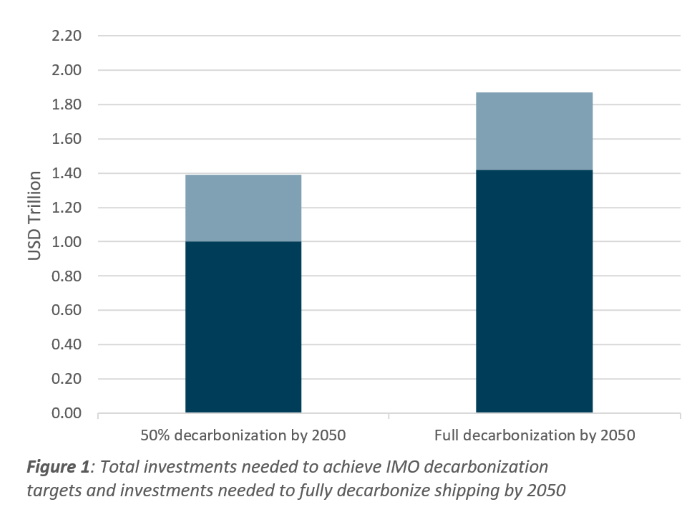
A new study by UMAS and the Energy Transitions Commission for the Getting to Zero Coalition spells out the scale of the challenge. According to their analysis, the cumulative investment needed between 2030 and 2050 to halve shipping’s emissions amounts to approximately $1-$1.4 trillion, or an average of $50-$70 billion annually for 20 years. This should be seen in the context of global investments in energy, which in 2018 amounted to $1.85 trillion.
If shipping was to fully decarbonize by 2050, this would require further investments of some $400 billion over 20 years, bringing the total to $1.4-$1.9 trillion.
Need for land-based investments outweighs the rest
The analysis also sheds light on where investments need to take place. These can be broken down into two main areas: ship-related investments, which include engines, on-board storage and ship-based energy-efficiency technologies; and land-based investments, which include investments in the production of low-carbon fuels, and the land-based storage and bunkering infrastructure needed for their supply.
The biggest share of investments is needed in the land-based infrastructure and production facilities for low-carbon fuels, which make up around 87% of the total.
Only 13 % of the investments needed are related to the ships themselves. These investments include the machinery and onboard storage required for a ship to run on low-carbon fuels both in new-builds and, in some cases, for retrofits. Ship-related investments also include investments in improving energy efficiency, which are estimated to grow due to the higher cost of low-carbon fuels compared to traditional marine fuels.
What’s the World Economic Forum doing about the transition to clean energy?
A trillion-dollar market opportunity
While the exact numbers on total bunker fuel consumption for shipping are not readily available, they are estimated to be around 250-300 million tons of fuel consumed annually. This means that shipping’s decarbonization has the scale to be a catalyst for the broader energy transition, unlocking the market for zero-emission fuels – a shift that represents a trillion-dollar market opportunity.
In order for companies and governments to make the investments required to accelerate the shift to zero-carbon fuels for shipping and other hard-to-abate sectors, we need to bring together the full range of the upstream and downstream fuel value chains to create a deeper understanding of the production and supply of the zero-carbon fuels that will pave the way for shipping’s decarbonization.
We invite stakeholders who share this ambition to join us in our mission to serve global trade in a sustainable manner.
Source: World Economic Forum



Related News.

Navigating the Multi-Orbit Era: In Conversation with Intellian’s Jon Harrison at SMM 2026
At SMM 2026 in Hamburg, the rapid evolution of maritime satellite communications took centre stage. Across the exhibition halls, discussions among…

Cyprus ports need joint energy and investment strategy, shipping agents chief says
Cyprus needs a coordinated strategy for shipping, energy and environmental protection to support port investment and modernisation, Cyprus shipping…

MASO Public Affairs introduces MASO Regulatory Intelligence
A new subscription service helping businesses understand what is changing and what it means for them MASO Public Affairs introduces MASO Regulatory…

Anglo-Eastern helps turn CMBTECH’s ammonia ambition into an operational reality
From early feasibility study and risk-based design to newbuilding supervision, crew readiness and technical management, Anglo-Eastern drew on its…

Escalation of attacks threatens to derail recovery in Middle East oil exports
World oil demand is forecast to fall by 2.5 mb/d y-o-y in 4Q26 and 2.6 mb/d on average in 2026. As the Iran war manifests itself through restricted…

New study finds shipping pays twice its share to EU ETS earmarked revenues should triple to help build market for sustainable fuels and technologies
Shipping is responsible for around 10% of EU ETS emissions but pays almost 20% of the ETS bill. Unlike other sectors, it has never received free…

MSARC strengthens maritime mass rescue readiness through training and national live exercise off Dakar, Senegal
Joint MSARC–FHAS programme combines three days of SAR training with a national multi-agency live exercise The Maritime Search and Rescue Council ,…

Sogese report deliveries are still being delayed as container freight rates fluctuate
FOR IMPORTERS Spot rates into the Mediterranean are back at January levels, Far East to Europe reliability sits at pandemic lows, and nearly…

Glencore begins trading on Australian Securities Exchange
Glencore has begun trading on the Australian Securities Exchange under the ASX code GLC. Gary Nagle, Glencore’s CEO, said it was an exciting day for…

BIMCO Shipping Number of the Week
Suez Canal container ship transits exceed 50% of pre-disruption levels "During the first two weeks of October, weekly container ship capacity…
Subscribe to our newsletter!
if you dont want to swim alone in the ocean of news, sign up for the newsletter, and you will receive daily all the important news of world shipping!
