Singapore’s gas pricing dilemma exacerbated by IMO 2020
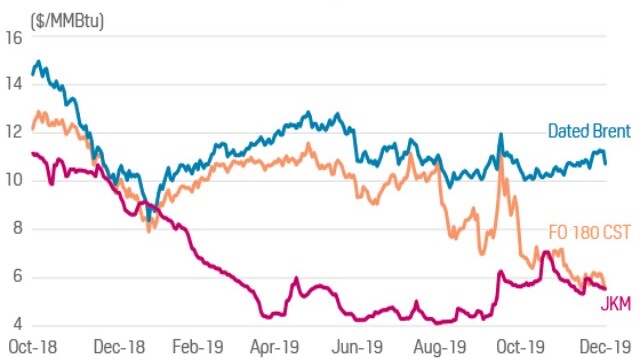

The impasse over Singapore’s piped gas import prices, largely set against fuel oil benchmarks, has taken a new turn as IMO 2020 is raising uncertainty over fuel oil prices and therefore heightening the risks faced by both gas suppliers and end users.
Singapore, where gas accounts for over 95% of electricity generation, imports more than 60% of its gas via long-term contracts from Indonesia and Malaysia, which are largely indexed against prices of high sulfur fuel oil with a maximum 180 CST viscosity. The rest, almost 40%, is imported via LNG carriers.
The sustainability of the current pricing system is under growing scrutiny, as Singapore’s exposure to global LNG spot fundamentals and prices grows, the price disparity between oil and LNG benchmarks widens, and the IMO 2020 implementation affects fuel oil availability and costs.
Pricing gas and LNG against fuel oil or oil benchmarks is not uncommon among Asia’s growing economies, particularly those that have turned to LNG imports in order to displace gasoil and fuel oil from their electricity feedstock landscape as a way of cutting electricity bills and improving air quality.
But this pattern has underestimated the inherent risk that the unpredictable disparity between oil prices and LNG market-based prices places on both buyers and sellers.
This risk is particularly high in Asia, a market that consumes around 70% of global LNG and is still dominated by long-term contracts, which increases the risk of a disparity between expected delivered prices when the contracts are signed and market-based pricing when deliveries begin.
RISING LNG IMPORTS
Singapore’s monthly imports of pipeline gas from Indonesia and Malaysia averaged 524,000 mt in the first 10 months of the year, accounting for about 62% of its total gas imports, according to data from Enterprise Singapore, the national trade agency.
The rest is shipped in the form of LNG, which has increased its share in total gas imports over the years, from180,000 mt/month in 2015, accounting for 23.6% of total gas imports, to 323,000 mt/month over January-October 2019, accounting for 38% of total gas imports during the period.
Piped gas is sourced from a group of gas fields about 100 km south of the intersection of Indonesia, Malaysia and Vietnam’s exclusive economic zones in the West Natuna Sea and piped through the 654 km West Natuna Transportation System to Singapore.
Further south on Indonesia’s Sumatra, the 468 km Grissik-Batam-Singapore pipeline is a second direct system that pipes natural gas to Singapore for the island’s industrial, residential and commercial use.
FUEL OIL PRICES
From gas producers in Indonesia to importers and distributors in Singapore, all have been asking the same question – where is the price of HSFO 180 CST heading?
Perhaps sensing the possible weakness in fuel oil price in the near future, buyers seem willing to continue pricing gas off the current formula, leaving sellers even more eager to find out which side is right about the price outlook.
However, significantly reduced supplies of high sulfur fuel oil from refineries globally, and the prospects that more shipowners will install scrubbers to allow ships to continue using HSFO, have fueled hopes that HSFO prices will rebound as soon as late 2020, although few expect its price to recover to pre-IMO 2020 levels.
Some market participants have thought of switching the pricing basis to crude oil, again a commodity whose fundamentals have little positive correlation with gas, giving little thought on rationality.
In August the swap crack of HSFO 180 CST against Dubai crude, a gauge of the fuel’s relative strength against crude oil, started to fluctuate wildly. This was the first direct sign on price of potential impact of IMO 2020 on the bottom of the barrel.
The trend became amplified from mid-September, and on November 29 the crack fell by an unprecedented $30/b to negative $26.25/b. Front-month Dubai swaps sat in a range of $56-66/b during the same period.
There is also significant uncertainty over the relatively thin spot liquidity of this grade. The shipping industry, which consumes most of the world’s fuel oil, has long shifted away from the 180 CST grade, which now accounts for a fraction of total bunker sales.
The main buyers of the grade from the Singapore spot market are some utilities in Northeast and Southeast Asia, which still use it to generate electricity. With sporadic spot demand, the price of the grade is more prone to wild swings than the more viscous 380 CST grade, which provides most of the liquidity in the physical fuel oil market.
Source: Platts, By Dexter Wang and edited by Jonathan Fox



Related News.

ISLAND OIL: Unveiling of the Sculpture “Cyprus’s Journey Through the Ages” in Protaras – A Tribute and Landmark to Cyprus’s Historical Memory and Cultural Heritage
In a modest ceremony marked by a moving atmosphere, the sculpture “Cyprus’s Journey Through the Ages”, created by acclaimed Cypriot sculptor…

World Maritime Day 2026 from Policy to Practice – powering Maritime Excellence
Global regulations will deliver safer, more resilient shipping when they are implemented worldwide. The international maritime community marks…

Diana Shipping announces Time Charter Contract for m/v DSI Polaris with Dai An Ocean Shipping
Diana Shipping , a global shipping company specializing in the ownership and bareboat charter-in of dry bulk vessels, announced that, through a…

Chief Economists Expect Global Economy to Stabilize, but Fiscal Constraints, Rising Living Costs and AI Investment Uncertainty Threaten Growth
The global economy is stabilizing, but the fiscal support that cushioned successive shocks since 2020 is unlikely to play the same role in the year…

V. welcomes its new graduate cohort as programme expands across the group
Twelve graduates from nine nationalities join 11th year of V.’s expanded international management programme. V., the global ship manager and marine…

From Policy to Practice: Why Seafarers Are the Key to Maritime Excellence
The shipping industry is no stranger to regulation. Seafarers and ship operators work within a vast framework of international conventions, national…

Intermodal Report – Week 38 2026
Please find below the Intermodal market report for week 38 2026. Intermodal Report Week 38 2026 Market Insight By Nikos Tagoulis, Head of…

Allied – Weekly Market Review – Week 38
Please find below the Allied Weekly Report for Week 38 | 2026 ALLIED - Weekly Market Report- Week 38

Record year on the Northeast Passage but Arctic shipping remains very limited
In 2025, a record 103 transit voyages were made via the Northeast Passage. However, this is still equivalent to only around a day and a half of…

[xclusiv] S&P Report 21th September 2026
Please find below the [xclusiv] latest Weekly S&P Report [xclusiv] 2026_09_21 Market Commentary: VLCCs: Freight Boom Reprices the Fleet The VLCC…
Subscribe to our newsletter!
if you dont want to swim alone in the ocean of news, sign up for the newsletter, and you will receive daily all the important news of world shipping!
