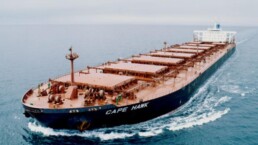

For the first time in the last decade, a few days in October 2019 seemed just glorious for the shipping industry: a VLCC (supertanker) was temporarily committed “on subjects” for a voyage at $307,000 per diem (pd), reminiscent of the days of the super-cycle when large dry bulk and tanker vessels were earning around $200,000 pd.
For the first time in the last decade, a few days in October 2019 seemed just glorious for the shipping industry: a VLCC (supertanker) was temporarily committed “on subjects” for a voyage at $307,000 per diem (pd), reminiscent of the days of the super-cycle when large dry bulk and tanker vessels were earning around $200,000 pd. Not only rates were high, but also charterers seemed scared and in dire need of covering the shipment of their cargoes, which meant that rates could go even higher. As a matter of reference, VLCC tankers were earning approximately $25,000 pd at the beginning of this year, and the average earnings for the last decade have been appr. $30,000 pd. The strength of the market, in both relative and absolute terms, made several pundits claim that the much awaited market recovery had finally arrived. And, it supposed to be a broad shipping market recovery as dry bulk vessels (and capesize vessels, in particular) were also enjoying a relatively strong market with capesize vessels earning appr. $28,000 pd (at the beginning of 2019, the average rate was below $10,000 pd).
For anyone following the shipping industry, the last decade has been rough. A collapsing freight market after the Lehman Brother bankruptcy caused many shipowners to default on their mortgage loans to the banks, with an astronomical estimate of $250 billion shipping loans to be subsequently in default. Many ships got arrested by the banks, but even more shipping loans were sold for pennies-on-the-dollar to hands-on private equity investors, itching to generate double-digit returns on their investments by any means – including by more vessel arrests and restructurings. The average shipowner saw their fleet cut in half and smaller shipowners got entirely wiped out in Greece and abroad, while whole rows of buildings with shipping companies as tenants have been emptied in Hamburg, as many KG shipping companies folded. It has been a tough decade for shipping for most people, but several large shipowners seem to have thrived and expanded their fleets.
A market recovery was promised several times over the last decade either with the introduction of “eco design” vessels (newbuilding, fuel efficient vessels), orchestrated quantitative easing (QE) efforts and very low interest rates by major central banks worldwide (“Whatever it takes” were famous words of the era pronounced by ECB’s President Mario Draghi), China’s strong stimulus to prevent social turmoil by keeping the economy humming via domestic demand), and last, Trump’s strong tax cut that supposed to stimulate investment. Despite a few seasonal freight improvements here and there, the bitter truth of the matter is that shipping has led to operating losses for most shipowners, as freight rates and asset price improvements were mostly “false positive” and short-lived, and ended up sucking more people and more money into the vortex.
A few new type of investors for shipping, such as private equity funds and alternative capital funds, especially the few that had to make monumental investments (“bets”) in order to move the proverbial needle – for a fund managing $500 billion, a $50 mil investment even if it provides outstanding returns would never amount to much in such a tremendous portfolio, and cheered by a few opportunistic shipowners keen for a share of the new action, drove to a chronically oversupplied market from crude and product tankers to containerships to dry bulk vessels to LNG tanker to offshore vessels. Without having to point fingers and naming names, the end result has been a shipping market whereby the world’s fleet was growing much faster than the movement of cargoes and growth of trade. But, it’s clear that the bad shape of the shipping market has been partially self-inflicted as many players opted for speculation and trying to out-smart the competition.
All along, shipping banks, the industry’s traditional source of funding, in the last decade had to focus on their notorious “NPLs” (Non Performing Loans) in almost every activity they had been active in, besides shipping, from commercial loans and residential loans to project and trade finance. Besides nurturing big losses (well in excess of $100 billion in the shipping industry alone), and figuring out strategies that would “not rock the boat” (both literally and metaphorically) by selling ships massively to further distress asset pricing, shipping banks have been saddled with new banking regulations and accounting standards. As a result, only a handful of privately held shipowners could get a shipping bank’s lending attention so much so that certain (well-known “systemic”) shipowners could borrow to the tune of billions at L+175 bps (basis points) while the great majority of the shipowners have to live with L+450 bps from the remaining reduced bank capacity. The shipping banking market has been so dis-functional that alternative capital funding sources are popping up monthly in London and New York, and are happy to provide ship mortgages (usually structured as leasing) at L+900 bps and hefty fees. And, a great deal of shipowners feel compelled to accept such expensive cost of capital.
Funding is not an issue for privately held shipping companies alone; publicly traded shipping companies has seen their stock trading on the “pink sheets” (having dropped so low that the price per share is quoted in pennies) and several more have been delisted altogether. Institutional investors have stopped being interested in an industry that seems to be chronically oversupplied and trailing in earnings potential, while future prospects seem ever more anemic.
And, in a weak freight environment and expensive cost of capital, at a time when the world’s fleet stands at its lowest average age in the last two decades, new regulations keep adding up (and further squeezing earnings). It’s indicative that less than two months before the IMO2020 emissions implementation, it remains highly speculative on whether installation of scrubbers or switching to low sulphur fuel remains the optimal choices. And, this is before new technologies such as dual-fuel ships start gaining a larger market share, and before disruptive technologies can make established industry practices obsolete.
Thus, in this challenging market environment that now turns into its second decade, the market developments and the excitement of this past October were a refreshing break from the tough reality. Having shipowners chasing charterers and cargo owners and financiers for a decade now has been depressing, and last October’s frenzy was an inflection to the boom days of 2008 when the market was stepping up (both freight rates and vessel prices) on an almost daily basis. It was great to experience again how a strong market really feels!
We are in November, and October’s events have deflated; the $307,000 pd supertanker fixture never happened as the charterers walked away; the highest rate recorded was “only” at $170,000 pd – which was fantastic by any means; however, the market now is closer to $65,000 pd. Likewise, for capesize vessels and the drybulk market, freight rates have dropped by 25% since October. We are back to reality, as the saying goes. The developments of October had been another “false positive” due to the US Administration imposition of trade sanctions to tankers trading with Iran, including Chinese-state-owned tankers, thus shortening tanker availability by appr. 15%. As the market got by a wild surprise, charterers instinctively rushed to commit vessels “on subjects”, and they unfolded their positions soon thereafter once there was more visibility.
As structurally un-balanced the shipping industry remains, it was nostalgic to feel again – even for a couple of days – like a great market… hopefully, this may be a jolt of perseverance for the shipowners braving so many market unknowns in expectation of a normalized market again.
* Basil Karatzas is the Founder and CEO of Karatzas Marine Advisors, a shipping finance and shipbrokerage firm based in New York. Basil is an Accredited Senior Appraiser and Fellow of the Institute of Chartered Shipbrokers. More info on Basil and the firm can be found at www.karatzas.com
Source: maritimes.gr



Related News.

Hong Kong Global Maritime Trade Summit to return for third edition
The International Chamber of Shipping, in collaboration with the Transport and Logistics Bureau of the Government of Hong Kong and the Hong Kong…

Appetite for US crude oil exports climbs despite high freight
South Korea tops US crude destinations at 568,600 b/d VLCC rates to Asia double, closing arbitrage window European refining margins…
Shipping stocks Rally as Hormuz Traffic plunges 75%
Ship traffic through the Strait of Hormuz — a critical chokepoint handling about 20% of global crude oil and liquefied natural gas shipments — has…
Diana Shipping announces Time Charter Contract for m/v G P Zafirakis with Classic Maritime
Diana Shipping, a global shipping company specializing in the ownership and bareboat charter-in of dry bulk vessels, announced that, through a…
New IMO ESP Code framework for Remote Inspection Techniques
The International Maritime Organisation, through Resolution MSC.584(111) , has adopted amendments to the International Code on the Enhanced…

ABS opens Offshore & Marine Support Center in Bergen
ABS has expanded its capabilities in the Norwegian maritime market with the opening of a cutting-edge support center in Bergen, bringing advanced…

MOL holds giant step memorial ceremony and beach cleanup at Kashima Coast
Memorial and Reflection 20 Years After the Accident: Learning from the Past to Foster an Even Stronger Safety Culture Mitsui O.S.K. Lines, announced…

KEZAD-based Arabian Gulf Steel Industries achieves lowest verified Carbon Footprint for Rebar
CARES UK verified Environmental Product Declaration confirms 139 kg CO₂e per tonne for rebar produced at AGSI’s KEZAD Abu Dhabi facility Arabian…

Indian Register of Shipping announces launch of first fleet support ship INS Surya
Indian Register of Shipping continues to strengthen its role in supporting the Indian Navy and India’s naval shipbuilding capabilities through the…

VLCCs Climbing the Record Charts
LR2 The TC1 75kt MEG/Japan index decreased by only a single point this week to WS928. The corresponding Baltic round-trip TCE fell by $2,000 to…
Subscribe to our newsletter!
if you dont want to swim alone in the ocean of news, sign up for the newsletter, and you will receive daily all the important news of world shipping!
