Robots that learn everyday tasks, free humans from repetitive work
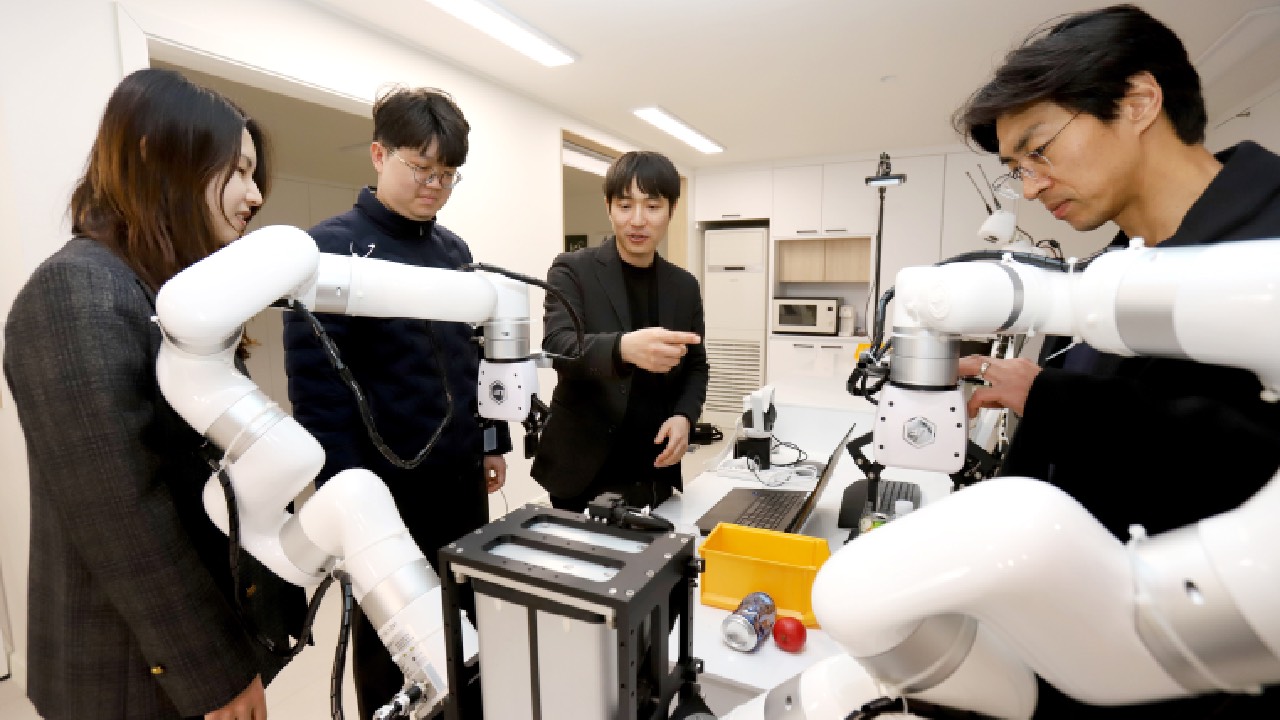

– KIMM has developed robot task AI capable of performing everyday activities through human demonstrations and hierarchical task execution
– Technology enables flexible execution of repetitive tasks such as organizing items, clearing tables, and manipulating objects
– High-success-rate task framework expected to expand applications in various robot-based service sectors
□ A robot task AI capable of learning and performing everyday repetitive tasks in a human-like manner has been developed. The AI learns tasks through human demonstrations and executes complex tasks step by step based on a hierarchical task execution framework. The technology is expected to contribute to the automation of labor-intensive repetitive work and reduce human workload in homes, offices, as well as retail and logistics environments.
□ The Korea Institute of Machinery and Materials (KIMM, President Seog-Hyeon Ryu) announced that a research team led by Dr. Jeong-Jung Kim, Head of the Department of AI Machinery at the Research Institute of AI Robotics, has developed a robot task AI capable of performing everyday activities such as organizing items, clearing tables, and manipulating objects.
□ The system consists of three key technologies: task extraction technology, which converts human task demonstrations into usable data; task virtualization (simulation) technology, which recreates real environments in virtual space for training and validation; and hierarchical task execution AI, which enables robots to perform tasks sequentially and systematically.
□ The robot task AI is designed to learn and operate in a manner similar to how humans perform tasks. By observing demonstrations, the system learns task procedures and performs them through hierarchical reasoning and execution. In addition, the use of virtualized environments enables data generation, training, and validation under diverse conditions, allowing the robot to maintain stable task performance even when environmental conditions change. Through its hierarchical task execution structure, complex everyday tasks can be broken down into sequential steps and carried out systematically.
□ Existing robot task technologies have often been limited to single-task datasets or simulation-based validation. In contrast, the technology developed by the KIMM research team integrates the entire development pipeline, including the construction of datasets covering diverse everyday tasks, virtualization of real-world environments, hierarchical task execution AI, and integration with real robot systems followed by verification in real environments.
□ The research team implemented hierarchical task execution technology capable of handling different types of tasks reliably, achieving a success rate of over 90 percent across various tasks. The system was integrated with an actual robot platform and tested in real-world environments, confirming its practical applicability. With strong generalization for repetitive tasks and adaptability to environmental changes, the technology can be expanded to various real-world applications.
□ The developed robot task AI can be widely applied across various service scenarios, including household and office service tasks, product arrangement in retail stores, and picking and organizing work in logistics environments. The research team plans to further expand the range of tasks that robots can perform and enhance their adaptability to changes in spaces and objects to increase their usability in real service environments.
□ Dr. Jeong-Jung Kim, Head of the Department of AI Machinery at KIMM, said, “This robot task AI learns from demonstrations and performs tasks through hierarchical reasoning, much like humans do. Its key strength lies in its generalized task capability that can be applied across a wide range of everyday activities.” He added, “By building datasets that include diverse tasks, establishing validation environments, and verifying the technology using real robot systems, we confirmed that robots can reliably support repetitive everyday work. This technology is expected to significantly improve work efficiency while reducing the burden on people.”
□ Principal Researcher Doo-Yeol Koh explained, “Accurately collecting real human task data during the data acquisition stage is crucial for improving the performance of robot task AI systems. To achieve this, we developed an interface that enables precise task data collection while maintaining a high degree of freedom during human demonstrations.”
□ This research was conducted as part of KIMM’s institutional research program titled “Development of Core Technologies for the RoGeTA Framework (Robot General Task AI) for Diverse Daily Services (2024–2029).” The project aims to develop robot intelligence technologies capable of supporting everyday tasks and covers the entire development cycle from dataset construction and real-world virtualization to validation in real environments. The research team also plans to release the collected task datasets and virtualized models of real environments so that other researchers can freely utilize them, providing foundational resources for future service robots and industrial applications.


Related News.

60 days of a broken US-Iran MoU: the market stopped waiting for Hormuz
The 60-day window under the Islamabad MoU lapsed on 17 August with no deal, no extension, and no talks under way. Kpler data shows the truce cleared…

The global diesel crunch: Russia’s refinery crisis meets Middle East turmoil
The global refined products market is being squeezed by two major disruptions occurring simultaneously. In the Middle East, the escalation of the…

Crude markets underpricing an impending supply tightness
For a brief window in mid-July, global crude markets looked well-supplied. After the US-Iran MoU was signed on June 17th, Hormuz transits picked up,…

Russia imports gasoline from India amid fuel shortages
Russia has received at least one cargo of gasoline from India as the country works to address domestic fuel shortages following Ukrainian drone…

AM Best assigns Credit Ratings to Korea Shipping Association
AM Best has assigned a Financial Strength Rating of A- (Excellent) and a Long-Term Issuer Credit Rating of “a-” (Excellent) to Korea Shipping…

Technologies driving the maritime transformation: SMM 2026 showcases innovations moving into real-world application
The maritime industry is undergoing a profound transformation. At SMM 2026, companies from around the world will showcase technologies that are…

Britannia P&I unveils new website, enhancing user experience and access to maritime knowledge
The Britannia Group is pleased to announce the launch of its newly redesigned website, delivering a cleaner, faster digital experience with…

BIMCO Shipping Number of the Week
Global grain shipments fall 8% as attacks in the Black Sea escalat "Over the last five weeks (week 29-33) global grain shipments have fallen 8% y/y,…

Bunker Holding appoints new CFO with strong risk management expertise
Jacob Nørgaard is appointed CFO of Bunker Holding, the world’s largest supplier of marine fuels to the shipping industry. He succeeds Michael…

Oslo Ocean Days thought Leader article Jan Ole Huseby, DNB
Bringing the industry together to navigate a new ocean business reality How can the industry navigate change while staying on course to achieve…
Subscribe to our newsletter!
if you dont want to swim alone in the ocean of news, sign up for the newsletter, and you will receive daily all the important news of world shipping!
