Three out of drydock underwater propeller repairs across Europe


Damage to propeller blades can seriously affect a vessel’s performance. Bent or broken blade tips can cause vibrations, reduce propulsion efficiency and even prevent a ship from continuing its voyage. Fortunately, even extensive damage can often be repaired while the vessel remains afloat, avoiding the need for a costly drydock visit.
Hydrex diver/technician teams regularly carry out underwater propeller repairs using specially developed equipment and techniques. Depending on the extent of the damage, blades can be straightened back to their original shape or cropped to restore the propeller’s balance and efficiency.
Three recent operations on a bulk carrier in Spain, a small cargo vessel in Portugal and a crude oil tanker in Denmark demonstrate these different approaches. The work ranged from straightening four severely bent blades to cropping damaged sections and carefully balancing propellers with missing blade tips.
Four propeller blades straightened in Spain
The team was called to Gijón, Spain, to carry out a propeller repair on a 190-meter bulk carrier. An inspection revealed that all four blades of the vessel’s fixed-pitch propeller had suffered significant bending damage.
The tips were bent at angles ranging from 20 to 45 degrees. As no visible indications of cracking were found, underwater cold straightening was selected as a suitable repair method.
The divers used the Hydrex specially-developed cold straightening equipment to carefully bend the damaged sections back towards their original shape. This technique allows blades to be repaired without applying heat or removing the propeller from the vessel.
After all four blades had been straightened, the edges were ground smooth. A final inspection was carried out in the presence of a class representative, and the repair was approved.
The operation was successfully completed without removing the propeller or taking the vessel into drydock.
Propeller blade cropping and balancing in Portugal
A different approach was required during an operation in Caniçal, Madeira, where a team attended a 63-meter cargo vessel with a damaged four-bladed propeller.
One of the blades had lost a substantial section of its tip, measuring approximately 340 mm in length and 180 mm in depth. A crack was also discovered next to the missing piece, making it necessary to remove the affected section.
Before the repair could begin, Hydrex divers had to clean the propeller, which was heavily covered with marine fouling, including barnacles, calcium deposits and slime. Once the surfaces were accessible, the damaged blade could be inspected and the cutting line accurately marked.
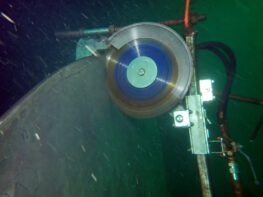
The affected blade was cropped along a 574 mm cutting line, removing both the damaged section and the adjacent crack.
Simply removing this material, however, would have left the propeller unbalanced. To compensate, the technicians cropped a corresponding section from the opposite blade, removing a similar amount of material.
The two remaining blades were undamaged and did not require modification.
The precisely planned cropping allowed the damaged section to be removed while maintaining the balance of the propeller.
Extensive propeller damage on tanker in Denmark
Another challenging operation took place in Skagen, Denmark, where a team was mobilized to inspect and repair the propeller of a 250-meter crude oil tanker.
All four blades had sustained severe damage. One blade tip was bent by more than 90 degrees, while the other three blades had sections of their tips missing.
Given the extent of the damage, blade cropping was selected as the repair approach rather than attempting to straighten the heavily deformed sections.
A team traveled from Antwerp to the vessel’s location, where a workboat was required because the mooring position could only be reached from the water.
A detailed underwater inspection was carried out to measure the damaged areas and determine the appropriate cropping dimensions.
The repair plan involved removing corresponding sections from opposite blades to maintain the propeller’s balance. Measurements were taken from the blade roots along the leading and trailing edges, allowing the cutting lines to be established accurately.
The resulting cropping plan accounted for the different damage patterns on the four blades, with matching dimensions established for each opposing pair.
The operation illustrates the importance of accurate measurements and careful planning when dealing with extensive damage across an entire propeller. Rather than treating each blade separately, the repair approach must consider the propeller as a complete system.



Related News.

Crewing After 2026: How AI Will Take Over the Routine in 2027
The crewing market of late 2026 is not the market of 2025. Artificial intelligence has moved from presentations into daily crewing work, while the…

Dualog launches secure maritime AI service amid surge in seafarer AI use
The new service, Sparks lets crew and shore teams search company emails, documents and conversations without exposing sensitive fleet information to…

Time Ticking: Two weeks for Governments to Green-Light Framework for Cutting Shipping Emissions
As a crucial fortnight of meetings opens at the International Maritime Organization opens in London, the Clean Shipping Coalition calls on member…

“K” LINE signs contract for construction of two LPG dual-fuel VLGCs
Kawasaki Kisen Kaisha, announces today that it has signed agreements with South Korea-based HD Hyundai Samho regarding the construction of two LPG…

Equinor and VNG sign 18-year gas sales agreement for supplies to Germany
Equinor will supply natural gas to the German energy company VNG until the end of 2044. The 18-year agreement is the longest gas sales agreement…

Open letter to MEPs to reject the motion for a resolution and support the inclusion of Indian ship recycling yards on the European List
Dear Members of the European Parliament, Ahead of this week’s plenary vote, European Shipowners | ECSA, BIMCO, the Cruise Lines International…

ShipVet appoints James Stairmand as Chief Executive Officer
Founder Captain Fintan Cullen moves to a non-executive role as the company builds on investment in its vetting team and technology. ShipVet, the…

USD ≈7bn lost per year the hidden cost of how shipping trades
New Torvald Klaveness study quantifies around USD 7bn a year in potentially avoidable costs in dry bulk and product tanker shipping, with a possible…

APM Terminals Maasvlakte II and Port of Rotterdam Authority take next step in terminal development
APM Terminals Maasvlakte II and the Port of Rotterdam Authority are moving forward in terminal’s development with preparations for a new phase of…

ABP inspiring the next generation
ABP host 500 young people to explore maritime and transport careers More than 500 young people from across Hampshire and the Solent explored career…
Subscribe to our newsletter!
if you dont want to swim alone in the ocean of news, sign up for the newsletter, and you will receive daily all the important news of world shipping!
