

The crewing market of late 2026 is not the market of 2025. Artificial intelligence has moved from presentations into daily crewing work, while the shortage of officers keeps growing. In my view, 2027 will be the year AI takes over most of the routine in crewing, and the companies that prepare now will set the standard for everyone else.
The market is no longer what it was in 2025
Two things changed at the same time. The first is technology. Tools that a year ago were tested by a few early adopters now screen CVs, match candidates to vacancies, fill in application forms and answer seafarers’ first questions around the clock.
The second is the shortage. According to the BIMCO/ICS Seafarer Workforce Report 2026, the world fleet is short of 39,100 STCW-certified officers this year. The gap was 16,500 in 2015 and 26,240 in 2021. By 2030, shipping will need another 113,735 officers, or about 22,747 new officers every year.
A crewing department that still works the way it did in 2025, with spreadsheets, email chains and manual certificate checks, will struggle to keep up with that demand.
2027: AI takes over the routine
I expect 2027 to be the breakthrough year, when AI stops being an add-on and takes over the routine in three areas of crewing:
- AI will search a database of tens of thousands of CVs in minutes, ask seafarers about their readiness, salary expectations and preferred vessel types, and hand a recruiter a short list of candidates who are ready and suitable.
- Document checks. Certificate validity, endorsements, sea service and the documents required by the flag and the vessel type will be checked automatically, with the recruiter dealing only with exceptions.
- Seafarer preparation. Online training, test preparation and refresher courses will adapt to each seafarer’s gaps, instead of the same programme for everyone.
This does not remove people from crewing. It removes repetitive work from them. The recruiter’s time moves to what AI cannot do well: judging people, building trust with seafarers and understanding what a particular shipowner really needs on board.
From routine to personal touch
When AI takes the routine, a crewing team does not shrink. It changes what it spends its day on. Today a recruiter may spend most of the day searching CVs, chasing scans of certificates and sending the same offer to dozens of people. In 2027, that time should go to the seafarers themselves.
What changes in practice:
- Recruiters become career advisors. Instead of filling a vacancy, they plan a seafarer’s next contract, promotion and move to a new vessel type.
- Document controllers handle exceptions, not every file. They focus on the cases AI flags as doubtful and on audits.
- Contact does not stop at signing. A call before joining, a check-in during the contract and a debrief after sign-off become the norm, not a courtesy.
- KPIs change. Retention, re-join rate and seafarer satisfaction matter more than the number of CVs processed.
How to make the shift: measure how many hours your team spends on routine today, automate it step by step, and train people in communication, career guidance and seafarer welfare. Seafarers return to the company that knows them by name. That personal touch is the one thing AI cannot provide, and in a market short of officers it is what keeps good crews.
One platform instead of ten tools
Most crewing departments today use a separate tool for each task: one database for CVs, another for certificates, email for offers, a spreadsheet for payroll. AI works best when the data sits in one place.
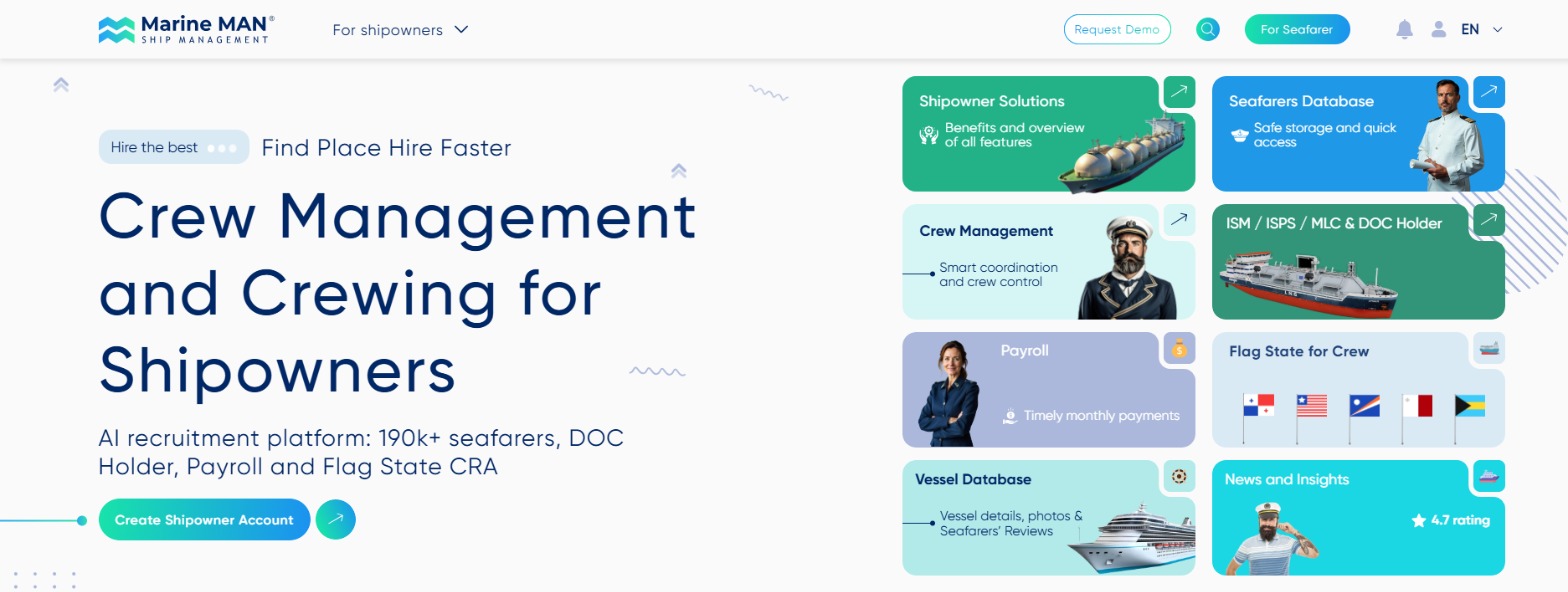
That is the idea behind jobmarineman.com, built by Marine MAN, a crew management company operating since 2007. The platform already brings together:
- A database of more than 190,000 seafarer CVs
- Vacancies published directly by shipowners, so anyone looking for a job at sea deals with the employer, not a chain of agents
- A vessel database with ratings from seafarers who served on board
- Crew management, payroll, flag state documentation and DOC holder services for shipowners
- A mentorship programme for seafarers
The next step is already under way. We are testing AI on the platform and will add it to each of these blocks: an AI recruitment assistant for sourcing, automated document checks and a learning portal for seafarer training.
And one more thing matters for both sides of the market: the platform is completely free for seafarers and for shipowners, and will remain free for at least the coming year.
The shipowner side of the platform: seafarer database, crew management, payroll, flag state services and vessel data in one place. Screenshot: jobmarineman.com
Technology does not replace experience
AI can find a seafarer faster. It cannot create an experienced chief officer. The officer shortage is ultimately a question of how fast knowledge passes from senior seafarers to junior ones.
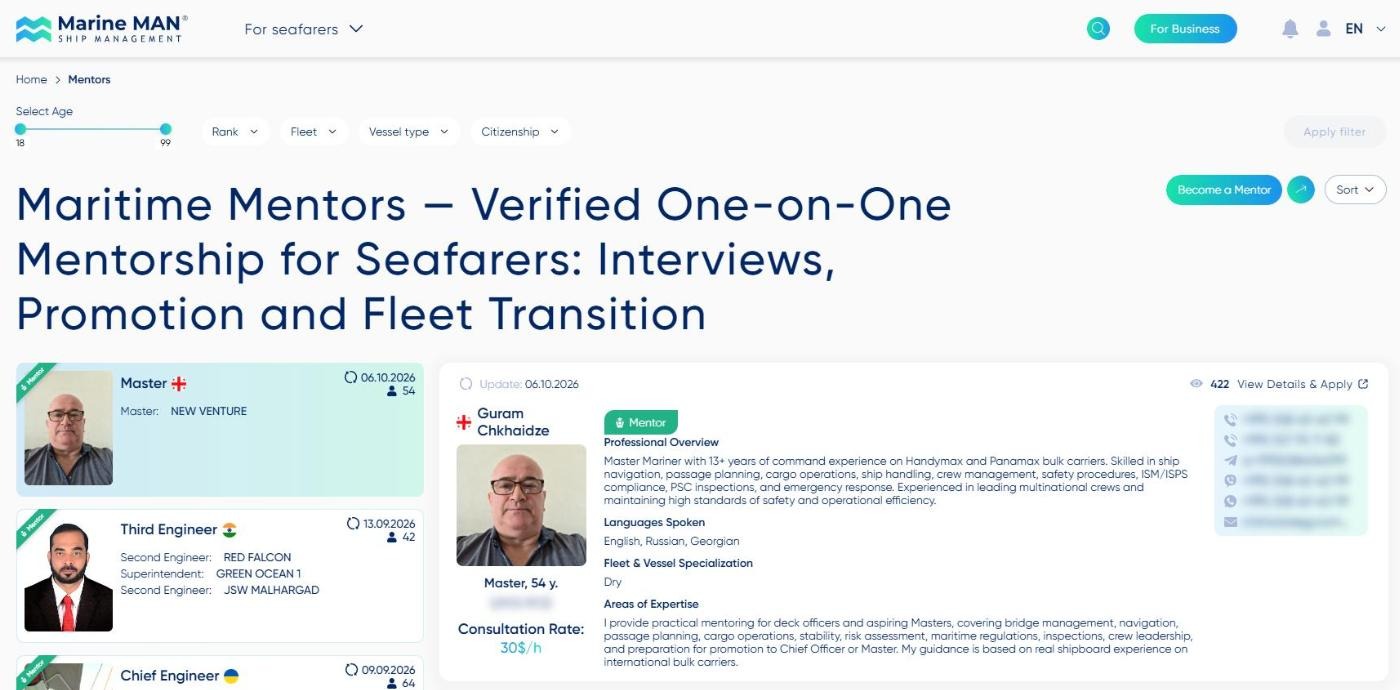
That is why Marine MAN did not wait for the industry to solve the shortage. Our Maritime Mentors programme is already running on jobmarineman.com. Masters, chief engineers and other senior officers, verified by us, help junior seafarers prepare for interviews, promotion and a move to a new fleet or vessel type. Mentors set their own consultation rates and agree terms with the seafarer directly.
The Maritime Mentors catalogue: each mentor shows rank, vessels served on and a consultation rate. Screenshot: jobmarineman.com
For shipowners, this means a pipeline of better prepared officers. For senior seafarers, it is a way to pass on their experience, and to be paid for it.
Preparing now
The shortage will not wait for technology to mature, and technology will not wait for companies to get used to it. Ship managers who connect their crewing data, sourcing and training in one system today will be the ones who fill vacancies fastest in 2027.
About the author
Pavel Manchenko is the Founder and Managing Director of Marine MAN, a ship and crew management company and IMO DOC holder operating since 2007. He served at sea from cadet to Second Officer and holds DPA (ISM), CSO (ISPS) and MLC 2006 auditor certificates. Marine MAN runs jobmarineman.com, a direct crew hiring platform for shipowners and seafarers. Shipowners and managers can contact him at b2b@marineman.eu.
Sources
- BIMCO and ICS report warns of potential future shortage of officers, ICS, June 2026
- Officer shortage deepens as seafarer demand jumps 35%, Seatrade Maritime, 2026
By Pavel Manchenko, Founder and Managing Director, Marine MAN



Related News.

Dualog launches secure maritime AI service amid surge in seafarer AI use
The new service, Sparks lets crew and shore teams search company emails, documents and conversations without exposing sensitive fleet information to…

Time Ticking: Two weeks for Governments to Green-Light Framework for Cutting Shipping Emissions
As a crucial fortnight of meetings opens at the International Maritime Organization opens in London, the Clean Shipping Coalition calls on member…

“K” LINE signs contract for construction of two LPG dual-fuel VLGCs
Kawasaki Kisen Kaisha, announces today that it has signed agreements with South Korea-based HD Hyundai Samho regarding the construction of two LPG…

Equinor and VNG sign 18-year gas sales agreement for supplies to Germany
Equinor will supply natural gas to the German energy company VNG until the end of 2044. The 18-year agreement is the longest gas sales agreement…

Open letter to MEPs to reject the motion for a resolution and support the inclusion of Indian ship recycling yards on the European List
Dear Members of the European Parliament, Ahead of this week’s plenary vote, European Shipowners | ECSA, BIMCO, the Cruise Lines International…

USD ≈7bn lost per year the hidden cost of how shipping trades
New Torvald Klaveness study quantifies around USD 7bn a year in potentially avoidable costs in dry bulk and product tanker shipping, with a possible…

APM Terminals Maasvlakte II and Port of Rotterdam Authority take next step in terminal development
APM Terminals Maasvlakte II and the Port of Rotterdam Authority are moving forward in terminal’s development with preparations for a new phase of…

ABP inspiring the next generation
ABP host 500 young people to explore maritime and transport careers More than 500 young people from across Hampshire and the Solent explored career…
HGK introduces new general brand “Port of Cologne” and launches the first Port Dialogue meeting
The significance of the ports in Cologne for business, the reliability of supplies and sustainable logistics was the focal point for HGK AG’s first…
xclusiv S&P Report 23rd November 2026
Pls find below the[xclusiv] S&P Report 23rd November 2026 [xclusiv] 2026_11_23
Subscribe to our newsletter!
if you dont want to swim alone in the ocean of news, sign up for the newsletter, and you will receive daily all the important news of world shipping!
