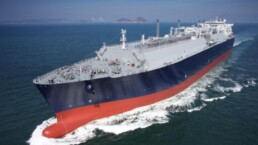

Fierce competition is unfolding between South Korea and China in the market for large liquefied natural gas )carriers, which represent high value-added vessels. As China initiates a pursuit by putting forward a volume offensive through shipyard expansion and the ultra-upsizing of vessels, the South Korean shipbuilding industry is stepping up to maintain a super gap by increasing operational efficiency and advancing gas processing technologies.
According to Clarkson Research, a British shipbuilding and shipping market analysis agency, on Oct. 6, a total of 82 large LNG carriers have been ordered worldwide from January of this year to this day. Among these, South Korean shipyards won orders for 44 vessels, recording a 53.7% market share. Chinese shipyards accounted for 42.7%, winning orders for 35 vessels. The gap between the two countries, which was 29 vessels last year when South Korea accounted for 32 vessels and China for 3 vessels out of the global order volume of 37 vessels, has narrowed to within 10 vessels this year.
China is expanding its foundation for building LNG carriers. Currently, there are five Chinese shipyards with a history of building large LNG carriers, including Hudong-Zhonghua Shipbuilding, Jiangnan Shipyard, Dalian Shipbuilding Industry Company, China Merchants Heavy Industry, and Yangzijiang Shipbuilding. In addition, Hengli Heavy Industry has recently been pushing to enter the LNG carrier market. Hengli Heavy Industry is known to be building two large LNG carriers using the so-called ‘build first, sell later’ method, where vessels are constructed first and then sold to shipowners.
They are also increasing the size of the vessels. Hudong-Zhonghua Shipbuilding, which is leading the construction of Chinese LNG carriers, began building a 271,000 cubic meter-class LNG carrier starting in June. Compared to the 174,000 cubic meter-class LNG carriers that South Korean shipbuilders focus on, the cargo loading capacity increases by about 56%. This vessel is scheduled to be delivered to Qatar, a major global LNG exporter, in 2028.
On the other hand, South Korean shipbuilders are focusing on increasing the operational efficiency of the vessels themselves. LNG carriers have a high level of technical difficulty as they must transport LNG in a cryogenic state of minus 163 degrees Celsius. Among these requirements, the insulation performance of the cargo hold and the boil-off gas processing technology determine the competitiveness of the vessel.
HD Hyundai Heavy Industries has increased loading efficiency by changing the structure of the cargo hold. It succeeded in commercializing a three-tank LNG carrier for the first time in the world, reducing the four cargo holds applied to existing LNG carriers to three. Reducing the number of cargo holds also decreases the bulkheads and insulation space between the tanks. Accordingly, the space available to actually load LNG can be increased within the same hull size. The LNG loading capacity of the vessels currently being built by HD Hyundai Heavy Industries has been expanded from 174,000 cubic meters to 176,800 cubic meters.
As the total surface area of the cargo hold is reduced, the heat flowing in from the outside also decreases. Through this, HD Hyundai Heavy Industries improved the daily boil-off rate (BOR) by about 6% to a level of 0.08% by removing a single bulkhead. It has increased the loading capacity and operational efficiency without upsizing the vessel.
Samsung Heavy Industries applies a technology that minimizes the amount of loss by re-liquefying the gas generated as LNG vaporizes during the transportation process. Its independently developed LNG re-liquefaction system for low-pressure dual-fuel engines, X-Reli, can re-liquefy the boil-off gas by utilizing the gas itself as a refrigerant without using a separate refrigerant. Currently, performance verification has also been completed at the demonstration facility in the Geoje Shipyard.
Experts note that it appears difficult for Chinese shipyards to replace the volume of South Korean shipyards for the time being. This is because LNG carriers typically take 3 to 4 years from order to delivery, and verification of quality and delivery capabilities is required to entrust vessels to new shipyards. However, it is worth noting that the barriers to entry into the LNG carrier market are becoming lower than in the past, as Chinese shipyards are successively securing licenses for LNG cargo hold design and technology from France’s GTT.
Source:Business Korea



Related News.

WISTA Cyprus brings the next generation closer to the sea
As part of its activities for World Maritime Day 2026, WISTA Cyprus brought its members and their families together for “Here Only Monachus”, a…

Europe remains top destination for US LNG in September amid winter storage rebuild
HIGHLIGHTS Europe receives 53% of September cargoes Netherlands, Egypt top September destinations EU storage trails prior years……
NORDEN raises full-year guidance
On the back of strong operational performance, NORDEN upgrades the 2026 full-year net profit On the back of strong operational performance, NORDEN…
Iran insists it controls Hormuz as rial hits record low and exports dry up
Iran's military insisted it retained full control of Hormuz and the foreign minister said the strait could reopen within seven days if Tehran's…
“K” LINE holds opening ceremony for new consolidated office in Singapore
Bringing Together the Knowledge, Human Resources, and Functions of Three Group Companies to Strengthen Its Business Foundation in Southeast Asia On…
Intermodal Report Week 40 2026
Pls find below the Intermodal Report - Week 40 2026 Intermodal Report Week 40 2026
Allied Weekly Market Review Week 40
Pls find below the Allied - Weekly Market Review - Week 40 ALLIED - Weekly Market Report- Week 40

FIS-RDC, EnPower, Trafigura and Gridworks join forces to deliver landmark power interconnector to supply the DRC’s Copperbelt
A 700MW cross-border transmission line will bring affordable power to the DRC's Copperbelt, unlock new mining and industrial capacity, open export…

Ocean Network Express expands partnership with Project Maji to Nigeria
Ocean Network Express announced the expansion of its partnership with Project Maji, a pan-African safe water social enterprise, in Nigeria.…

Noatum Logistics launches a New Global Fairs & Events Logistics Business Line
International industry expertise and experience brought together to support customers across major global events Noatum Logistics, an AD Ports Group…
Subscribe to our newsletter!
if you dont want to swim alone in the ocean of news, sign up for the newsletter, and you will receive daily all the important news of world shipping!
