“Cut Shipping’s Black Carbon to Protect the Arctic” Clean Arctic Alliance response to ICCI & UNEP overshoot & Cryosphere reports
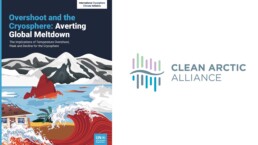

Responding to publication of two reports, Overshoot and the Cryosphere: Averting Global Meltdown and State of the Cryosphere 2026: The Cost of Overshoot by the International Cryosphere Climate Initiative (ICCI) and the UN Environment Programme (UNEP), which find that overshooting the 1.5°C Paris Agreement target, which is now inevitable, will cause large-scale, and perhaps irreversible changes, to melting ice sheets, glaciers, permafrost, sea ice and polar oceans, Dr Sian Prior, Lead Advisor to the Clean Arctic Alliance said:
“These reports acknowledge that global impacts and risks from the loss of snow and ice systems – the cryosphere – increases with every fraction of a degree of warming and that humans and the environment face greater risks from the melting of the cryosphere. The Arctic and Antarctic polar ice sheets covering Greenland and Antarctica are melting about six times faster now than 30 years ago.”
“Meanwhile, with the shipping industry currently responsible for some 3% of global GHG emissions as well as increasing emissions of the short-lived climate forcing pollutants black carbon and methane – recognised by the Overshoot report as having a disproportionate impact in the Arctic, it is essential that the sector immediately intensify efforts to rapidly reduce its climate impact through cutting emissions – and this means cleaner fuels and decarbonisation.”
“After 15 years of discussion on reducing the impact of black carbon emissions on the Arctic, a proposal on polar fuels is currently slated for the International Maritime Organization’s Pollution Prevention and Response meeting in January 2027”, said Prior. “If adopted by IMO Member States, a polar fuels regulation will have a major impact on reducing climate-heating black carbon emissions in the Arctic. The proposal, from Denmark, Germany, France and the Solomon Islands, must now be backed by Arctic countries, in particular Canada, Finland, Iceland, Norway and Sweden.”
The two Cryosphere reports state that a chance remains to limit such impacts can still be limited by minimising overshoot – this means sharply reducing emissions, coupled with a scaled-up carbon drawdown (when carbon in the atmosphere declines) and calls for a more rapid transition from fossil fuel dependency in order to manage the impacts to, for example to, Arctic sea ice and glacier ice.
The reports recognise that limiting global losses and damages from the cryosphere requires limiting the magnitude of peak warming as much as possible, keeping the duration of overshoot as brief as possible and returning to well below 1.5oC, and preferably to near or below 1.0oC as quickly as possible. Importantly, returning to 1.5oC following a brief overshoot is still feasible if efforts to reduce GHG emissions are intensified immediately and supported by deep reductions in short-lived climate forcers including black carbon to kick-start this pathway.
The reports:



Related News.

GNSS is an opinion: Apostolos Giannetsos on the Geopolitical Realities of Maritime Cyber Security
In an industry undergoing rapid digital transformation, the operational interface between vessel, satellite, and shore has become maritime’s most…

MOL holds joint naming ceremony for world’s 1st 3 ammonia-fueled capesize bulk carriers
New Beginning for Vessels Powered by Next-Generation Fuels as Group Moves toward Net-zero Emissions by 2050 Mitsui O.S.K. Lines, announced that on…

Infleqtion demonstrates timing and navigation capabilities during the Maritime Big Play Pacific Military Exercise
Infleqtion operated its Tiqker optical atomic clock continuously aboard the U.S. Navy’s RV Merlin support vessel, also in support of the BARB-26…
Offshore industry sends urgent call to EU policymakers for fit-for-purpose EU ETS and MRV framework
OFFSHORE INDUSTRY SENDS URGENT CALL TO EU POLICYMAKERS FOR FIT-FOR-PURPOSE EU ETS AND MRV FRAMEWORK Eight maritime associations including the Royal…

International Transport Employees Federation (ITEF) formed in Chennai to strengthen Seafarers’ Rights, Welfare, Safety and Justice Worldwide
Representatives of seafarers’ unions and transport workers’ unions, seafarers’ welfare organisations and maritime charitable institutions from across…
Indian Register of Shipping showcases five decades of Maritime Contribution and future-ready capabilities at INMARCO 2026
Indian Register of Shipping had an extensive presence at INMARCO 2026, held in Mumbai from 27–29 October 2026, with senior IRS professionals…
“K” LINE’s top management speak at TradeWinds Shipowners Forum Japan 2026
Sharing Information about the Resilience of the Maritime Shipping Industry in a Changing Business Environment Kawasaki Kisen Kaisha, announces that…
DP World strengthens China-Africa corridor with new shipping link
The China Africa Link strengthens maritime connections between the Far East and Africa, supporting more flexible supply chains and access to growing…

2026 Abu Dhabi Maritime Awards receives Record 132 Submissions, underlining Regional Industry Strength and Awards’ Rising Influence
Etihad Airways, Forbes Middle East, Caliber Watches, ADNEC Group, and Abu Dhabi International Boat Show announced as event partners Public voting…

HHLA PLT Italy expands its terminal in the Port of Trieste – parking capacity for 300 semi-trailers added
HHLA PLT Italy has brought around 37,000 square metres of the former Servola steelworks site into operation, creating parking capacity for…
Subscribe to our newsletter!
if you dont want to swim alone in the ocean of news, sign up for the newsletter, and you will receive daily all the important news of world shipping!
