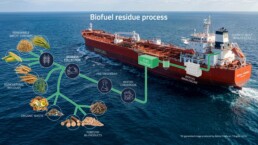

While corn, sugarcane, wheat, or vegetable oils can be converted into fuel, their use for food is driving demand to develop waste or bi-products from agricultural, forestry, food-processing and other biological industries as more prudent alternatives. Bio-residues can, for example, be used to derive fuels or fuel blends which promise to ‘drop-in’ as replacements for conventional oils to help ships reduce greenhouse gas emissions (GHGs).
Already, Fuel EU Maritime regulations financially incentivise the use of bio-residue, where a reduced emissions ‘surplus’ can be sold to ship operators in deficit to avoid compliance penalties.
A proposed revision to the EU ETS would introduce a technology neutral framework called SMAP (Sustainable Maritime Alternative Propulsion) to help close the cost gap between fossil and low-carbon fuels.
Furthermore, the Renewable Energy Directive (RED III) encourages the production of biofuel from residues including used cooking oil (UCO), some animal fat, Palm Oil Mill Effluent, tall oil (a pine wood pulp by-product), and lignocellulosic residues (from non-food plant parts), as well as forestry, agricultural and some industrial residues
In its initial form, the IMO Net Zero Framework (NZF) also envisaged ‘GHG pricing’, supported by a mechanism incentivising lower emissions, although administrations are currently divided on whether the measure is workable, or even desirable. Between 30 November and 3 December, the 85th Marine Environment Protection Committee meeting will test the basis on which the NZF can move forward.
Residual fuel demand
Nevertheless, demand for marine biofuels continues to grow. In its latest ‘Maritime Forecast to 2050’, DNV notes that 89.8% of in-service tonnage can operate only on oil fuels.
“This implies reliance on drop-in fuels such as fatty acid methyl ester (FAME) or hydrotreated vegetable oil (HVO) for decarbonization, unless these vessels are converted to use alternative fuels or equipped with onboard carbon capture and storage,” says DNV. “For vessels currently on order, 60.6% of the tonnage and 79.5% of the ships by number face similar limitations.”
Against this backdrop, it is likely that suppliers seeking to satisfy maritime demand will increasingly look beyond conventional feedstocks towards more complex bio-residue sources.
It is therefore worth acknowledging that bio-residues need to be treated as waste-derived fuel which require enhanced fuel-quality management and pollution preparedness.
Potential unintended consequences
As RED III applies to all industries, there will also be competition from the airline and heavy transport industries in the use of bio-residues, and we suspect this will create additional risks in the maritime sector.
Buyers in the sector may be exposed to lower-quality residues, for example, chemically variable feedstocks and/or blends from multiple residue streams. Pressure may mount on traceability systems, fraud risks may increase (due to misclassification of sustainability values in Proof of Compliance documents) and disputes over the chain of custody accumulate.
For ship operations, the risks may translate into oxidation instability, and greater variability in acidity and cold flow properties, or in degradation during storage. Lower quality fuels could foul injectors or cause fuel pump wear. More sediment could form and more blockages occur in purifiers and filters, and microbial growth could increase where residual contaminants or water are present.
Compatibility with conventional marine fuels and cross-contamination may also become issues when biofuel specifications are not reliable. Fuel incompatibility can cause issues with seals, gaskets, coatings and certain alloy metals.
Inconsistency in fuel composition between batches also has consequences for ship performance – during a single voyage and for the machinery condition over time. Uncertainty over long-term engine performance could easily result in higher maintenance costs.
Loss Prevention and bio-residues
Given the rising uptake of biofuels and the consequent risks, NorthStandard is recommending particular care in this area of marine fuel management. Members are advised to ensure that stringent tank cleaning requirements are upheld prior to use, for example.
Where standard fuel testing may not include parameters such as microbial growth, chemical contamination or other contaminants, NorthStandard recommends its Members consult fuel testing agencies for enhanced testing specific for biofuels.
General guidance to use reliable suppliers and require detailed fuel specifications and quality declarations is also supplemented by specific advice to avoid blending with other fuels unless compatibility testing confirms suitability. The P&I Club’s members can also use VPS fuel insights to check ISO Grade categorised data, but also the most common off-spec biofuel parameters, the suppliers with most ISO 8217 off specs at barge level and the ports with most off-spec fuels, among other information.
A general NorthStandard recommendation to minimise fuel storage duration is also augmented by counsel to undertake additional monitoring including temperature and water drainage, and to closely monitor purification, filtration, sludge production and fuel transfer system for abnormalities. Owners should also consider enhanced monitoring of fuel pumps, injectors and cylinder condition
Users of fuels derived from bio-residues should also ensure that their transfer procedures, spill contingency plans, Shipboard Oil Pollution Emergency Plan (SOPEP) and crew training are wholly suitable. They will also need to obtain and retain fuel composition documentation, including any blend information, as this will help with potential pollution clean-up actions for any properties that may disperse differently.
To ensure that uncertified products have not entered the supply chain, specific attention should also be given to certification such as the widely used International Sustainability & Carbon Certification ISSC EU. The right documentation is essential as proof that a biofuel is made from waste or residue as opposed to crops, to verify life cycle GHGs and to support 3rd party compliance audits.

By Mark Smith, Director – Decarbonisation, NorthStandard



Related News.

Meet the panellists of the CSN London Maritime Forum – Panel Discussion – “International Rule of Law; Is it a thing of the past?”
Meet the Panellists of the CSN London Maritime Forum "Shipping: Predicting an Unpredictable Future" - Panel Discussion - “International Rule of Law;…

1ST Joint Maritime Committee Meeting Cyprus and India
The 1st meeting of the Cyprus–India Joint Maritime Committee was held yesterday in Limassol, within the framework of the Bilateral Agreement on…

BSM expands offshore services with strategic investment in OffshoreCrew
Bernhard Schulte Shipmanagement has agreed to acquire a 50% stake in OffshoreCrew AS, a Norwegian specialist in offshore recruitment and crewing…

Australia’s accelerated coal phase-out demands swift dispatchable capacity replacement, says GlobalData
Australia operates one of the world’s fastest-decarbonizing power systems, marked by a rapid structural shift away from thermal baseload generation…

PATH TO NET ZERO: Shipping companies face slow low-carbon bunker transition
Intensity reduced, not total emissions Cost of green fuel much higher Cargo owners less willing to pay premiums This is the sixth…

Allied Weekly Market Review Week 39
Pls find below the Allied - Weekly Market Review - Week 39 ALLIED - Weekly Market Report- Week 39

DORIC MONTHLY CHINA BAROMETER SEPTEMBER 2026
Pls find below the DORIC MONTHLY - CHINA BAROMETER SEPTEMBER 2026 CHINA_BAROMETER_SEPTEMBER_2026

Intermodal Report Week 39 2026
Pls find below the Intermodal Report - Week 39 2026 Intermodal Report Week 39 2026

New Direct Travel sustainability report sets context for lower-carbon crew change travel
Scope 1, 2 and 3 emissions baseline established across the combined organisation Report highlights marine expertise in addressing travel-related…

Wirana urges Pakistan to give ship recycling scrap equal tax treatment
Wirana Shipping is calling on Pakistan to give scrap recovered from ship recycling the same tax treatment as imported scrap. The call follows several…
Subscribe to our newsletter!
if you dont want to swim alone in the ocean of news, sign up for the newsletter, and you will receive daily all the important news of world shipping!
