Sailing vessel ‘Batavia’ arrives at Damen Shiprepair Amsterdam to prepare for her final voyage, taking her onshore
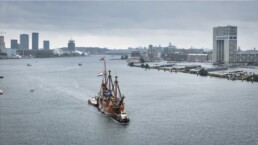

The wooden hull will be lowered into a purpose-built steel cradle in dry dock 4; the same dock she was launched from in 1995
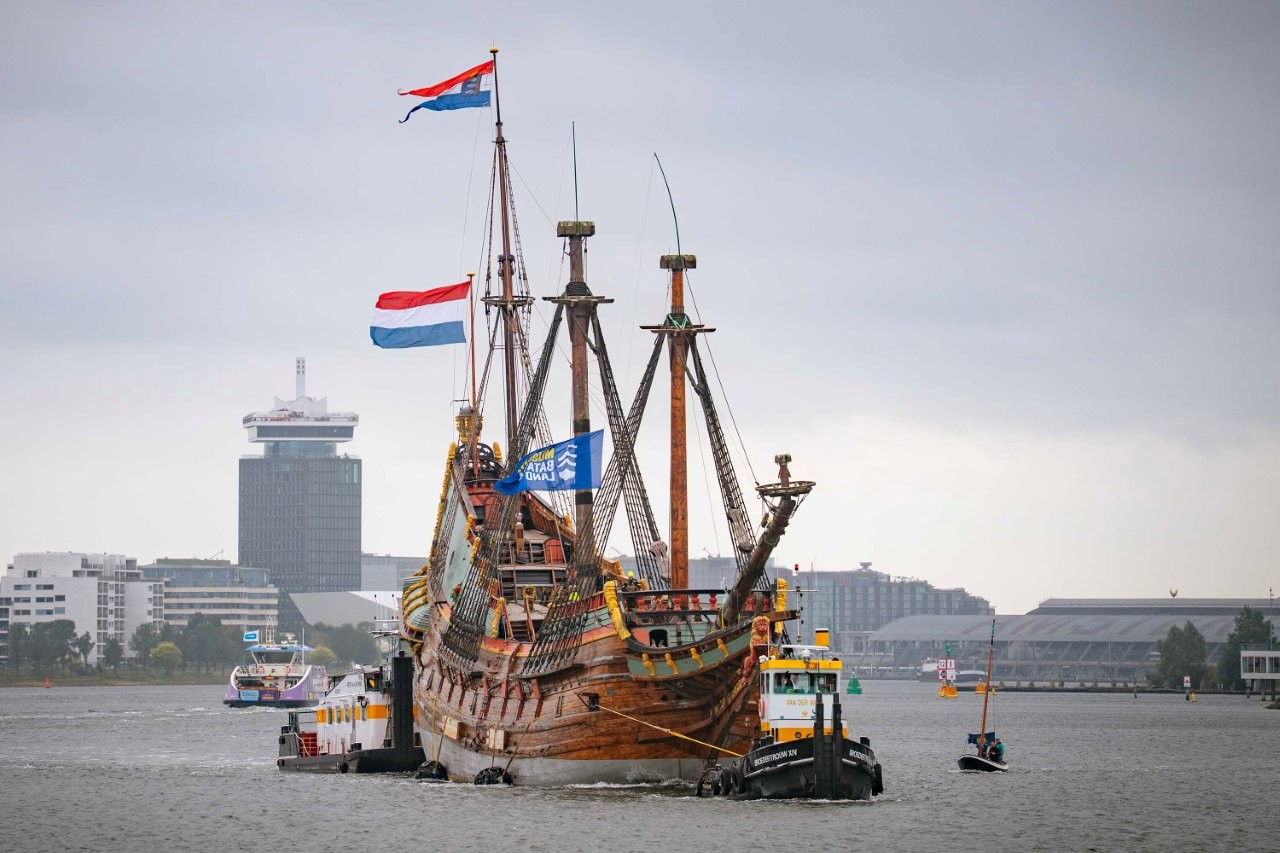
The Batavia, the full-scale reconstruction of the 1628 Dutch East India Company ‘retourschip’, arrived at Damen Shiprepair Amsterdam on Saturday 19 September after a six-hour tow. The 56.6-metre wooden ship made the passage afloat on her own hull, masts standing, under tow by two tugs of Koninklijke Van der Wees. At the Damen yard she will be lowered onto a 100+ tonne steel and wood cradle in dry dock 4, the first step in moving her permanently ashore at Museum Batavialand in nearby Lelystad.
A hull that cannot be replaced
The Batavia was towed rather than carried. Placing her on a pontoon for the passage would have introduced loads the hull is not built to carry, so she stayed in the water, with her full rig in place and a 30.5-metre air draught. The timber has been afloat for 31 years. In the 17th century these vessels could last between 15 to max. 25 years. Hence, the vessel must be handled with the utmost care. The hull is in fragile condition, which set strict weather limits on the operation: the ship could not be allowed to work or move excessively in a seaway. The guns and a large part of the ballast were removed in advance, and temporary steel shoring was fitted in the hold and on the decks to absorb the loads that arise once the supporting buoyancy of the water falls away.
Centimetre work in dry dock 4
The dry-docking follows a sequence engineered over the past 14 months. Crane mats are laid on a Van der Wees pontoon to distribute load, support pots are set on the mats, and the steel cradle – 39.7 metres long, 15.5 metres wide, 87.2 tonnes of steel and 14 tonnes of wood – is craned onto the pots from the quay. The pontoon is then ballasted down and submerged in dry dock 4, for which Damen Shiprepair designed a dedicated dock bed. Two small tugs manoeuvre the Batavia over the cradle, after which the dock is pumped down and the ship settles into her supports under controlled conditions.
Once dry, the remaining voids between hull and cradle are packed with timber, a task expected to take two days while the structure beds in. The pontoon is then deballasted, and the dockreflooded until it lifts the pontoon with the ship clear, and the Batavia is towed to the quay, where the remaining ballast is removed. She will leave Amsterdam at a hull weight of almost 650 tonnes.
Paul van de Craats, Commercial Manager at Damen Shiprepair Amsterdam: “I followed the construction of this ship during my own training years, under Mr Vos, and what struck me was that they built her authentically and taught young people the carpentry trade while doing it. We work the same way; we train our own people on the job to master ship repair. That is why this project means something here. Dutch maritime history came into dock 4 in 1995 and it is back now. In addition, the cradle carrying her, designed by Q3 Heavy Lift, was built by our sister company Niron Staal. We are incredibly proud to be part of this project coming full-circle.”
Where a wooden ship is strong
The load model behind the cradle took ten months to develop. FaraFlash established the ship’s dimensions and weight and produced the basic cradle design; Q3 Heavy Lift carried out the detailed engineering, including the support and jacking arrangement. Kuperus & Gardenier verified dimensions and weight and advised on the hull’s vulnerable areas – Jan Kuperus and Rienk Gardenier trained on the Batavia as apprentices under shipwright Willem Vos during her construction. Niron Staal fabricated the cradle. Trans Global Projects is responsible for project management, risk analysis, permitting and public safety.
Ard Suvaal, Project Manager at Trans Global Projects, says: “When we were contracted to arrange this project for Museum Batavialand, we wasted no time in bringing in the specialised subcontractors needed for this job. That is where our strength sits: making sure every link in the chain is present and delivered on time, including permits, the risk analysis, the interfaces between parties and more. We normally move transformers and offshore structures for a living. Nobody ever sees that work, except for the people who are inconvenienced by road closures and such. This project is different: it’s highly public and has enormous historical value. Both from a professional engineering point of view and from a personal perspective, it’s very special to suddenly manage the logistics of a reconstruction of a 17th-century East India vessel. And I am especially proud of the smooth collaboration between all partners; that is what brings success.”
The Batavia is scheduled to return to Lelystad on the pontoon on 1 October and to be moved ashore at Museum Batavialand on 2 October. The entire operation is part of Museum Batavialand’s large-scale redevelopment.
- Batavia dimensions: LOA 56.6 m, LBP 45.3 m, beam 10.5 m, air draught 30.5 m, draught 3.8 m
- Cradle: 39.7 × 15.5 m, 87.2 t + 14t of wood
- Project partners: Museum Batavialand (owner); Trans Global Projects (project management, risk analysis); Damen Shiprepair (dry dock operations, setting the ship in the cradle); Koninklijke Van der Wees (towage, pontoon); FaraFlash (weighing, dimensional survey, basic cradle design); Kuperus & Gardenier (verification, advice on design and vulnerable areas); Q3 Heavy Lift (detailed cradle engineering, SPMT transport, roll-off, jacking, final placement); Anton Bouw- en Betontechniek (concrete foundation); Niron Staal (cradle fabrication); Halyard Risk (risk assessment on behalf of the insurer)
- Commissioned by: Museum Batavialand, the Municipality of Lelystad, the Province of Flevoland and the Cultural Heritage Agency of the Netherlands
- The Batavia was launched and christened by Queen Beatrix on 7 April 1995 from this same dock
- A separate press release (and photo/video material) is in the making about the heavy lift transport operation to the ship’s final destination, involving specialized engineering, tugs, pontoons, SPMT’s, equipment, and more.
- All dates and times subject to weather and operational conditions



Related News.

Hong Kong Global Maritime Trade Summit to return for third edition
The International Chamber of Shipping, in collaboration with the Transport and Logistics Bureau of the Government of Hong Kong and the Hong Kong…

Appetite for US crude oil exports climbs despite high freight
South Korea tops US crude destinations at 568,600 b/d VLCC rates to Asia double, closing arbitrage window European refining margins…
Shipping stocks Rally as Hormuz Traffic plunges 75%
Ship traffic through the Strait of Hormuz — a critical chokepoint handling about 20% of global crude oil and liquefied natural gas shipments — has…
Diana Shipping announces Time Charter Contract for m/v G P Zafirakis with Classic Maritime
Diana Shipping, a global shipping company specializing in the ownership and bareboat charter-in of dry bulk vessels, announced that, through a…
New IMO ESP Code framework for Remote Inspection Techniques
The International Maritime Organisation, through Resolution MSC.584(111) , has adopted amendments to the International Code on the Enhanced…
ABS opens Offshore & Marine Support Center in Bergen
ABS has expanded its capabilities in the Norwegian maritime market with the opening of a cutting-edge support center in Bergen, bringing advanced…
MOL holds giant step memorial ceremony and beach cleanup at Kashima Coast
Memorial and Reflection 20 Years After the Accident: Learning from the Past to Foster an Even Stronger Safety Culture Mitsui O.S.K. Lines, announced…

KEZAD-based Arabian Gulf Steel Industries achieves lowest verified Carbon Footprint for Rebar
CARES UK verified Environmental Product Declaration confirms 139 kg CO₂e per tonne for rebar produced at AGSI’s KEZAD Abu Dhabi facility Arabian…
Indian Register of Shipping announces launch of first fleet support ship INS Surya
Indian Register of Shipping continues to strengthen its role in supporting the Indian Navy and India’s naval shipbuilding capabilities through the…

VLCCs Climbing the Record Charts
LR2 The TC1 75kt MEG/Japan index decreased by only a single point this week to WS928. The corresponding Baltic round-trip TCE fell by $2,000 to…
Subscribe to our newsletter!
if you dont want to swim alone in the ocean of news, sign up for the newsletter, and you will receive daily all the important news of world shipping!
