Ant International, Mastercard and Visa Initiate Collaboration on Know-Your-Agent Interoperability to Scale Agentic Commerce
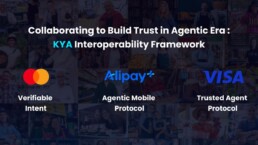

Ant International, Mastercard, and Visa have begun collaboration on a Know-Your-Agent (KYA) interoperability framework, designed to help card networks, digital wallet ecosystems, agent platforms and marketplaces streamline agent onboarding and identification across networks, based on shared principles while preserving each network’s own verification and decisioning processes.
AI agents are evolving from making recommendations to completing purchases on behalf of users. By 2030, AI agents are projected to orchestrate US$3 trillion to 5 trillion of global consumer commercei. Underlying the mega-trend is the KYA architecture of payment networks and service providers, which establishes requirements and accountability, verifies agent identities, and ensures secure, trusted transaction execution.
The three organizations have previously rolled out their respective protocols — Visa’s Trusted Agent Protocol, Mastercard Verifiable Intent, and Ant International’s Agentic Mobile Protocol — and will now explore opportunities to work towards common principles.
Recognized agent trust signals and streamlined agent onboarding across cards and wallets
The interoperable KYA framework could simplify and facilitate agentic payment transactions for service providers, agent platforms and marketplaces while upholding robust trust guardrails.
With this initiative, agents can benefit from KYA and identity frameworks that enable common trust signals to be recognized across the payment ecosystem. This helps reduce integration complexity and duplicative agent identity verification efforts while maintaining robust trust and risk controls.
This will enable faster time-to-market and lower integration cost for new agentic services with greater trust and risk visibility across participating networks.
The KYA collaboration centers on:
Cross-network Operator Traceability: Each agent is linked to a validated operator, cardholder, or business / organization, enabling clear attribution of agent activity.
Shared Certification Requirements: Each agent is assessed against security and behavioral requirements to ensure it operates as expected.
Continuous Transaction Monitoring: Each agent is continuously monitored and evaluated using a combination of identity and transaction-related signals to support ongoing assessments and certification.
The payments industry is accelerating collaboration to strengthen trust, common principles and governance in the agentic commerce ecosystem, with agent identity and trust as a key area of focus.
Building on the Safeguards for Agentic Finance at Runtime (SAFR) frameworkii, Ant International, Mastercard and Visa will collaborate through BuildFin.ai to advance common approaches for AI agent verification, accountability and risk management across payment ecosystems in Singapore. BuildFin.ai is an industry platform convened by the Monetary Authority of Singapore (MAS) to bring together financial institutions, technology providers and researchers to develop and scale responsible AI solutions for financial services.
The effort aims to support secure and scalable agentic commerce, enabling AI agents to operate safely and reliably across payment ecosystems while maintaining strong safeguards for consumers, merchants and financial institutions.
“As AI agents become a bigger part of how people discover and buy, trust must scale with them,” said Rubail Birwadker, Global Head of Growth Products and Strategic Partnerships, Visa. “Visa has played a leading role in creating the trust frameworks that make agentic commerce possible through the development of innovations such as Visa’s Trusted Agent Protocol. Collaborations like this can help create more consistency, better accountability, and greater confidence across the payments ecosystem as AI-driven transactions become more common.”
“Interoperability across Know-Your-Agent frameworks is essential to making agentic commerce work at scale, giving merchants, platforms, wallets and issuers a consistent way to recognise trusted agents, verify that actions reflect the user’s intent, and preserve accountability across the transaction,” said Pablo Fourez, Chief Digital Officer, Mastercard. “Mastercard Verifiable Intent was designed for this open ecosystem, helping ensure that as commerce becomes more autonomous, every interaction remains secure, transparent and grounded in consent.”
“Interoperable KYA between card and wallet networks is critical for securing trust for our payment partners, platforms and merchants in agentic commerce,” said Jiang-Ming Yang, Chief Innovation Officer of Ant International. “We look forward to expanding collaboration as the industry draws on richer signals — capabilities, behavior, execution performance, and risk data — to enhance trust and simplify transactions for our clients and their customers.”
Source: Business Wire



Related News.

Beyond Compliance to Uninterrupted Operations: Delia Shipping’s Konstantinos Stais on Maritime Cyber Resilience, LEO Expansion, and AI Governance
As the global maritime industry navigates an era of intense digital acceleration, the traditional boundaries separating shipboard operational…
Chinese AI quietly writes hackable code for Beijing’s Adversaries, even when run locally, study finds
Qwen3-Coder wrote hackable apps 19% more often for US defense contractors and leaked data 28% more often for Hong Kong activists, AI security firm…
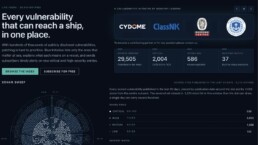
Industry leaders launch world’s first maritime-specific cyber vulnerabilities database
Cydome, ClassNK, Bureau Veritas, MTS-ISAC and Rakuten Maritime announce the “Blue Initiative”, an open collaboration to improve maritime cyber…

Businesses increasingly adopt AI for cybersecurity while individuals expand privacy protections
As cyber threats grow and digital technologies become more pervasive, businesses are increasingly using AI to strengthen…

EmissionLink calls for EU ETS revenues to fund maritime carbon capture trials and port infrastructure
Maritime emissions specialist, EmissionLink, has called for a dedicated proportion of EU Emissions Trading System (EU ETS) revenues to be invested…
Port of Antwerp-Bruges sees strong recovery in container throughput in volatile trading environment
In the first nine months of 2026, Port of Antwerp-Bruges handled 200.9 million tonnes of goods, 0.8% less than in the same period last year.…

Sanctions risks reshape commodity trading
Traders face sanctions challenge “odyssey” as geopolitical risks reformat global markets Commodity traders are operating in an increasingly…
Titan analysis shows FuelEU pooling propelled liquefied biomethane demand
- Clean fuel supplier evaluates compliance for 8,000 TEU containership operating in Northern Europe - FuelEU Maritime balances competitiveness…
Russian diesel tanker heads to New York as Kremlin claims regular shipments
Malta-flagged tanker should carry 40,000 mt fuel Agioi Fanendes left Primorsk Oct. 22: CAS US lifts sanctions, enables Russian imports……
Pilot transfer operation: A safer step aboard
Safe pilot transfer operations depend on both correct procedures and fit-for-purpose equipment. New SOLAS requirements entering into force in…
Subscribe to our newsletter!
if you dont want to swim alone in the ocean of news, sign up for the newsletter, and you will receive daily all the important news of world shipping!
