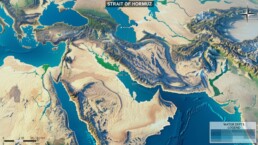

The new head of Iran’s Supreme National Security Council on Sunday said Tehran plans to announce an “exclusion zone” outside the Strait of Hormuz aimed at vessels it believes are attempting to transit the waterway.
Mohsen Rezaei’s comments to Iran’s state broadcaster came with few details, a day after the U.S. struck three Iranian oil tankers in response to Tehran launching ballistic missiles at U.S. warships. Experts called the launches a dangerous escalation after Iran’s previous attacks at sea targeted commercial shipping.
The new zone should be announced in the coming days and weeks and “will begin from the line of the U.S. naval blockade, extend toward the Strait of Hormuz, and from this side continue into the Persian Gulf,” Rezaei said. “Any ship that enters this area with the intention of passing through the Strait of Hormuz and is identified will be placed on our sanctions list.”
It is not clear where Iran defines the location of the weekslong U.S. blockade, which is aimed at Iranian ports and keeping Tehran from shipping out its oil. The U.S. military has said over 20 warships are supporting the blockade, which as of Sunday had redirected 92 commercial ships and disabled three.
The U.S. has been introducing new measures to increase the economic pain on Iran after negotiations collapsed and no end to the intermittent fighting appears in sight. Meanwhile, Iran continues to attack some ships trying to transit the strait, which has become an important source of leverage for Tehran in the war that began Feb. 28 with U.S. and Israeli strikes.
Iran earlier Sunday said it struck an unmanned U.S. vessel trying to enter the Strait of Hormuz, a claim that the U.S. military dismissed as a “total lie.”
Fighting resumed a week ago
The United States and Iran resumed attacks last week, following a month of relative calm, with the Strait of Hormuz and areas along Iran’s southern coast again being targeted. At least five people were killed earlier in the week during a U.S. bombardment that returned attention to the area where a school was hit in the war’s opening strikes.
The Trump administration appears to have adopted a dual-prong approach to the conflict, responding militarily to attacks on the strait while going after foreign financial institutions that handle Iran’s money.
But Tehran’s hard-line new senior leaders including Rezaei have signaled a willingness to dig in after weathering decades of sanctions. Iran has found ways over the years to circumvent sanctions, and now the U.S. blockade of its ports, and get its oil to buyers to help ease growing economic pressures.
On the matter of the collapsed negotiations with the U.S., Rezaei on Sunday expressed wariness not only of the U.S. but also of the mediators. The memorandum of understanding that the U.S. and Iran signed in mid-June began to fall apart within days as each side accused the other of violations.
“We had trusted our friends in Pakistan, Qatar or Oman, thinking that since they had stepped in as mediators, one of a mediator’s responsibilities is that if one side violates the agreement, they should stop them,” Rezaei said. “We are now pursuing diplomacy with guarantees.”
US says 9 million barrels of oil a day pass through the strait
The Strait of Hormuz is crucial to global oil and natural gas shipments and was seen as an international waterway before the war began.
On Sunday, U.S. Energy Secretary Chris Wright said that on average, 9 million barrels of oil a day are getting through the strait, which should help to relieve pressure on energy prices. His estimate appeared to exceed average flows over the past 28 days through the strait, according to TankerTrackers.com and other sources
Wright told CNN that with oil also flowing through pipelines in the region, “we’re probably two-thirds or more of preconflict flows.”
But those flows depend on the presence of the U.S. Navy to help escort tankers and provide some protection against possible Iranian attack. Wright said he expected that other countries would eventually support the Navy’s efforts.
Meanwhile, Iran’s Rezaei in his interview with state TV claimed that “every day we are selling one million, one and a half million (barrels), as if Iran’s oil production and trade are continuing as usual.”
Source: AP



Related News.

Hong Kong Global Maritime Trade Summit to return for third edition
The International Chamber of Shipping, in collaboration with the Transport and Logistics Bureau of the Government of Hong Kong and the Hong Kong…

Appetite for US crude oil exports climbs despite high freight
South Korea tops US crude destinations at 568,600 b/d VLCC rates to Asia double, closing arbitrage window European refining margins…
Shipping stocks Rally as Hormuz Traffic plunges 75%
Ship traffic through the Strait of Hormuz — a critical chokepoint handling about 20% of global crude oil and liquefied natural gas shipments — has…
Diana Shipping announces Time Charter Contract for m/v G P Zafirakis with Classic Maritime
Diana Shipping, a global shipping company specializing in the ownership and bareboat charter-in of dry bulk vessels, announced that, through a…
New IMO ESP Code framework for Remote Inspection Techniques
The International Maritime Organisation, through Resolution MSC.584(111) , has adopted amendments to the International Code on the Enhanced…

ABS opens Offshore & Marine Support Center in Bergen
ABS has expanded its capabilities in the Norwegian maritime market with the opening of a cutting-edge support center in Bergen, bringing advanced…
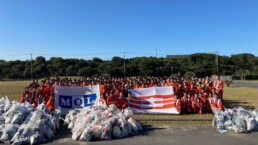
MOL holds giant step memorial ceremony and beach cleanup at Kashima Coast
Memorial and Reflection 20 Years After the Accident: Learning from the Past to Foster an Even Stronger Safety Culture Mitsui O.S.K. Lines, announced…

KEZAD-based Arabian Gulf Steel Industries achieves lowest verified Carbon Footprint for Rebar
CARES UK verified Environmental Product Declaration confirms 139 kg CO₂e per tonne for rebar produced at AGSI’s KEZAD Abu Dhabi facility Arabian…

Indian Register of Shipping announces launch of first fleet support ship INS Surya
Indian Register of Shipping continues to strengthen its role in supporting the Indian Navy and India’s naval shipbuilding capabilities through the…

VLCCs Climbing the Record Charts
LR2 The TC1 75kt MEG/Japan index decreased by only a single point this week to WS928. The corresponding Baltic round-trip TCE fell by $2,000 to…
Subscribe to our newsletter!
if you dont want to swim alone in the ocean of news, sign up for the newsletter, and you will receive daily all the important news of world shipping!
