EU to make last-minute decision on Arctic oil and gas drilling ban
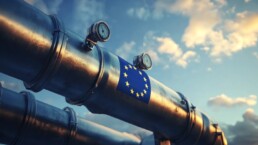

The European Union is expected to make a last-minute decision on banning new oil and gas exploration in the Arctic during a weekly meeting of the bloc’s 27 commissioners in October, according to two EU officials who spoke to Euronews on condition of anonymity.
Earlier media reports suggested that the EU is considering dropping its ban on new drilling in the Arctic in its revision of the 2021 Arctic strategy as the bloc is enduring an energy crisis triggered by the closure of the Strait of Hormuz, where 20% of the world’s gas and oil transit.
The Artic has become increasingly contested due to its abundant oil and gas reserves and critical raw materials — essential components for clean technologies and defence systems that are in high demand.
Russia and China have increased activity in the region, including through the “Ice Silk Road,” a regular Arctic shipping route linking eastern ports such as Ningbo with European hubs.
Hard-line rhetoric from the United States seeking to ‘acquire’ Greenland has also unsettled Europe, prompting the bloc to revise its 2021 Arctic strategy, with greater emphasis on defence and the region’s economic potential, even if indigenous people in the Arctic may be skeptical of its outcomes.
Drilling for oil and gas in the Arctic is perhaps one of the biggest sticking points in the upcoming EU strategy, which set a firm stance against it in 2021, declaring a commitment to ensure that “oil, coal, and gas stay in the ground.”
Germany, Sweden and Finland broadly backed the Commission’s position. Denmark had to thread a delicate balance, supporting the EU’s green ambitions while having limited ability to impose them on Greenland, its autonomous region, which controls its own vast mineral resources, including the estimated significant undiscovered oil and gas reserves.
At the time, the Commission proposed developing a multilateral legal obligation to ban new oil and gas exploration in the Arctic and contiguous regions — a proposal backed by Germany — but the strategy has ultimately remained a non-binding political commitment.
Ban or no ban?
The EU’s shift in approach to Arctic drilling was recently echoed by International Energy Agency chief Fatih Birol, who urged the bloc to reconsider its ban on new oil and gas exploration projects in the region, citing concerns over security of supply.
Estimates suggest the US-led war against Iran cost the EU an extra €60 billion in imported fossil fuels during the first 100 days of the conflict.
Unlike in 2021, the decision on whether to ban oil and gas drilling in the Arctic is a ‘yes-or-no topic’ that will be decided by the College of Commissioners, meaning the team of 27 top political leaders who head the Commission, according to one EU official.
Despite the IEA plea and strong lobbying from Norway — which holds vast deposits of oil and gas in the Barents Sea — for the ban to be scrapped, “the most likely is that the EU position remains the same”, a second EU official told Euronews.
However, given the strategy’s non-binding nature, the decision will ultimately lie with countries alone.
“I can tell you that many member states which are not Arctic countries have been extremely interested in the strategy,” the first EU official said.
Paal Frisvold, coordinator at the NGO Alliance to Preserve the Moratorium on Oil Drilling in the Arctic, said that despite the lack of legal instruments, the political weight OF WHAT? will affect other regions’ plans and strategies.
Nonetheless, while the EU wants a bigger geopolitical role in the Arctic, its main tool remains a non-binding strategy, leaving Brussels dependent on persuasion, money and cooperation from countries that actually control the region.
Norway’s hard stance
With a looming strategy and mounting fears of gas and oil supply shortages ahead of winter, Norway, a non-EU country and the EU’s top supplier of natural gas, said recently that it will continue exploring oil and gas regardless of the EU’s position.
“In today’s geopolitical and security environment, and given the resource situation, I believe continued activity in the Barents Sea serves both Norwegian and European interests,” the Norwegian Energy Minister Terje Aasland recently told Reuters.
Frisvold snubbed Minister Aasland’s remarks, saying that EU policies driving the climate and energy transition, like electrification and the shift to domestically produced clean energy, could lead to “stranded assets” if Norway decides to invest in new exploration.
“By 2040, these policies could reduce EU gas demand by around two-thirds. That matters when new discoveries in the northern Barents Sea can take 15–20 years to reach production. Fields discovered today risk coming on stream just as European gas demand is falling sharply, raising an obvious risk of stranded assets,” Frisvold told Euronews.
Grunde Almeland, a member of Norway’s parliament, the Storting, declined to speculate on the EU’s final decision but urged the bloc to maintain its opposition to new oil and gas drilling in the Arctic.
“The Arctic is an extremely vulnerable region, and it is already being heavily affected by climate change. We should protect this unique environment, not open up new areas for fossil fuel extraction,” Almeland told Euronews.
“Expanding Arctic oil and gas production is also not a sustainable way to address Europe’s long-term energy needs. Norway should help Europe accelerate the transition to clean energy, rather than push for more drilling in the Arctic.”
Economic potential vs indigenous people
According to the first EU official, who is involved in the Arctic strategy, the overall idea is to set priorities for the EU’s role in the Arctic and identify potential investments that can be co-financed by the EU budget. Economic and defence elements in the strategy will feature highly, the EU official added.
Mikael Janson, Director of the North Sweden European Office, where he coordinates a network of 14 regions in the European Arctic of northern Sweden, Eastern and Northern Finland, and Northern Norway, expressed concern that the upcoming Arctic talks will “once again lose track” of local and regional perspectives.
In general, all agree on the competitiveness advantage for the Arctic regions on investments in global green transformation and defence of the area’s integrity in the global power-grabbing we all see,” Janson told Euronews.
“It must go hand in hand with societal investments that reach all parts of communities and the interests and potential of small actors. What we lack in EU Arctic policy is a coherent EU response: one part of the EU institutions engages in indigenous dialogue, while another emphasises a “dig it up, babe” approach that ends up in our reality at the local level.”
Source: Euronews



Related News.

Highly successful conclusion of the 2nd CSN Northern European Crewing Conference in Hamburg: Crewing 5.0 in Focus
We are delighted to report the highly successful conclusion of the 2nd CSN Northern European Crewing Conference, which took place on the 22nd of…
Dualog launches secure messaging for ship and shore
Dualog has launched Dualog Chat, a secure messaging service built for shipping. The first service in Workspace by Dualog, Chat gives crews and shore…
India and the Widening Tanker Freight Squeeze
This week’s Tanker Market Monitor tracks India’s return to Iraqi supply as Gulf oil movements recover amid persistent shipping risk. Yanbu is…
Star Bulk announces strategic partnership with Hermes World Maritime
Star Bulk Carriers Corp. (the "Company" or "Star Bulk") (Nasdaq & Euronext Athens: SBLK), today announced that it has entered into a strategic…

Thai Cave Rescue Diver Chris Jewell to Bring Lessons in Risk and Safety to IMCA Global Summit
The International Marine Contractors Association (IMCA) will launch its new strategy to 2030 as hundreds of offshore leaders and technical…
Port call optimisation pilot projects reveal significant emissions savings potential
Commercial ships spend between 4% and 6% of their operating year waiting outside ports. That idle time is one of the clearest inefficiencies in…
Port Houston celebrates Historic Project 11 Milestone
Houston Ship Channel expansion strengthens safety, efficiency, and regional prosperity Port Houston joined federal, state, and local elected…
Global VLCC Spot Earnings rise to $805,000/Day
Clarksons Research, the data and analytics arm of the Clarksons Group, continue to track and monitor shipping activity and markets impacted by the…
IMO adopts frameworks to assess marine geoengineering research activities
New guidance will help governments evaluate marine geoengineering research proposals to ensure they are safe for the environment. The…
BIMCO adopts addendum to support investments in retrofit projects
The shipping industry is working to improve fuel efficiency and ship performance to address decarbonisation requirements, new regulations and rising…
Subscribe to our newsletter!
if you dont want to swim alone in the ocean of news, sign up for the newsletter, and you will receive daily all the important news of world shipping!
