Onboard carbon capture offers a practical CO2 emissions reduction pathway for shipping’s global fleet
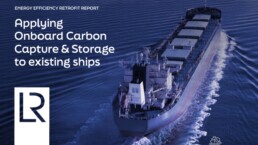

New report identifies onboard carbon capture as a viable CO₂ emissions reduction solution for global fleet, but warns that offloading infrastructure and regulatory certainty will determine uptake.
Onboard carbon capture and storage systems could play a significant role in helping shipping reduce CO2 emissions, while alternative fuel supply chains continue to develop, according to a new Lloyd’s Register (LR) report.
The report, Applying Onboard Carbon Capture & Storage to Existing Ships, comes as shipowners face increasing pressure to decarbonise and reduce CO₂ emissions. Only around 4% of the near-zero GHG emission fuel production capacity needed by 2030 has reached final investment decision. Alternative fuel-capable vessel orders have also fallen from 45% of contracted tonnage in 2024 to 37% in 2025.
Against this backdrop, the report argues that much of the fleet on order or in service today will continue to rely on conventional petroleum fuels well into the 2030s. For these vessels, oCCS offers an additional route to reducing CO₂ emissions alongside alternative fuels and energy efficiency technologies.
The research finds that specific oCCS technologies have moved beyond the concept stage and are entering commercial deployment. Current full-scale installations are capturing 30-40% of CO₂ emissions, while larger pilots are targeting capture rates of around 70%.
LR’s analysis identifies oCCS as a viable retrofit for a specific fleet segment: vessels with more than ten years of trading life remaining, significant exposure to carbon pricing, access to a credible CO₂ offloading chain and sufficient onboard space for capture equipment without unacceptable commercial penalties. For these ships, the technology could help extend commercial competitiveness as environmental regulations tighten and carbon costs increase.
The report identifies three market segments as the strongest near-term candidates for oCCS deployment: MR and chemical tankers trading on EEA routes, LNG-fuelled vessels able to harness the cryogenic cold energy released during the vaporisation of LNG to cool and liquefy CO₂ captured from exhaust gases, and short-sea or feeder vessels with frequent access to EEA ports and carbon pricing exposure.
Panos Mitrou, Senior Vice President of Shipping Strategy, Lloyd’s Register said: “The reality is that much of the fleet on order or in service today will still be operating well into the 2030s and beyond. While alternative fuels remain central to shipping’s long-term decarbonisation strategy, shipowners also need practical options for reducing CO₂ emissions from existing vessels.
“Onboard carbon capture has the potential to become an important part of shipping’s decarbonisation toolkit. For the right vessel types and trades, it offers a realistic pathway to reducing CO₂ emissions and managing carbon costs while fuel supply chains, infrastructure and regulations continue to evolve.”
While the report highlights significant opportunities, it also cautions that the technology is not a universal solution. Current oCCS systems can impose fuel consumption penalties of between 15% and 30% in many current applications and can require significant onboard space for capture equipment and CO₂ storage. Retrofit decisions must be assessed on a vessel-by-vessel basis, taking account of trading patterns, remaining asset life, carbon pricing exposure and access to CO₂ offloading infrastructure.
The main barrier to wider deployment remains the limited availability of ports and infrastructure capable of receiving captured CO₂. While major carbon storage projects are progressing in north-west Europe, including North Sea storage networks, the report identifies port reception facilities as the weakest link in the emerging carbon value chain.
The report also highlights the need for greater regulatory clarity. While EU ETS allows captured and permanently stored CO₂ to reduce compliance obligations, other frameworks, including FuelEU Maritime and future IMO regulations, are still evolving.
Looking ahead, broader deployment will depend on three key developments progressing in parallel: the outcome of FuelEU Maritime’s Article 30 review, IMO recognition of captured CO₂ within a global pricing framework, and expansion of CO₂ offloading infrastructure.
The report, which forms part of LR’s Retrofit Research Programme, was launched today at SMM in Hamburg. It is available from Lloyd’s Register at: Applying Onboard Carbon Capture and Storage to Ships | LR



Related News.

Hong Kong Global Maritime Trade Summit to return for third edition
The International Chamber of Shipping, in collaboration with the Transport and Logistics Bureau of the Government of Hong Kong and the Hong Kong…
Appetite for US crude oil exports climbs despite high freight
South Korea tops US crude destinations at 568,600 b/d VLCC rates to Asia double, closing arbitrage window European refining margins…
Shipping stocks Rally as Hormuz Traffic plunges 75%
Ship traffic through the Strait of Hormuz — a critical chokepoint handling about 20% of global crude oil and liquefied natural gas shipments — has…
Diana Shipping announces Time Charter Contract for m/v G P Zafirakis with Classic Maritime
Diana Shipping, a global shipping company specializing in the ownership and bareboat charter-in of dry bulk vessels, announced that, through a…
New IMO ESP Code framework for Remote Inspection Techniques
The International Maritime Organisation, through Resolution MSC.584(111) , has adopted amendments to the International Code on the Enhanced…

ABS opens Offshore & Marine Support Center in Bergen
ABS has expanded its capabilities in the Norwegian maritime market with the opening of a cutting-edge support center in Bergen, bringing advanced…

MOL holds giant step memorial ceremony and beach cleanup at Kashima Coast
Memorial and Reflection 20 Years After the Accident: Learning from the Past to Foster an Even Stronger Safety Culture Mitsui O.S.K. Lines, announced…

KEZAD-based Arabian Gulf Steel Industries achieves lowest verified Carbon Footprint for Rebar
CARES UK verified Environmental Product Declaration confirms 139 kg CO₂e per tonne for rebar produced at AGSI’s KEZAD Abu Dhabi facility Arabian…

Indian Register of Shipping announces launch of first fleet support ship INS Surya
Indian Register of Shipping continues to strengthen its role in supporting the Indian Navy and India’s naval shipbuilding capabilities through the…

VLCCs Climbing the Record Charts
LR2 The TC1 75kt MEG/Japan index decreased by only a single point this week to WS928. The corresponding Baltic round-trip TCE fell by $2,000 to…
Subscribe to our newsletter!
if you dont want to swim alone in the ocean of news, sign up for the newsletter, and you will receive daily all the important news of world shipping!
