Cyprus’s next big opportunity is at Sea: How AI can transform shipping into a pillar of the new economy
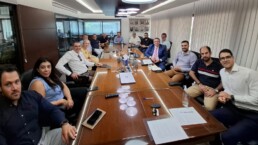
An exclusive CSN interview by Adonis Violaris with Demetris Skourides, Chief Scientist for Research, Innovation and Technology, and Chairman of the National Working Group for Artificial Intelligence.
Demetris, welcome to CSN. We often hear about Artificial Intelligence in abstract terms, but you argue that Cyprus’s next major technological opportunity does not need to be built from scratch; it is already right in front of us, at sea. How exactly can the shipping industry lead this transition?
Adonis, Cyprus shipping possesses exactly what many other sectors are still struggling to build. We have scale, an international presence, a highly regulated environment, significant digital maturity, and above all, a massive volume of operational data. The Cyprus Shipping Chamber counts around 200 major shipowning, shipmanagement, chartering, and shipping-related companies. Its members own, control, or manage over 2,900 vessels with a combined gross tonnage exceeding 161 million GT, while the sector supports about 4,500 onshore professionals and over 80,000 seafarers. This foundation gives us the opportunity to move past theoretical discussions and apply AI where it can produce real economic value.
Having been actively involved in maritime ICT for decades, I know very well that this industry demands practical solutions. What immediate applications do you foresee, and what is the bigger picture for Cyprus?
The immediate applications are already visible. Predictive maintenance can minimise a vessel’s unnecessary downtime. Voyage optimisation helps reduce both costs and emissions. Digital tools can simplify complex regulatory procedures, while better data utilisation between ship and shore improves safety and decision-making. The real bet, however, is much bigger. It is about whether we can build a new generation of exportable services around shipping, such as Maritech, cybersecurity, digital twins, regulatory technology (RegTech), and advanced digital applications. Essentially, using a comparative advantage we already have to create our next one.
Such an evolution requires close cooperation with the relevant authorities and institutions. You recently held consultations with the Cyprus Shipping Chamber, including its Director General Alexandros Josephides and the Digitalisation Committee Chairman Manolis Manoli. How does your strategy align with the industry’s real needs and the ongoing work of the Shipping Deputy Ministry?
The leadership of this effort naturally belongs to the Shipping Deputy Ministry. Under Deputy Minister Marina Hadjimanolis, significant actions regarding competitiveness, innovation, and digital transformation have already been promoted, such as the Cyprus Shipping One-Stop-Shop. The proposed National AI Strategy does not aim to create a parallel maritime strategy. Instead, it is here to enhance what is already being done through initiatives like a Maritime AI Programme. Our consultation with the Shipping Chamber was incredibly useful because our strategy must meet the everyday reality of the vessel, the shore office, cybersecurity demands, and regulatory compliance.
European shipping is facing immense challenges, from decarbonisation to the security of supply chains. How does AI address these issues without undermining the human element?
AI is not an end in itself; it is a tool. It helps reduce administrative burdens, protects digital ships, and supports emissions management. We must be very clear here, AI changes jobs, but it does not remove responsibility. It is here to enhance human judgment, not replace it. If we save an experienced professional from hours of repetitive paperwork and data cross-referencing, we give them back the time to focus on risk assessment and complex decision-making. At the same time, new specialisations are being created, such as data stewards, digital twin experts, RegTech professionals, and cybersecurity analysts. AI can propose and predict, but the ultimate responsibility remains with suitably trained professionals.
Finally, how do you envision Cyprus positioned within the international maritime and technological landscape in the coming years?
Our opportunity goes far beyond the purely economic dimension. Small countries gain international influence not by competing in size, but by developing capabilities and solutions that others trust and choose to adopt. Cyprus can evolve into a European testing and validation base for digital ships, autonomous systems, drone inspections, and advanced ship-to-shore communications. By combining this with our maritime research and international partnerships, we can create an ecosystem that attracts startups and established global corporations. This will keep high-quality jobs, intellectual property, and high-value decision-making right here in Cyprus. That is our true goal, to turn decades of maritime expertise into our greatest technological advantage for the future.



Related News.

Spyros Papavassiliou honoured with the “Ge’ Néo Epicheirein” 2026 Award in the Shipping Enterprises category
Celebrating leadership, entrepreneurial excellence and a strong contribution to Cyprus shipping. Island Energies is proud to announce that Mr Spyros…
ABP welcomes HANSEATIC spirit the largest ever cruise ship to visit the Port of Ipswich
Hapag-Lloyd Cruises’ expedition vessel, HANSEATIC spirit, becomes the largest cruise ship ever to visit Ipswich, highlighting the growing appeal of…
Prime Tanker Management deploys ShipIn across its entire fleet to improve safety performance
Master-led use of operational insight supports measurable improvement across PPE, bridge, and technical performance while strengthening fleet-wide…

Goltens Worldwide enters into agreement for sale to HD Hyundai Marine Solution
Proposed acquisition supports long-term growth while preserving Goltens’ independence and commitment to customers Goltens Worldwide announced that it…
Port of Piraeus receives special award marking 10 years since COSCO SHIPPING joined its Shareholding Structure
Award presented at the 9th Infrastructure and Transport Conference ITC 2026 A significant milestone in the history of Piraeus Port Authority and the…

Seafarers’ voices must shape the future of mental health support at sea, says OneCare Group
The shipping industry must listen more closely to the lived experiences of seafarers if it is to build working environments that genuinely protect…

Bangladesh’s Chittagong Port Authority and DP World sign 15 year concession for new Mooring Container Terminal
The Chittagong Port Authority and DP World have signed a 15-year concession agreement for the operation and maintenance of the New Mooring Container…

ABP’s HELM Immingham opens for business
Associated British Ports marked the official opening of its HELM Immingham site, a 227-acre industrial and logistics development site. Seen as one…
Veson Nautical and Marcura expand partnership to Streamline Demurrage Management
Marcura Claims now integrates with IMOS, giving joint clients another way to manage demurrage. Global maritime technology leaders Veson Nautical and…
Thermal Weakness Drags Global Coal Flows Lower
Global seaborne coal flows fell 6.7% year on year in September 2026 to 115 Mt. Thermal coal drove the decline, and a rise in met coal flows was not…
Subscribe to our newsletter!
if you dont want to swim alone in the ocean of news, sign up for the newsletter, and you will receive daily all the important news of world shipping!
