MacGregor advances direct ship-to-well LCO₂ transfer, built on 50 years of proven bow-loading technology
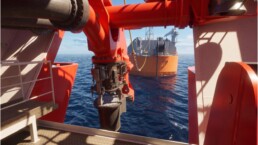

New Bow Transfer System enables flexible, direct connection between LCO₂ carriers and offshore injection sites, removing the need for costly onshore buffer and conditioning facilities
MacGregor has developed a new Liquid Carbon Dioxide Bow Transfer System to enable safe, reliable ship-to-well and ship-to-rig transfer of LCO₂ across a wide range of operating conditions. The system connects capture plants directly to offshore injection units, removing the need for the costly intermediate onshore storage and conditioning facilities that current standards often require.
The BTS builds on MacGregor’s Bow Loading System (BLS), which has served the oil and gas sector reliably since the 1970s. Around 79% of the new system draws on field-proven technology, with the remainder comprising targeted modifications and newly engineered components designed specifically to handle the highly volatile properties of LCO₂.

Seal materials for the system have been tested with research organisation SINTEF under rapid gas decompression and LCO₂ conditions, maintaining integrity through repeated pressure cycles and temperatures as low as -57°C, the threshold below which CO₂ can no longer exist in a liquid state. The system is designed to support safe, uninterrupted handling in heavy sea states with wave heights of five to six metres, and to seal against water ingress at depths of up to 150 metres.
“Our robust new design solves the challenges of securing reliable and safe connection, transfer, and disconnection in all seasons, even in severe weather, without delays or interruptions,” said Øyvind Solli, Development Programs Manager, MacGregor. “This ensures zero disruption across the value chain, directly supporting the business case for CCS projects.”

MacGregor’s hardware is designed as the foundation for four distinct system architectures, spanning low- and medium-pressure (30–60 bar) and high-pressure (300 bar) direct reservoir injection via seabed swivels or disconnectable turrets — giving operators flexibility to match the system to their specific field requirements.
MacGregor joined the EU-funded COREu research and innovation consortium in early 2025 and is engaged in an ongoing technology qualification process with DNV. The company has completed the planning phase of this process — comprising a qualification basis, technology assessment, threat assessment and qualification plan — with prototype testing and demonstration expected in mid-2027.

“At this stage, we have successfully identified all risks associated with our equipment and its application for LCO₂ transfer,” said Solli. “DNV has formally acknowledged these findings, and together, we have established a framework for managing and mitigating the identified risks, including the specific methods required to provide the evidence for final verification.”
MacGregor will present the LCO₂ Bow Transfer System at ONS 2026 in Stavanger, 24–27 August, Hall 5, Stand 5540.



Related News.

Navigating the Multi-Orbit Era: In Conversation with Intellian’s Jon Harrison at SMM 2026
At SMM 2026 in Hamburg, the rapid evolution of maritime satellite communications took centre stage. Across the exhibition halls, discussions among…

Cyprus ports need joint energy and investment strategy, shipping agents chief says
Cyprus needs a coordinated strategy for shipping, energy and environmental protection to support port investment and modernisation, Cyprus shipping…

MASO Public Affairs introduces MASO Regulatory Intelligence
A new subscription service helping businesses understand what is changing and what it means for them MASO Public Affairs introduces MASO Regulatory…

Anglo-Eastern helps turn CMBTECH’s ammonia ambition into an operational reality
From early feasibility study and risk-based design to newbuilding supervision, crew readiness and technical management, Anglo-Eastern drew on its…

Escalation of attacks threatens to derail recovery in Middle East oil exports
World oil demand is forecast to fall by 2.5 mb/d y-o-y in 4Q26 and 2.6 mb/d on average in 2026. As the Iran war manifests itself through restricted…

New study finds shipping pays twice its share to EU ETS earmarked revenues should triple to help build market for sustainable fuels and technologies
Shipping is responsible for around 10% of EU ETS emissions but pays almost 20% of the ETS bill. Unlike other sectors, it has never received free…

MSARC strengthens maritime mass rescue readiness through training and national live exercise off Dakar, Senegal
Joint MSARC–FHAS programme combines three days of SAR training with a national multi-agency live exercise The Maritime Search and Rescue Council ,…

Sogese report deliveries are still being delayed as container freight rates fluctuate
FOR IMPORTERS Spot rates into the Mediterranean are back at January levels, Far East to Europe reliability sits at pandemic lows, and nearly…

Glencore begins trading on Australian Securities Exchange
Glencore has begun trading on the Australian Securities Exchange under the ASX code GLC. Gary Nagle, Glencore’s CEO, said it was an exciting day for…

BIMCO Shipping Number of the Week
Suez Canal container ship transits exceed 50% of pre-disruption levels "During the first two weeks of October, weekly container ship capacity…
Subscribe to our newsletter!
if you dont want to swim alone in the ocean of news, sign up for the newsletter, and you will receive daily all the important news of world shipping!
