Southeast Asia to deliver less than one-third of planned gas power capacity by 2030

Southeast Asia is expected to deliver less than one-third of its planned gas-fired power capacity by 2030, according to new research from Wood Mackenzie, highlighting a widening gap between government ambitions and project execution.
Across six major Southeast Asian power markets, governments are targeting approximately 53 GW of new gas-fired capacity by 2030. However, Wood Mackenzie forecasts that only 14.9 GW will reach commercial operation, as volatile fuel cost, equipment shortages, financing constraints and infrastructure bottlenecks delay project development.
“The challenge today is not planning power projects but executing them. New gas-fired capacity depends on several critical enablers, including LNG infrastructure, project financing, and turbine availability. A bottleneck in any one of these areas can delay an entire project,” said Alvin Tan, Southeast Asia power and renewables research analyst at Wood Mackenzie.
The report, Is Southeast Asia Being Gaslighted? A Deep Dive Into Southeast Asia’s Gas-to-Power Market, further finds that only 11 GW of the planned gas-to-power pipeline has secured gas turbines. The remaining planned capacity, which has yet to secure gas turbines, is likely to face delivery lead times of at least five years.
Southeast Asia’s electricity demand is projected to grow 2.4-fold by 2050, outpacing China, Australia and South Korea. Growth is being fuelled by industrial expansion, the China+1 manufacturing shift and rising investment in semiconductor production, electronics and hyperscale data centres. Wood Mackenzie forecasts that gas demand from the power sector will more than double between 2026 and 2050, accounting for more than one-quarter of regional electricity generation by mid-century.
Energy security adds a new layer of complexity
Wood Mackenzie expects Southeast Asia to become a net gas importer by 2033, with LNG projected to supply more than 80% of regional gas demand by 2050. However, delivering the region’s planned gas capacity is becoming increasingly challenging. While gas turbine shortages have emerged as the most visible constraint, project timelines are also being affected by fuel availability, LNG infrastructure, financing, permitting and equipment procurement.
“Gas was once seen as a key enabler of Southeast Asia’s energy transition, capable of meeting rising electricity demand, supporting the integration of renewable energy, and, most importantly, maintaining energy security. Today, that assumption is being challenged. As gas project delays mount and supply chains tighten, policymakers are being forced to rethink not only the role of gas in the near term, but also the long-term pathways to achieving their energy transition goals,” said Wei Han Tan, Southeast Asia power and renewables research analyst at Wood Mackenzie.
Vietnam: the largest delivery gap
Vietnam faces the region’s widest gap between ambition and delivery. While the government targets 29.4 GW of new gas-fired capacity by 2030, Wood Mackenzie expects only 3.7 GW to come online. Early LNG-to-power projects have exposed commercial challenges around fuel pricing and cost allocation, while uncertainty over domestic gas supply and project timing continues to delay development.
Malaysia: extending existing capacity
Peninsular Malaysia is managing near-term execution risk by extending nearly 5 GW of existing gas-fired capacity through 2030, providing a temporary bridge while new projects progress. Wood Mackenzie forecasts 5.9 GW of new capacity additions against a requirement of around 9.4 GW, underscoring the continued need for new-build gas capacity to meet future demand and maintain system reliability. At the same time, the government is exploring the repurposing of retiring coal plants into renewable energy hubs.
Indonesia: equipment constraints slow progress
Indonesia has secured turbine supply for only 200 MW of its planned 8.4 GW gas capacity pipeline, the lowest proportion among the markets analysed. While abundant domestic coal reduces near-term reliability risks, it may also slow decarbonisation. As a result, Indonesia is placing greater emphasis on accelerating solar deployment alongside selective gas development.
Singapore: best positioned, but not immune
Singapore remains the region’s strongest performer on project execution, with turbine supply secured for all major projects expected before 2030. However, its next procurement round for 1.8 GW of hydrogen-ready generation capacity will test whether even well-prepared markets can continue to navigate tightening global equipment supply.
Philippines: delivery delays threaten reliability
The Philippines faces immediate supply adequacy challenges, highlighted by simultaneous red alerts across the Luzon and Visayas grids in May 2026. Wood Mackenzie forecasts only 0.4 GW of new gas capacity against a government target of around 2 GW by 2030. Beyond project delays, fragmented responsibility for long-term resource planning remains a key structural challenge.
Thailand: managing surplus capacity
Thailand’s challenge is managing an oversupplied power system. Draft PDP2024 targets 1.4 GW of new gas capacity by 2030, while Wood Mackenzie expects only 0.5 GW to be delivered. The bigger question is how policymakers address surplus generation capacity locked into long-term power purchase agreements while advancing the country’s energy transition.
Source: Wood Mackenzie



Related News.

Hong Kong Global Maritime Trade Summit to return for third edition
The International Chamber of Shipping, in collaboration with the Transport and Logistics Bureau of the Government of Hong Kong and the Hong Kong…

Appetite for US crude oil exports climbs despite high freight
South Korea tops US crude destinations at 568,600 b/d VLCC rates to Asia double, closing arbitrage window European refining margins…
Shipping stocks Rally as Hormuz Traffic plunges 75%
Ship traffic through the Strait of Hormuz — a critical chokepoint handling about 20% of global crude oil and liquefied natural gas shipments — has…
Diana Shipping announces Time Charter Contract for m/v G P Zafirakis with Classic Maritime
Diana Shipping, a global shipping company specializing in the ownership and bareboat charter-in of dry bulk vessels, announced that, through a…
New IMO ESP Code framework for Remote Inspection Techniques
The International Maritime Organisation, through Resolution MSC.584(111) , has adopted amendments to the International Code on the Enhanced…

ABS opens Offshore & Marine Support Center in Bergen
ABS has expanded its capabilities in the Norwegian maritime market with the opening of a cutting-edge support center in Bergen, bringing advanced…
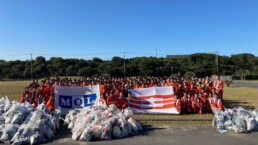
MOL holds giant step memorial ceremony and beach cleanup at Kashima Coast
Memorial and Reflection 20 Years After the Accident: Learning from the Past to Foster an Even Stronger Safety Culture Mitsui O.S.K. Lines, announced…

KEZAD-based Arabian Gulf Steel Industries achieves lowest verified Carbon Footprint for Rebar
CARES UK verified Environmental Product Declaration confirms 139 kg CO₂e per tonne for rebar produced at AGSI’s KEZAD Abu Dhabi facility Arabian…
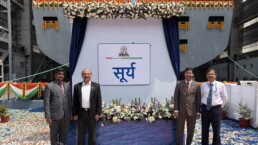
Indian Register of Shipping announces launch of first fleet support ship INS Surya
Indian Register of Shipping continues to strengthen its role in supporting the Indian Navy and India’s naval shipbuilding capabilities through the…

VLCCs Climbing the Record Charts
LR2 The TC1 75kt MEG/Japan index decreased by only a single point this week to WS928. The corresponding Baltic round-trip TCE fell by $2,000 to…
Subscribe to our newsletter!
if you dont want to swim alone in the ocean of news, sign up for the newsletter, and you will receive daily all the important news of world shipping!
