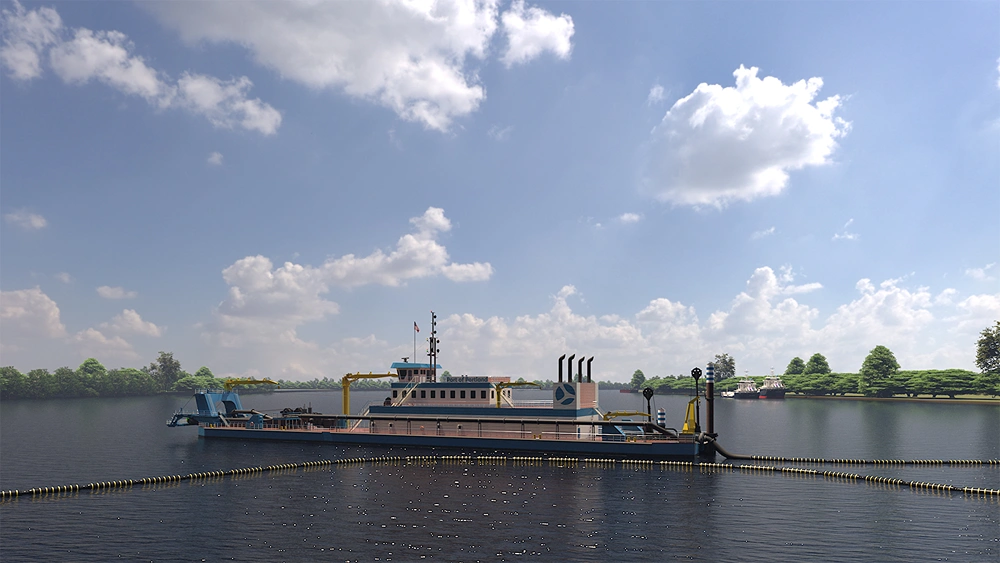
Future-Proofing the Dredge
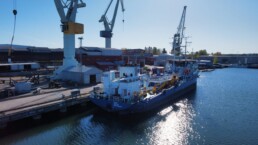

Designing practical pathways for changing requirements and long-term performance
A dredge delivered in 2026 may still be working in 2055. Its core mission – moving sediment efficiently, safely and reliably – may remain familiar, but the conditions around that mission will not. Project requirements, environmental constraints, digital systems and energy infrastructure will continue to change during the vessel’s operational life.
That makes flexibility a commercial design decision. The objective is not to predict every future requirement or build unnecessary capability into the vessel from day one. It is to identify the changes that are sufficiently plausible, then avoid early design decisions that would make those changes disproportionately expensive, disruptive or impractical later.
Avoiding overbuild while keeping options open
A dredge should first be optimized for its intended operational profile. The type of sediment, production requirements, sailing distances, discharge method, project geography and environmental operational windows will all shape the right vessel and mission-equipment configuration. Future readiness should not weaken that day-one fit by adding weight, complexity or cost for possibilities that may never materialize.
The more disciplined approach is to distinguish between equipment that must be installed now and provisions that are relatively inexpensive to make during the original design. Depending on the vessel and its likely future duties, those provisions might include reserved space and weight, accessible foundations, lifting and removal routes, spare electrical capacity, adaptable switchboards, cooling margins, cable routes or machinery-room arrangements that allow a defined future upgrade to be carried out without reconstructing major parts of the vessel.
This is not flexibility for its own sake. Every allowance should relate to a credible use case, such as a later battery package, an upgraded emissions-control system or a revised control-room arrangement. The value comes from avoiding the discovery, years later, that new equipment will not fit without relocating existing systems, modifying major structures or reopening machinery, electrical and access arrangements that were already settled during the original build.

Changing project requirements start with the operational profile
Environmental requirements can change how dredging work must be performed, but the design implications depend on the vessel’s expected project profile. Sediment characteristics, production requirements, transport distances, discharge methods, operating windows and placement locations all influence the right combination of vessel and mission equipment.
A dredge intended to support several discharge or placement methods may require different pumping capacity, connections, routing or equipment arrangements from one built for a narrower and well-defined duty. The design question is therefore not how to prepare the vessel for every possible future project. It is whether a particular change in the owner’s expected work is credible enough to justify preserving a conversion path.
An owner may not require a shore-discharge arrangement at delivery but may foresee projects where pumping material to land becomes commercially important. The design team can then assess whether relatively modest provisions for space, structural support, routing, access and power would avoid having to relocate existing systems or significantly reconstruct the vessel later.
The environmental objective may shape the project, but it is the resulting operational requirement that creates the vessel-design question.
Keep energy flexibility proportional to reality
The same discipline applies to energy-system optionality. A future hybrid package, battery installation, shore connection or alternative-fuel conversion may be commercially plausible for some dredges and remote for others. The answer depends on power demand, duty cycle, project location, available infrastructure, machinery arrangement and the owner’s likely investment horizon.
Where a pathway is credible, preserving the physical and electrical conditions required for a later conversion may protect the option. But that provision is not automatically worthwhile. The decision should compare four factors: what the allowance costs now, what disruption and reconstruction it could avoid later, how likely the conversion is to occur and whether the allowance imposes any penalty on the vessel’s day-one cost or performance.
A modest cable route, adaptable switchboard or accessible foundation may be easy to justify. Reserving substantial space, weight or generating capacity for an uncertain technology may not be. Future readiness has value only when the cost of preserving the option is proportionate to both its likelihood and its potential benefit.
Future-proofing a dredge does not mean preparing it for every conceivable sediment, fuel, technology or regulatory scenario. That approach can add cost and complexity while compromising the performance of the vessel the owner needs today.
It means starting with a clear operational profile, identifying the changes that are plausible enough to matter and determining which provisions are sensible to make before steel is cut and the vessel’s principal systems and arrangements become difficult to change.
This requires choices. Some future capabilities may justify reserved space, structural support, electrical capacity or an adaptable arrangement. Others should remain later equipment or supplier decisions. Some will be too uncertain to warrant any provision at all. Making those distinctions clearly is more valuable than attempting to keep every theoretical option open.
The dredges that remain competitive through the decades will not necessarily be those designed to do everything. They will be those that perform their core mission exceptionally well from day one while preserving carefully selected pathways for the changes most likely to matter next.
Related News.
September 24, 2026
Cyprus Marine Club Welcomes a Full House for Aphentrica’s War Risks Presentation
The Cyprus Marine Club marked its return after the summer break with a full house at Gazebo Mare on Tuesday, 22 September, bringing together members,…
September 24, 2026
IMO seeks feedback on Maritime Single Window implementation
The International Maritime Organization (IMO) has launched a global survey to assess the implementation and use of Maritime Single Windows (MSWs),…
September 24, 2026
World Maritime Day industry panel to examine the gap between maritime policy and the reality of life at sea
OneCare Group will bring together crewing, safety, insurance and wellbeing specialists for a World Maritime Day webinar examining how shipping can…
September 24, 2026
IUMI President – Marine insurers are war insurers
Marine insurers are at the heart of managing war risks to global shipping and must continue to develop the tools needed to support and facilitate…
September 24, 2026
Seafarer welfare is improving amongst leading companies, but five years of evidence shows this progress is far from the norm
Five years on, the Seafarers’ Rights Code of Conduct is driving more than 1,000 companies to participate in RightShip’s Crew Welfare…
September 24, 2026
The UK ETS arrives for shipping what it means for charterers
Introduction The UK Emissions Trading Scheme (UK ETS) was extended to domestic maritime activity on 1 July 2026, following the EU ETS, FuelEU…
September 24, 2026
ABP Southampton invests locally with Marine Cranes to boost capability
Associated British Ports , the UK’s largest port operator, has invested a new marine deck crane aboard Spartina, one of the Port of Southampton’s…
September 24, 2026
BIMCO Shipping Number of the Week
Caribbean Basin crude oil and heavy product exports jump 45% “Seaborne exports of crude oil and heavy products from the Caribbean Basin have…
September 24, 2026
xclusiv S&P Report 21th September 2026
Pls find below the [xclusiv] S&P Report 21th September 2026 [xclusiv] 2026_09_21
September 24, 2026
Marine insurance supply remains stable as geopolitical and technical changes reshape the market, says IUMI President
The global marine insurance market remains in a stable position, with premium growth strongly supported by a weak USD in hull and cargo. Meanwhile…
Subscribe to our newsletter!
if you dont want to swim alone in the ocean of news, sign up for the newsletter, and you will receive daily all the important news of world shipping!
Design & Development by P.KAN.DESIGNER
© 2026 Cyprus Shipping News. All rights reserved
Design & Development by P.KAN.DESIGNER
© 2026 Cyprus Shipping News. All rights reserved