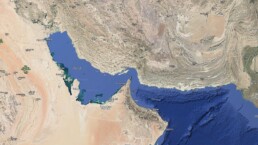

Disruption in the Strait of Hormuz has exposed the vulnerability of global trade to a single maritime chokepoint, with early data showing sharp falls in exports of energy, fertilizers and industrial products.
Exports of natural gas dropped by a staggering 95 per cent.
The finding comes in analysis published by the International Trade Centre (ITC), a multilateral agency that has a joint mandate with the World Trade Organization (WTO) and UN trade and development body UNCTAD.
Critical maritime corridor
The Strait, located south of Iran, is responsible for around one quarter of global seaborne oil trade and a significant share of liquefied natural gas flows and fertilizers, including a third of globally traded urea.
Since the military escalation in late February, reduced commercial passage, concerns over navigational safety and higher transport and insurance costs have affected trade flows far beyond the region.
Although recent lulls in the fighting have raised hopes that shipping could resume more fully, traffic remains far below normal levels.
Strategic products examined
The analysis focuses on 12 strategically important energy, fertilizer and industrial products for which Hormuz-dependent economies are important global suppliers.
This group comprises Bahrain, Iran, Iraq, Kuwait, Qatar, Saudi Arabia and the United Arab Emirates.
Trade data for April reveals that combined merchandise exports across all products from these economies declined by 21 per cent in value.
The ITC noted, however, that export values are also affected by sharp movements in international commodity prices triggered by the disruption itself, therefore changes in physical quantities provide complementary evidence on the extent of the disruption to actual trade flows.
Decline in exports
Across all 12 products, export volumes fell between April 2025 and April 2026. Combined export volumes declined by 54 per cent, with liquified natural gas recording the steepest contraction, 95 per cent.
Urea exports declined by 83 per cent, followed by methanol (80 per cent) and ammonia (75 per cent. Polymers of propylene (or polypropylene) – used for plastic packaging in consumer goods – were the least affected, declining by 24 per cent.
The largest absolute losses were in energy products such as crude petroleum oil exports, which fell by 28 million tonnes, followed by refined petroleum oils and liquefied natural gas which declined by 7.3 million tonnes and 5.5 million tonnes respectively
“Sizeable falls in fertilizers, chemicals, plastics and aluminium show that the disruption affected a broader range of industries and supply chains,” the authors noted.
Importers seek alternatives
Meanwhile, importing markets were not affected in the same way, depending on factors such as reliance on Hormuz suppliers, access to inventories and strategic reserves, domestic demand and ability to source from alternative suppliers.
Japan, for example, historically sourced 91 per cent of its crude petroleum oil imports from Hormuz-dependent economies. In April, the country recorded a 64 per cent decline in total imports. Other highly dependent markets such as the Republic of Korea and Malaysia faced the same situation.
In contrast, Thailand recorded a 62 increase as refiners moved to secure additional cargoes from alternative suppliers and maintain supplies during the disruption.
Alternative suppliers in fact increased shipments for 10 of the 12 selected products across all reporting markets, yet these gains fully offset lower imports from Hormuz-dependent economies only for ammonia and polymers of propylene.
The finding suggests that trade diversion had begun but had not fully replaced disrupted supplies by April as some markets may have drawn on inventories or strategic reserves, increased domestic production where possible, or reduced consumption.
The ITC update also examined other aspects of the crisis, including trade measures adopted in response to the disruption such as policies aimed at ensuring adequate access to supplies, particularly of crude and refined oil.
Source: United Nations



Related News.

Hong Kong Global Maritime Trade Summit to return for third edition
The International Chamber of Shipping, in collaboration with the Transport and Logistics Bureau of the Government of Hong Kong and the Hong Kong…

Appetite for US crude oil exports climbs despite high freight
South Korea tops US crude destinations at 568,600 b/d VLCC rates to Asia double, closing arbitrage window European refining margins…
Shipping stocks Rally as Hormuz Traffic plunges 75%
Ship traffic through the Strait of Hormuz — a critical chokepoint handling about 20% of global crude oil and liquefied natural gas shipments — has…

Diana Shipping announces Time Charter Contract for m/v G P Zafirakis with Classic Maritime
Diana Shipping, a global shipping company specializing in the ownership and bareboat charter-in of dry bulk vessels, announced that, through a…
New IMO ESP Code framework for Remote Inspection Techniques
The International Maritime Organisation, through Resolution MSC.584(111) , has adopted amendments to the International Code on the Enhanced…

ABS opens Offshore & Marine Support Center in Bergen
ABS has expanded its capabilities in the Norwegian maritime market with the opening of a cutting-edge support center in Bergen, bringing advanced…
MOL holds giant step memorial ceremony and beach cleanup at Kashima Coast
Memorial and Reflection 20 Years After the Accident: Learning from the Past to Foster an Even Stronger Safety Culture Mitsui O.S.K. Lines, announced…

KEZAD-based Arabian Gulf Steel Industries achieves lowest verified Carbon Footprint for Rebar
CARES UK verified Environmental Product Declaration confirms 139 kg CO₂e per tonne for rebar produced at AGSI’s KEZAD Abu Dhabi facility Arabian…

Indian Register of Shipping announces launch of first fleet support ship INS Surya
Indian Register of Shipping continues to strengthen its role in supporting the Indian Navy and India’s naval shipbuilding capabilities through the…

VLCCs Climbing the Record Charts
LR2 The TC1 75kt MEG/Japan index decreased by only a single point this week to WS928. The corresponding Baltic round-trip TCE fell by $2,000 to…
Subscribe to our newsletter!
if you dont want to swim alone in the ocean of news, sign up for the newsletter, and you will receive daily all the important news of world shipping!
