SAP connecting cargo how live positioning is streamlining supply chains


Hapag-Lloyd has equipped 2 million shipping containers with tracking devices that transmit location data in real time. SAP uses this data in its ERP systems to help businesses identify potential delays and adjust their production schedules accordingly. Carriers, buyers, and production planners all over the world are benefiting.
Managing logistics operations has become increasingly challenging in recent years. The coronavirus pandemic and its repercussions caused unprecedented disruption across global supply chains, and today, hostilities in the Strait of Hormuz are severely hindering shipping traffic.
In situations like these, the only option many companies have to protect their manufacturing and delivery timelines from delays and uncertainties is to carry larger inventories. This inevitably leads to higher costs.
Now, a combination of container tracking technology and real-time data is revolutionizing supply chain visibility, enabling businesses to keep their inventories at efficient levels. Hapag-Lloyd, the world’s fifth-largest shipping company, provides live position data for its containers. SAP uses this information in its ERP systems and SAP Business Network Global Track and Trace cloud solution, connecting it to the shipment and material data that is stored there. Which means that, as well as being an SAP customer, Hapag-Lloyd is an SAP supplier and partner, too.
Karsten Schmidt, director and product owner of the Live Position and Track & Trace tools at Hapag-Lloyd, and Sven York Pohl, chief expert for Digital Adoption at SAP SE, discuss how the collaboration between the companies began, how it is benefiting users already, and what opportunities lie ahead.
Q: Tracking technology has advanced rapidly in recent years. What sparked the wave of innovation we’ve seen here?
Schmidt: Until recently, we could only track certain milestone events in sea shipping, such as a container arriving at a port or being loaded onto a ship. We knew when a container had been loaded onto a ship or when it left the Port of Hamburg, but if it failed to arrive in Munich as planned, we had no way of knowing what had happened to it.
Q: So how do you track containers today?
Schmidt: After the pandemic, we decided to equip all our dry containers with IoT tracking devices that continuously transmit location data. By mid-2024, we had fitted these devices to 90% of our container fleet. Since then, we have been able to track more than 2 million containers worldwide and provide position data every 15 minutes for shipments on land—and every six hours for shipments by sea. This means that our customers can check the precise location of “their” containers online in real time.
Q: How did the collaboration between Hapag-Lloyd and SAP begin?
Pohl: I was involved in an SAP transformation project at Hapag-Lloyd, which meant I had frequent meetings with Karsten. We realized early on that position data had immense potential, both for Hapag-Lloyd as a shipping company and for its customers. If you know exactly when an intermediate product will arrive, or how many days late it will be, you can plan your downstream production steps with pinpoint precision. And this obviously works best if position data is visible not only on a separate website, but also in the applications you use to manage your production and other business processes. So Karsten and I began discussing how we could feed position data into SAP ERP systems.
Q: Which SAP applications use this data?
Pohl: The SAP Business Network Global Track and Trace cloud solution offers companies transparent shipment information in real time along the entire supply chain. And it enables this data to be embedded natively in back-end systems. Which means, for example, that you can integrate automated alerts directly into SAP S/4HANA that show where a container is currently located. The data can also be leveraged in SAP’s cloud-based supply chain collaboration platform, SAP Business Network for Logistics, to seamlessly connect shippers with logistics services providers and carriers. And, aside from ensuring visibility, real-time data such as that provided by Hapag-Lloyd maximizes supply chain security and drives sustainability by enabling businesses to track materials from their source to the finished product.
Q: Who benefits most from Hapag-Lloyd’s tracking data?
Schmidt: Logistics managers, definitely. Because they need precise information about where their containers are located and when they will arrive. The tracking data also provides insights into how sustainable a transportation chain is. Warehouse planners benefit too, because they can keep inventory levels as low as possible, without them dropping too low. And as well as enabling carriers to plan their routes with maximum efficiency, tracking data can also help streamline and optimize payment processes.
Q: Would you say that the current conflict in the Middle East has highlighted the value—and necessity—of using tracking technology to plan shipping routes?
Schmidt: Absolutely. A huge number of containers have been transported from the Persian Gulf across Saudi Arabia to the Red Sea port of Jeddah to be shipped on from there. Our container tracking solution keeps me constantly updated on the land route I have chosen and on where my container is currently located.
Q: What happens if the container is held up somewhere? How does the system help?
Schmidt: That’s what we’re working on right now. Usually, when customers want to know where their container is, they call our customer service number. But with 15,000 containers held up in the Persian Gulf, we were unable to handle the sheer volume of inquiries we received by phone. So we gave all our customers access to our live positioning service, even those who had not booked it. The solution we implemented to deal with this exceptional situation showed us the potential that was there going forward to simplify our customers’ processes—and our own.
Pohl: Looking ahead, SAP users will be able to ask their software what options they have when shipments get held up, and what alternative modes of transportation are available to them.
Schmidt: If, for example, a ship is delayed and misses its scheduled rail connection, the system will provide a predictive service, telling the user whether onward transportation by truck is possible and how much longer the journey will then take.
Pohl: We will also use Joule, the flagship AI brand that is built into SAP’s cloud portfolio, for this service, so that users will be able to ask AI to suggest specific actions.
Schmidt: Obviously, when goods are transported over long distances, and especially by sea, you can never rule out delays entirely. But what we can do is remove that feeling of helplessness and of having no room to maneuver when events occur that are out of my control.
Hapag-Lloyd container tracking
- Hapag-Lloyd has equipped 2 million standard containers with IoT tracking devices that transmit their current position in real time.
- Customers can constantly monitor the position of their shipments online.
- SAP integrates position data into its SAP Global Track and Trace cloud solution and embeds it in its cloud ERP back-end systems.
- Looking ahead, when shipments are delayed, these systems will proactively suggest alternatives and recommended actions.
- Joule will also help users make informed decisions that support efficiency in the supply chain.



Related News.

Navigating the Multi-Orbit Era: In Conversation with Intellian’s Jon Harrison at SMM 2026
At SMM 2026 in Hamburg, the rapid evolution of maritime satellite communications took centre stage. Across the exhibition halls, discussions among…
Cyprus ports need joint energy and investment strategy, shipping agents chief says
Cyprus needs a coordinated strategy for shipping, energy and environmental protection to support port investment and modernisation, Cyprus shipping…

MASO Public Affairs introduces MASO Regulatory Intelligence
A new subscription service helping businesses understand what is changing and what it means for them MASO Public Affairs introduces MASO Regulatory…
Anglo-Eastern helps turn CMBTECH’s ammonia ambition into an operational reality
From early feasibility study and risk-based design to newbuilding supervision, crew readiness and technical management, Anglo-Eastern drew on its…

Escalation of attacks threatens to derail recovery in Middle East oil exports
World oil demand is forecast to fall by 2.5 mb/d y-o-y in 4Q26 and 2.6 mb/d on average in 2026. As the Iran war manifests itself through restricted…

New study finds shipping pays twice its share to EU ETS earmarked revenues should triple to help build market for sustainable fuels and technologies
Shipping is responsible for around 10% of EU ETS emissions but pays almost 20% of the ETS bill. Unlike other sectors, it has never received free…

MSARC strengthens maritime mass rescue readiness through training and national live exercise off Dakar, Senegal
Joint MSARC–FHAS programme combines three days of SAR training with a national multi-agency live exercise The Maritime Search and Rescue Council ,…
Sogese report deliveries are still being delayed as container freight rates fluctuate
FOR IMPORTERS Spot rates into the Mediterranean are back at January levels, Far East to Europe reliability sits at pandemic lows, and nearly…

Glencore begins trading on Australian Securities Exchange
Glencore has begun trading on the Australian Securities Exchange under the ASX code GLC. Gary Nagle, Glencore’s CEO, said it was an exciting day for…
BIMCO Shipping Number of the Week
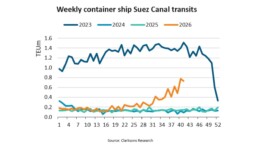
Suez Canal container ship transits exceed 50% of pre-disruption levels "During the first two weeks of October, weekly container ship capacity…
Subscribe to our newsletter!
if you dont want to swim alone in the ocean of news, sign up for the newsletter, and you will receive daily all the important news of world shipping!
