China restarts LNG re-exports on sufficient summer supply, stronger JKM
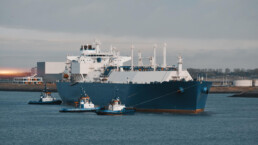

Chinese LNG buyers have resumed commercial re-export activity after a three-month pause, as stronger Northeast Asian spot LNG prices and weaker-than-expected domestic demand made selling cargoes abroad more profitable than marketing them within China, according to shipping data and market sources.
The LNG carrier Maran Gas Posidonia loaded about 67,695 mt of LNG from CNOOC Gas & Power’s Binhai LNG terminal on July 2 and discharged the cargo at Japan’s Chita terminal July 10, marking the first market-driven re-export from mainland China since reload activity effectively halted in April, shipping data compiled by S&P Global Energy CERA showed.
A second cargo aboard the Mu Lan was recorded reloading LNG at Hainan on July 15 and departed July 22, the data showed, although its final destination had not been confirmed. Market participants said Thailand was a potential destination for the cargo.
The restart follows a suspension in LNG reloads since April as concerns mounted over domestic supply security after the outbreak of the conflict involving Israel, Iran and the US, which led to disruptions in the Strait of Hormuz and uncertainty surrounding Middle Eastern LNG supply, Platts, part of S&P Global Energy, reported earlier.
Prior to the suspension, China recorded a record 12 LNG reload cargoes in March, according to the shipping data.
Although two LNG cargoes were reloaded from Hainan and delivered to Hong Kong in June, traders said those shipments were viewed as supporting Hong Kong’s summer gas demand rather than signaling a return to commercial re-exports.
Domestic demand disappoints
Chinese buyers returned aggressively to the spot market during April and May to secure summer supplies after concerns emerged over potential disruptions to Qatari LNG exports, Platts reported.
Trade sources said importers also purchased additional spot cargoes after LNG prices softened following the signing of a memorandum of understanding between Iran and the US in late June.
As a result, China’s LNG imports rose for a second consecutive month in June, increasing 8.3% year over year and 16.8% month over month to 5.68 million mt, according to customs data.
However, domestic demand has failed to keep pace with rising imports.
Despite the National Energy Administration saying China’s power load hit a record amid heat and economic growth, demand from gas-fired power plants remained weak, industry sources said.
According to sources, gas-fired power plants in South China have generally been able to keep turbines operating only at marginal profitability, while some East China utilities have struggled to maintain utilization rates.
“Many imported excess volume for summer, but demand has not been as strong as expected,” a source at a Chinese trading company said. “Power generation demand is not keeping up.”
Re-export economics improve
The economics of selling imported LNG into the domestic market have deteriorated significantly in recent weeks, market participants said.
According to traders, many of the cargoes purchased during April and May were acquired at around $16-$17/million British thermal units, equivalent to roughly Yuan 6,000-6,300/metric ton ($887-$931/mt) at prevailing exchange rates and LNG conversion factors.
Meanwhile, trucked LNG prices at eastern and southern coastal receiving terminals averaged around Yuan 5,923/mt so far in July, data from the Shanghai Petroleum and Natural Gas Exchange showed, implying that some imported cargoes could generate little or no margin — and potentially losses of around Yuan 100-400/mt — if sold into the domestic market.
By contrast, Platts JKM rose above $17/MMBtu on July 7 and September deliveries were assessed at $21.602/MMBtu July 21, reopening arbitrage opportunities for reload exports. July JKM averaged $18.783/MMBtu, according to Platts data.
The spread between domestic LNG prices and prevailing Northeast Asian spot values has created a stronger incentive for Chinese importers to redirect surplus cargoes into overseas markets rather than sell them domestically, trading sources said.
“If you consider the arriving July shipment imports, it’s more than profitable to sell at current price levels elsewhere,” a trader said. They estimated that cargoes purchased for July delivery could theoretically generate more than $3/MMBtu in margin if sold into the spot market instead of the domestic Chinese market.
More reloads expected
Offers for potential reload cargoes had increased noticeably in recent weeks, market participants said.
Market participants said the Chinese NOCs were seeking additional reload opportunities and potential buyers in both East Asia and Southeast Asia.
“There are inquiries from both Northeast Asia and Southeast Asia,” a trader said. “Domestic supply is sufficient, local selling prices are low, and reload margins are attractive.”
Market participants said the Mu Lan cargo was likely headed to Thailand to meet prompt demand, with the cargo originally a US Plaquemine export that was redirected.
PTT partially awarded a tender for August and September shipments July 16 and issued another tender for early September delivery July 22, creating near-term demand that Chinese reload cargoes could fill, trading sources said.
“Apart from Thailand, some cargoes can also be reloaded into Northeast Asia,” a Beijing-based source said, adding that Northeast Asian buyers were actively seeking fourth-quarter cargoes, although obtaining attractively priced supply remained difficult.
The latest cargoes suggest Chinese buyers are once again using reloads as a portfolio-optimization tool after prioritizing domestic supply security during the Middle East crisis, potentially restoring China as a meaningful source of reload volumes in the Asia-Pacific LNG market.
Source: Platts



Related News.

Navigating the Multi-Orbit Era: In Conversation with Intellian’s Jon Harrison at SMM 2026
At SMM 2026 in Hamburg, the rapid evolution of maritime satellite communications took centre stage. Across the exhibition halls, discussions among…

Cyprus ports need joint energy and investment strategy, shipping agents chief says
Cyprus needs a coordinated strategy for shipping, energy and environmental protection to support port investment and modernisation, Cyprus shipping…

MASO Public Affairs introduces MASO Regulatory Intelligence
A new subscription service helping businesses understand what is changing and what it means for them MASO Public Affairs introduces MASO Regulatory…

Anglo-Eastern helps turn CMBTECH’s ammonia ambition into an operational reality
From early feasibility study and risk-based design to newbuilding supervision, crew readiness and technical management, Anglo-Eastern drew on its…

Escalation of attacks threatens to derail recovery in Middle East oil exports
World oil demand is forecast to fall by 2.5 mb/d y-o-y in 4Q26 and 2.6 mb/d on average in 2026. As the Iran war manifests itself through restricted…

New study finds shipping pays twice its share to EU ETS earmarked revenues should triple to help build market for sustainable fuels and technologies
Shipping is responsible for around 10% of EU ETS emissions but pays almost 20% of the ETS bill. Unlike other sectors, it has never received free…

MSARC strengthens maritime mass rescue readiness through training and national live exercise off Dakar, Senegal
Joint MSARC–FHAS programme combines three days of SAR training with a national multi-agency live exercise The Maritime Search and Rescue Council ,…

Sogese report deliveries are still being delayed as container freight rates fluctuate
FOR IMPORTERS Spot rates into the Mediterranean are back at January levels, Far East to Europe reliability sits at pandemic lows, and nearly…

Glencore begins trading on Australian Securities Exchange
Glencore has begun trading on the Australian Securities Exchange under the ASX code GLC. Gary Nagle, Glencore’s CEO, said it was an exciting day for…

BIMCO Shipping Number of the Week
Suez Canal container ship transits exceed 50% of pre-disruption levels "During the first two weeks of October, weekly container ship capacity…
Subscribe to our newsletter!
if you dont want to swim alone in the ocean of news, sign up for the newsletter, and you will receive daily all the important news of world shipping!
