The Nautical Institute launches BRM Volume 2 to support safer, smarter voyage planning


New publication completes The Nautical Institute’s two-volume Bridge Resource Management series
The Nautical Institute has launched Bridge Resource Management Volume 2: Voyage planning, a new technical guide designed to help bridge teams plan, execute and monitor voyages safely in an increasingly complex operating environment.
The publication, launched at Trinity House, London, on 3 July, is the second and final volume in The Nautical Institute’s Bridge Resource Management series. It complements BRM Volume 1: The human element by focusing on the technical and practical aspects of voyage planning, while keeping teamwork, communication and decision-making central to safe bridge operations.
Voyage planning is under increasing scrutiny as bridge teams work with more digital information, electronic navigation tools, environmental compliance requirements and emerging technologies. At the same time, operational pressures can leave less time for planning to be properly discussed, understood and reviewed.
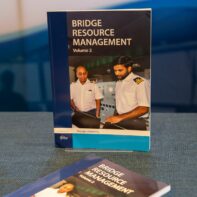
BRM Volume 2: Voyage planning responds to those challenges by setting out what good voyage planning looks like in practice. The book covers the planning stages required for safe ship operations, the use of electronic tools, route optimisation, risk mitigation, contingency planning, monitoring, decision-making and the impact of emerging technologies on modern bridge resource management.
It is complementary to IMO Model Course 1.22 and builds on The Nautical Institute’s long-standing work to support professionalism, safety and best practice across the maritime industry.
Steven Gosling AFNI, Head of Information and Publications at The Nautical Institute, said: “Much has changed in the world of voyage planning. The tools and technologies on the bridge today, the provision of digital information and the increasing emphasis on compliance, particularly environmental compliance, mean voyage planning is under more scrutiny than ever.
“Yet even as planning becomes more complex, there is often less time available to engage in it. To meet these challenges, voyage planning must be smart, efficient and well directed. This is where BRM Volume 2 comes in.
“Volume 1 and Volume 2 are two inseparable and interdependent sides of the same coin. One is about the people on the bridge and how they interact; the other is about planning and the tools available to support it. Together, both volumes encourage a culture in which people are fully supported, informed and in control, where everybody has a voice and is empowered to speak up particularly when things do not go to plan.”

Dr. Captain Mohammad Nadeem Anwar FNI, lead author of BRM Volume 2: Voyage planning, said voyage planning must be understood as a continuous operational discipline, not a static document.
“The most important thing is to make sure bridge teams are fully aware of all the known and anticipated factors that may affect the voyage, and that every aspect is addressed during the planning stage,” he said.
“But the plan must also remain under review. The maritime environment is not static. Traffic, weather, voyage instructions, equipment condition and operational circumstances can all change. Voyage planning must remain a living process, not simply a document completed , signed off and then followed without review.”
Professor Captain Zakirul Bhuiyan FNI, co-author of BRM Volume 2: Voyage planning, said bridge teams now have access to more information than ever before, but must be trained to use it effectively.
“Voyage planning is no longer only about chartwork and compliance. Bridge teams now have access to data from ECDIS, radar, GPS, voyage monitoring systems and external support tools. The challenge is not simply having data, but knowing which information is relevant and how to use it safely.
“That requires a balance between people, procedures and technology. We cannot ignore the importance of training, nor can we allow traditional navigational skills to disappear. Human judgement, cross-checking, communication and teamwork remain essential if bridge teams are to use technology effectively and avoid over-reliance on any single system.”
Walter Vervloesem FNI, President of The Nautical Institute, said the launch reflected The Nautical Institute’s wider mission to support professional standards and safer operations.
“This is not just about putting a line on a chart. It is about considering everything that may affect the voyage and ensuring the bridge team has the opportunity to discuss, challenge and make well-informed decisions.
“Good bridge resource management depends on teamwork. Modern bridge operations are complex, and they cannot be managed effectively by one person alone. By bringing together the human element and the technical discipline of voyage planning, this volume supports the professionalism, safety and best practice that The Nautical Institute exists to promote.”
Bridge Resource Management Volume 2: Voyage planning is intended for new and existing bridge teams – masters, watchkeeping officers and other personnel involved in the voyage planning phase of vessel management and operation.



Related News.

Navigating the Multi-Orbit Era: In Conversation with Intellian’s Jon Harrison at SMM 2026
At SMM 2026 in Hamburg, the rapid evolution of maritime satellite communications took centre stage. Across the exhibition halls, discussions among…
Cyprus ports need joint energy and investment strategy, shipping agents chief says
Cyprus needs a coordinated strategy for shipping, energy and environmental protection to support port investment and modernisation, Cyprus shipping…

MASO Public Affairs introduces MASO Regulatory Intelligence
A new subscription service helping businesses understand what is changing and what it means for them MASO Public Affairs introduces MASO Regulatory…
Anglo-Eastern helps turn CMBTECH’s ammonia ambition into an operational reality
From early feasibility study and risk-based design to newbuilding supervision, crew readiness and technical management, Anglo-Eastern drew on its…

Escalation of attacks threatens to derail recovery in Middle East oil exports
World oil demand is forecast to fall by 2.5 mb/d y-o-y in 4Q26 and 2.6 mb/d on average in 2026. As the Iran war manifests itself through restricted…
New study finds shipping pays twice its share to EU ETS earmarked revenues should triple to help build market for sustainable fuels and technologies
Shipping is responsible for around 10% of EU ETS emissions but pays almost 20% of the ETS bill. Unlike other sectors, it has never received free…
MSARC strengthens maritime mass rescue readiness through training and national live exercise off Dakar, Senegal
Joint MSARC–FHAS programme combines three days of SAR training with a national multi-agency live exercise The Maritime Search and Rescue Council ,…

Sogese report deliveries are still being delayed as container freight rates fluctuate
FOR IMPORTERS Spot rates into the Mediterranean are back at January levels, Far East to Europe reliability sits at pandemic lows, and nearly…

Glencore begins trading on Australian Securities Exchange
Glencore has begun trading on the Australian Securities Exchange under the ASX code GLC. Gary Nagle, Glencore’s CEO, said it was an exciting day for…
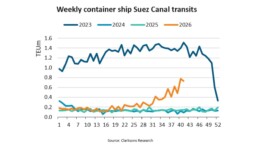
BIMCO Shipping Number of the Week
Suez Canal container ship transits exceed 50% of pre-disruption levels "During the first two weeks of October, weekly container ship capacity…
Subscribe to our newsletter!
if you dont want to swim alone in the ocean of news, sign up for the newsletter, and you will receive daily all the important news of world shipping!
