Shipping industry takes major step towards sustainable plastic procurement with new toolkit from the Maritime Association for Clean Seas


- MACS’ Sustainable Plastic Procurement Working Group publishes the first series of guides on how to reduce unnecessary plastic use before it becomes waste.
- Guides address key industry barriers, including unclear plastic terminology, practical challenges with alternatives, and fragmented supplier requirements.
- Public consultation period opens from 16 July to 16 August 2026, inviting feedback from maritime companies, suppliers, ports and industry bodies.
The Maritime Association for Clean Seas (MACS) has published a series of practical guides to enable the commercial shipping sector to implement sustainable plastic procurement in vessel operations.
The guides are designed to support shipping companies, suppliers and other industry players with a more consistent, practical and evidence-led approach to plastic usage through sustainable procurement in line with IMO goals to curb marine plastic pollution.
“Reducing the plastic footprint of shipping is critical but there are significant barriers to overcome. These guides provide the industry with a clear framework for collaborative action to make real progress in this direction,” said Oliver Kade, Director of MACS, an industry initiative led by Singapore-based ocean impact organisation Seven Clean Seas.
The publications are the outcome of MACS’ Sustainable Plastic Procurement Working Group, which brought together maritime stakeholders to explore how shipping companies can reduce unnecessary plastic use, improve procurement decisions, and send clearer signals to suppliers across the maritime value chain.
Tackling plastics dependency
This is the first in a series of MACS working groups geared to minimising plastics use across the maritime value chain by promoting best practices and collaboration in the areas of procurement and waste management to comply with the IMO Action Plan on marine litter, which requires measures to reduce plastic pollution from ships to be implemented by 2030.
While the IMO Action Plan on marine litter has created an important policy direction for reducing plastic pollution from ships, much of the focus to date has been on how plastics are managed once they have already entered vessel operations or become waste.
MACS’ Sustainable Plastic Procurement Working Group focused on an earlier intervention point: how to prevent unnecessary plastic from entering the maritime value chain in the first place.
“The most sustainable plastic is the plastic that is never used,” according to Kade.
But reducing plastic use in shipping is not always simple. The group found three common barriers:
- The industry does not always use the same language when talking about plastic. Terms such as recyclable, recycled content, compostable and plastic-free can mean different things to different people.
- Plastic alternatives are often difficult to adopt. Procurement teams need to know that any alternative is safe, affordable, available and practical to use onboard.
- Shipping companies often ask suppliers for different things. This makes it harder for suppliers to invest in better products and packaging at scale.
Overcoming complex barriers
The new MACS guides are designed to help close these gaps by giving the industry clearer language, practical tools, and a more coordinated approach to reducing unnecessary plastic use.
The guides were informed by a series of working group meetings and a recent roundtable discussion that brought together 53 participants from 28 organisations across the global maritime value chain and included participation from MACS members and partners such as Berge Bulk, Pacific International Lines, X-Press Feeders, Bernhard Schulte Shipmanagement, DP World, PT Scorpa Pranedya, Britoil and Howden.
Among the key guides are:
- Working Group Report: Sustainable plastic procurement in commercial shipping.
- Maritime Plastics Taxonomy: A common language for sustainable procurement.
- Priority Maritime Plastics: Phase-out pathways and timelines.
- Decision Support: A practical framework for assessing lower-plastic solutions
Together, the publications aim to move the conversation from ambition to implementation by giving maritime companies practical resources they can use in procurement conversations, supplier engagement, internal decision-making, and future plastic reduction strategies.
Michael Blanding, Head of Sustainability & Communications, from Berge Bulk said “From our experience, one of the biggest challenges in turning plastic reduction ambition into action is the lack of clear and consistent signals to suppliers across the maritime industry. These guides are valuable because they help us to establish a common language with suppliers, prioritise the most relevant plastics, and make more informed, consistent procurement decisions.”
Yasas Telwatta, General Manager of Marine Services – Asia Pacific, from Control Union said “From Control Union’s perspective, one of the biggest challenges in reducing plastic use in shipping is translating ambition into practical, day-to-day decisions onboard and across the supply chain. The work done through the MACS Sustainable Plastic Procurement Working Group brings much-needed clarity and structure to this, helping the industry move towards
more consistent and informed procurement practices. As a knowledge partner, Control Union sees strong value in supporting this shift through practical implementation and on the ground verification across the regions where we operate.”
The three practical guides will be open for public consultation from 16 July to 16 August 2026, giving industry stakeholders, suppliers, associations, and subject-matter experts the opportunity to provide feedback before final versions are confirmed.
MACS is inviting maritime companies, suppliers, ports, caterers, logistics providers, industry bodies, and sustainability professionals to review the guidance and contribute to the consultation process



Related News.

Navigating the Multi-Orbit Era: In Conversation with Intellian’s Jon Harrison at SMM 2026
At SMM 2026 in Hamburg, the rapid evolution of maritime satellite communications took centre stage. Across the exhibition halls, discussions among…

Cyprus ports need joint energy and investment strategy, shipping agents chief says
Cyprus needs a coordinated strategy for shipping, energy and environmental protection to support port investment and modernisation, Cyprus shipping…

MASO Public Affairs introduces MASO Regulatory Intelligence
A new subscription service helping businesses understand what is changing and what it means for them MASO Public Affairs introduces MASO Regulatory…

Anglo-Eastern helps turn CMBTECH’s ammonia ambition into an operational reality
From early feasibility study and risk-based design to newbuilding supervision, crew readiness and technical management, Anglo-Eastern drew on its…

Escalation of attacks threatens to derail recovery in Middle East oil exports
World oil demand is forecast to fall by 2.5 mb/d y-o-y in 4Q26 and 2.6 mb/d on average in 2026. As the Iran war manifests itself through restricted…
New study finds shipping pays twice its share to EU ETS earmarked revenues should triple to help build market for sustainable fuels and technologies
Shipping is responsible for around 10% of EU ETS emissions but pays almost 20% of the ETS bill. Unlike other sectors, it has never received free…

MSARC strengthens maritime mass rescue readiness through training and national live exercise off Dakar, Senegal
Joint MSARC–FHAS programme combines three days of SAR training with a national multi-agency live exercise The Maritime Search and Rescue Council ,…
Sogese report deliveries are still being delayed as container freight rates fluctuate
FOR IMPORTERS Spot rates into the Mediterranean are back at January levels, Far East to Europe reliability sits at pandemic lows, and nearly…
Glencore begins trading on Australian Securities Exchange
Glencore has begun trading on the Australian Securities Exchange under the ASX code GLC. Gary Nagle, Glencore’s CEO, said it was an exciting day for…
BIMCO Shipping Number of the Week
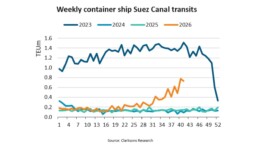
Suez Canal container ship transits exceed 50% of pre-disruption levels "During the first two weeks of October, weekly container ship capacity…
Subscribe to our newsletter!
if you dont want to swim alone in the ocean of news, sign up for the newsletter, and you will receive daily all the important news of world shipping!
